9th June 2026
When I was a young boy, my mother and I would collaborate on completing the weekly Littlewoods Pools coupon. By choosing 16 numbers from the list of that week’s matches, she would identify the selection of drawn games for the “Treble Chance”. I would meticulously study the league tables to predict the outcomes – home wins, away wins or draws – for my chosen fixtures in the “Nine Results” category (all of which had to be correct to qualify for a prize). Our successes might have been both (very) occasional and (very) modest, but they were invariably greeted with a sense of achievement and the promise of larger riches to follow.
My contribution to the pools coupon did not only force an understanding of which teams were doing well or badly in that year’s league tables in England and Scotland. It also encouraged the development of my geographical knowledge, as I sought to find out where some of these clubs were on the map. Most were straightforward, of course – Aberdeen, Wolverhampton Wanderers, Torquay United et al – but others were far less so, particularly in Scotland. Where exactly were the locations of Heart of Midlothian and St Mirren and Third Lanark?
Then, at the beginning of the 1967-68 season, I noticed that the name of Third Lanark had disappeared from the pools coupon.
Last Sunday, I attended the Greater Glasgow Programme and Memorabilia Fair, which was held in a room at Queen’s Park FC, next to the national stadium at Hampden Park. It was an enjoyable and interesting event. There was a free entry – and, later, free teas/coffees and sandwiches – and we were greeted at the door by the Fair’s organiser, who thanked us individually for coming. There were a dozen or so stalls manned by vendors selling a range of football-related merchandise: mainly vintage match programmes, but also old tickets, badges, photographs, replica shirts, etc. I turned up about a quarter of an hour after its official 10.00am start and the room was already nearly full.
Casual observation suggested that there was a range of potential customers. I suspected that I was one of a number of unattached attendees who just had a general interest in the event and the types (and prices) of the items on sale. By contrast, it was clear that other potential purchasers had more defined objectives. I noticed more than one consulting his list – the clientele was almost entirely male – of specifically targeted programmes, as if seeking to complete personal collections.
It was not surprising that the stalls focusing on the respective memorabilia of Rangers FC and Celtic FC had sizeable gatherings. The prices of some of their match programmes from the distant past – ranging from major European matches to friendly games on pre-season tours – seemed to be amongst the highest being sought, in a couple of cases eye-wateringly so. But the overall range of material available across the room extended far beyond that of the Old Firm. Afterwards, I spoke to a man who was delighted to have purchased some programmes from Motherwell FC’s adventures in Europe.
It has to be said that, before attending the Fair, I had determined that I could not leave empty-handed. And for some reason – a flashback to the time of completing the pools coupons with my mother, perhaps – I thought that a Third Lanark match programme would be a good choice. That would be a fiver well spent, I reasoned.
The initial search was not encouraging. There were some Third Lanark programmes on display at one of the stalls, but the attached prices were (very) considerably above my provisional budget as they were of big matches against, in some cases, Old Firm opposition. A conversation with another stallholder revealed that the Third Lanark programmes tended to be in short supply at these types of events, which suggested that the fundamental laws of supply and demand were in operation.
Later, I engaged in a chat with another stallholder who asked me if I was interested in anything in particular. I mentioned Third Lanark with some hesitation, remarking that I had been looking for something at a reasonable price. “I’ve got a Third Lanark”, he said and, from one of the boxes in front of him, immediately produced the official programme for a League Cup tie against Airdrie in August 1963. The programme was in very good condition and presented in a plastic wallet on which the price of £10 was marked. “I’ll sell it to you for a fiver”, he said. I produced a note from my jacket pocket and we shook hands.
The programme – originally priced at three (old) pence – is of eight pages with red print (the club’s colour) on a white background. The “editor talking” section, covering the better part of three pages, includes the keen anticipation of Third Lanark’s forthcoming First Division league fixtures against both Rangers and Celtic. The line-up of the two teams is presented in the centre spread, the surrounding advertisements including local establishments such as Paddy Neeson’s Bar at 165 Allison Street G2 where WM Younger’s Beer or Guinness’s stout is “always served in prime condition”. At two addresses in Kilmarnock Road S1 and Drakemire Drive S4 are branches of “Hershelle” Ladies and Gents Hair Stylists. The only annotation on the programme is the final result, which is given as a 2-1 win for Airdrie; in fact, it was Third Lanark who prevailed by that score.
Having made my purchase and, later, drunk my coffee, I made another circuit of the room before departing. I had not finished with Third Lanark Athletic Club however, as, in the foyer outside the room, there was another stall which focused on the former club. It was manned by a gentleman of about my age – attired in a replica shirt – who was not attempting to sell any items but, instead, was simply presenting some memorabilia: action photographs from big matches, a splendid picture of the club’s home stadium at Cathkin Park, a flag in the club’s colours from a corner post, an old football.
We had a nice conversation. The man told me about the club’s formation in 1872, the First Division League Championship success in 1903-04 and the three former Third Lanark players who had played in major European cup finals, including the veteran Ronnie Simpson, who had been in goal for Celtic in their famous 1967 European Cup win against Inter Milan in Lisbon.
With sadness in his voice, he then spoke of the club’s rapid decline and demise in the early 1960s: the good players sold cheaply, the recruitment of inferior replacements – I found out later than none of the August 1963 side featured in the club’s final game in April 1967 – the lack of any adequate financial management in the latter years, the fraud. In June 1967, a liquidator having reported to the Court of Session in Edinburgh that the liabilities considerably exceeded the liquid assets, the club was wound up.
In retrospect, I regret that I did not ask the man his name or, indeed, what his personal connection with the club had been, given that it folded 60 years ago. I assume it must have been his father’s – or even grandfather’s – team. In any event, there was another handshake and – a last-minute decision – I was on my way to Cathkin Park, about half a mile away along the Cathcart Road.
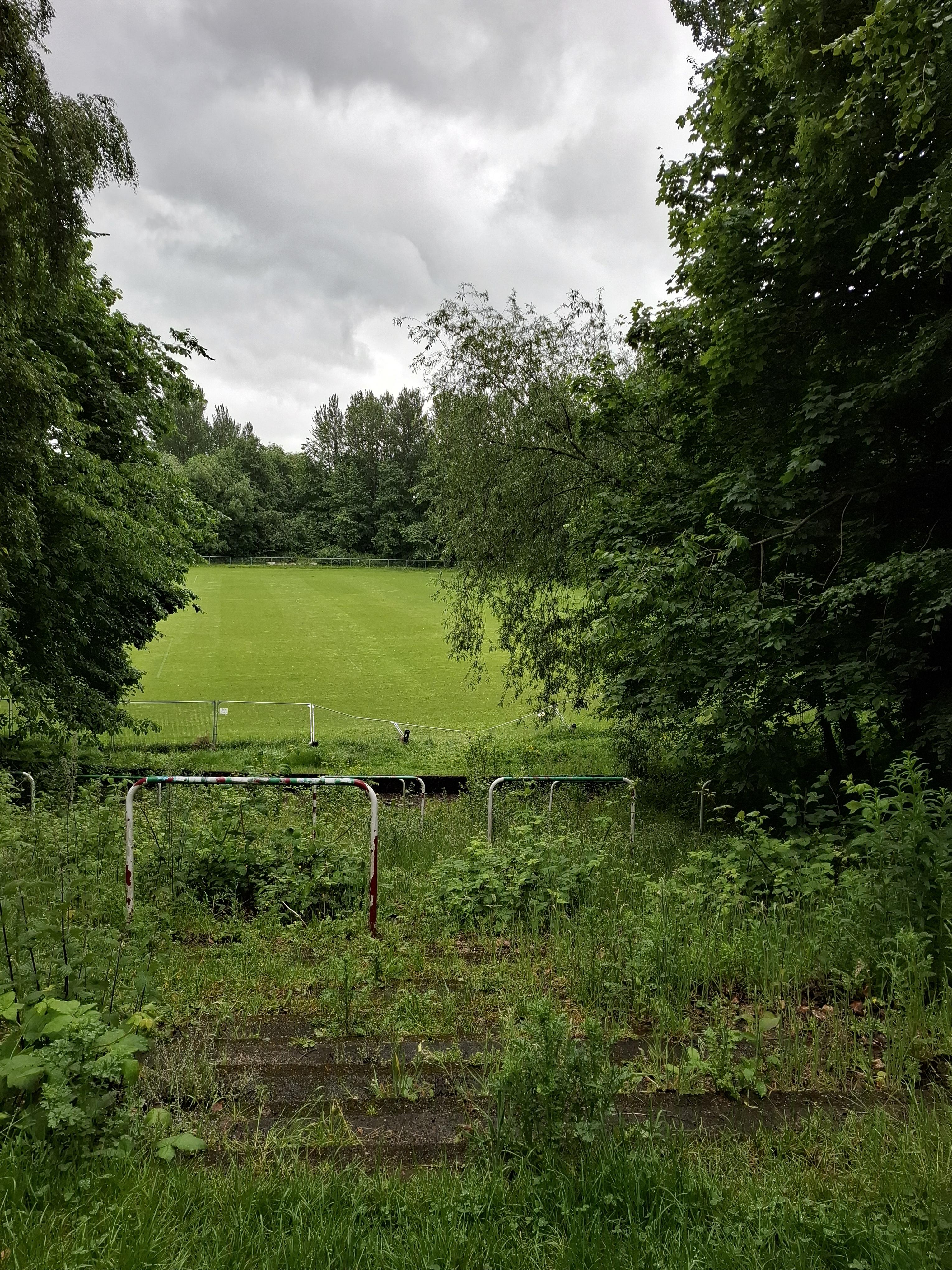
The centre of the park is a flat area with short grass and the markings of a football pitch though with the goalposts removed and the pitch surrounded by a metal fence. The embankments rise on three sides of the park, covered by mature trees. The most striking thing is that, on each of these sides, not only are the remains of large parts of the terracing clearly evident, but there are many of the short crash barriers – now heavily rusted – still in place. For the period of my walk around the park, gathering my thoughts and taking the occasional photograph, I was a sports archaeologist.
The club’s name lives on in the form of the Third Lanark Amateur FC, which mainly plays its matches at the nearby Toryglen Regional Football Centre and at the Barlia Football Centre in Castlemilk. In the 2025-26, the side finished 5th (out of 12) teams in the Hills Solicitors Colleges Championship within the Scottish Premier Amateur FA. The club’s Facebook page makes a clear link to previous times, stating that it was established in 1872 and reproducing an early badge with its prominent number 3.
Finally, back to old match programmes. I have written before – for example, in a Rugby League context, in “Windows into the Past” in the Rugby League Journal (Spring 2014), reproduced in Still An Ordinary Spectator – about their importance as significant social documents in their own right. Such memorabilia not only provide a source of personal reminiscence and enjoyment for sporting enthusiasts, they reflect – having been influenced by – the norms of the era and, accordingly, are important reference points for cultural and social historians.
In the modern era, the decline of the printed match programme reflects the rising costs of its production and distribution and, of course, the ready availability of instant and rapidly-changing information via social media. That is a loss, I think.
But in the meantime, as Sunday’s event at Queen’s Park FC showed, there remains a strong appetite for old match programmes and other memorabilia, in this case soccer-related. I invested £5 to buy a Third Lanark match programme of 63 years ago. It is a welcome addition to my collection.

 An Ordinary Spectator