17th May 2026
In The Line of Sixteen, I record that one of my great (x3) grandfathers was Peter McBride, who was born in Port Glasgow in 1797 and died in the Gorbals, Glasgow, in 1864. He was a joiner and carpenter and his wife was Williamina (née Walker, c1801-1885).
I also noted that one of Peter’s brothers – William McBride – died in the Govan Poor House in 1857 at the age of 54. A former merchant seaman, he was single and his usual address had been in the local Dale Street – a street that occurs several times in the McBride records between 1841 and 1885. The cause of death, certified by the surgeon HA Liddell, was “paralysed, 2 years” and the informant on the death certificate was his sister-in-law, Williamina, who marked her name with a cross.
In the book, I state that William was buried in the Gorbals Burying Centre. At the time, this was actually called the Gorbals Burying Ground (and, later the Gorbals Burial Ground), which had been established in the first half of the 18th Century on Old Rutherglen Road to serve the village of Gorbals. (The location is clearly identified as the “Gorbells Burial Place” on the “Road to Rutherglen” in John McArthur’s 1778 Plan of the City of Glasgow: Gorbells and Caulton).
By the time of William’s burial in 1857, the nearby Southern Necropolis had been established over its 19 acres. The need for this much larger burial site, which opened in 1840, was graphically described in the December 1988 edition of the Southern Necropolis Newsletter:
First, the old burial ground, first established…. to meet the needs of the one-time village of Gorbals, was, by the late 1830s, in an appalling state; the unfortunates “on the Parish” were buried in long trenches, left barely boarded over until the trenches were full; it had been used for mass pit burials in the cholera outbreak of 1832; the bought lairs were full, and not much space was left.
Secondly, the city had its great Necropolis by the cathedral, and the new Sighthill cemeteries – both places of great dignity. Gorbals, now joined by Laurieston and Hutchesontown, and full of merchants and professional people and prospering mill owners and engineers, aspired to similar dignity. But with a difference. The dignity was to be shared by all.
Whether it was actually “shared by all” is perhaps a moot point. Clearly, William McBride was not in the class of “merchants and professional people” and his final resting place was destined to be at the old site.
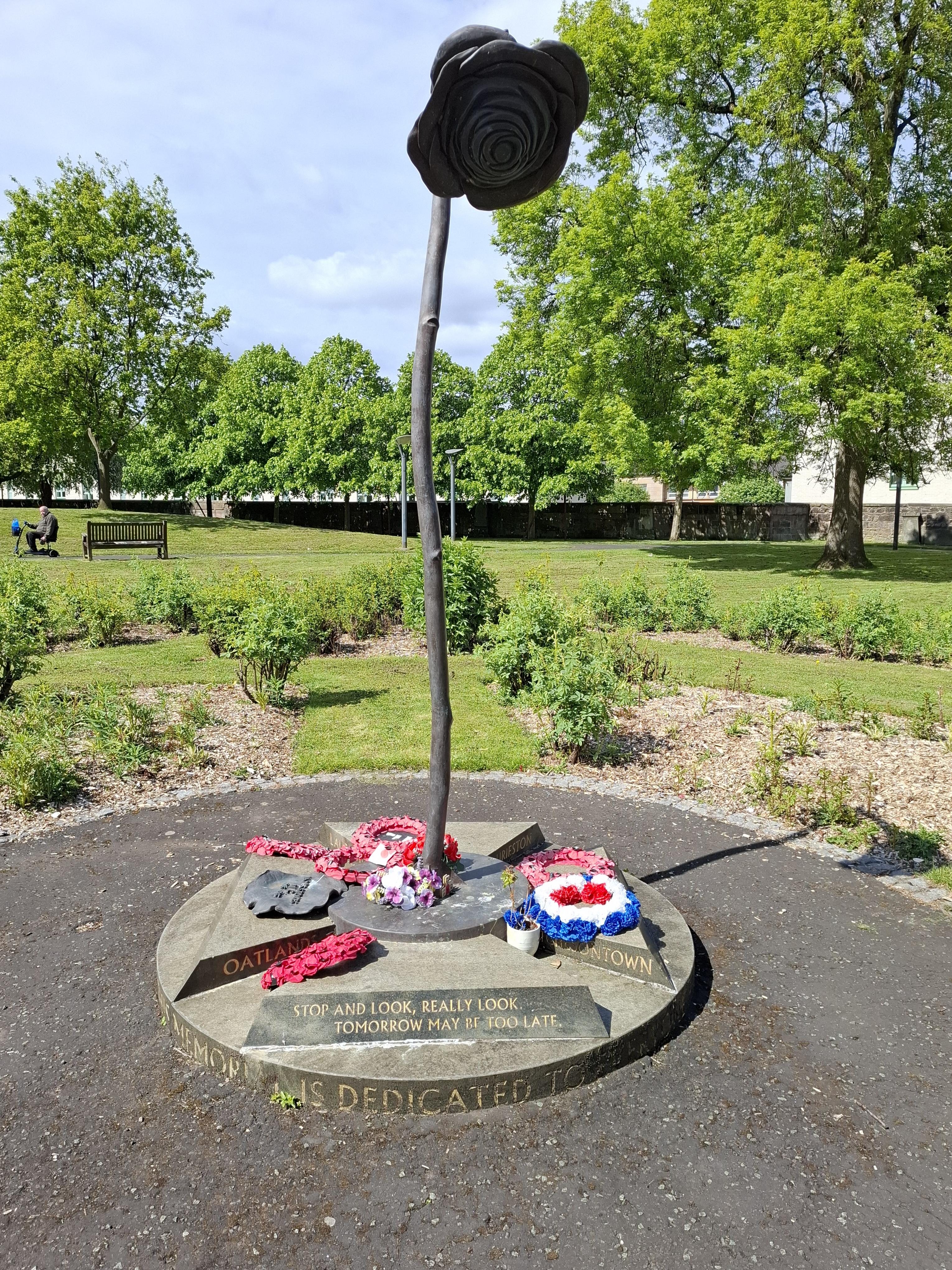
The former Gorbals Burial Ground is now a landscaped area maintained as a memorial garden – the Gorbals Rose Garden – which features historic headstones set into the boundary walls. I visited it yesterday on my way to participating in a guided tour of the Southern Necropolis that had been arranged by the Dunbartonshire Family History Society.
The centrepiece of the Garden is a large standing rose sculpture created by the local artist Liz Peden and unveiled in 2005. The inscription around the base reads “This memorial is dedicated to everyone from the Gorbals who served their country in times of conflict”, whilst another is “Stop and look, really look. Tomorrow may be too late”. There are plaques recognising the neighbouring localities of Oatlands, Laurieston and Hutchesontown and commemorating James Stokes VC (1915-1945). (Private Stokes, born in Hutchesontown, was in the King’s Shropshire Light Infantry. He received the British Army’s highest award posthumously for his gallantry in the face of the enemy at Kervenheim, Rhineland, in March 1945).
The Garden was a pleasant place in which to spend some time on a sunny early summer’s morning. It was neatly tended, the grass having been newly cut, and the trees over the former burial pits have reached a proper maturity. I have no idea where exactly William McBride was interred, but it was a worthwhile duty to visit the Garden and to pay him my respects.
The tour of the Southern Necropolis was hosted by Colin Mackie, an enthusiastic and knowledgeable guide. It was a very interesting two hours highlighted by the striking – in different ways – commemorations of the businessman and philanthropist Sir Thomas Lipton (who was born in the Gorbals) and the famed architect Alexander “Greek” Thomson.
Colin Mackie explained that, from its opening, there was a payments system through which lairs could be purchased in the Necropolis. This might explain why William McBride was buried elsewhere, if even the Necropolis’s cheapest rate had been beyond his means..