News Blog

Famous and Forgotten

19th April 2024

The latest book by the eminent rugby league historian Robert Gate – Famous and Forgotten: Albert Goldthorpe and Archie Rigg – covers the parallel careers of two of the earliest of the game’s great players. Goldthorpe played for Hunslet between 1888-1910 and Rigg for Halifax and (briefly) Bradford between 1891-1908. Both therefore began their playing days before the “Great Split” of 1895 – when a group of northern clubs seceded from the Rugby Football Union over the issue of “broken time payments” (to compensate players for the lost wages when playing for their clubs) to form the Northern Rugby Football Union, later the Northern Rugby League – and became key participants in the establishment of the new code at the turn of the century and into the Edwardian era.

Gate catalogues the similarities between the two players in terms of their records, skills, durability, sportsmanship, successes and disappointments. And yet – his main theme – their legacies are significantly different: Goldthorpe was inducted into Rugby League’s official “Hall of Fame” in 2015 and has a “legendary status as an icon of rugby league”; Rigg is all but unknown.

It is always a pleasure to read of Albert Goldthorpe’s achievements in his sport and in life. (I still have the shivers in recollecting an absolutely appalling portrayal of him by Dennis Waterman in an Australian television drama made in the 1980s). His Yorkshire Cup success with Hunslet in 1905 was merely a precursor to the 1907-08 season, when, at the age of 36, he led the side to their “All Four Cups” triumph. Hunslet won the Challenge Cup, Championship, Yorkshire Cup and Yorkshire League, the first time that this had been achieved in a single campaign.

Quite apart from his 700-plus appearances for Hunslet during his 22 years in the game and the record league goals and points tallies that he had accumulated by the time of his retirement, it is Goldthorpe’s stewardship during the All Four Cups season that has ensured his enduring recognition. When the final whistle sounded at the conclusion of Hunslet’s 12-2 win over Oldham in the replayed Championship final of 1908, his rightful place as a totemic figure in the game’s history was guaranteed.

Gate makes a strong case for Archie Rigg’s inclusion in the RL Hall of Fame – rather than just in the Halifax club’s corresponding pantheon, where he is currently placed. He captained Yorkshire in the first 5 seasons of the Northern Union and led Halifax to success in the 1903 Challenge Cup final against Salford at Headingley.

However, I do wonder – if Archie Rigg were to be considered for promotion – to which other candidates of that era this might also apply. To give one example, John Willie Higson was not only a member of Hunslet’s “Terrible Six” pack of forwards in 1907-08 but, after transferring to Huddersfield, was also a member of the “Team of All Talents” that itself won all four cups in 1914-15. He was the only player to be part of two such sides. (Swinton – in 1927-28 – were the only other side to accomplish the feat before the county leagues were abolished in 1970). Moreover – unlike both Goldthorpe and Rigg – Higson was an international player, winning 5 caps for either Great Britain or England (under the Northern Union banner) in 1908-09.

It is at this point that I must confess to a more personal interest in one of the subjects of Robert Gates’ book: that is, in finding out whether there was any family connection to Archie Rigg. The surname is not common – to say the least – amongst the front-line rugby league players of any era, my attempt to rectify this having terminated when I played my final match for the Chapel Allerton Primary School in Leeds nearly 60 years ago.

An hour’s research on Ancestry has provided the answer, I think. My known paternal line goes back four generations to the birth of George Rigg in North Yorkshire in 1802 to “Mary Rigg of Baldersby and an unknown father” (according to the parish register).

By contrast, Archie Rigg was of proven Halifax stock – still Yorkshire, of course, but sufficiently distant from the rural north to be fairly conclusive for this exercise. He was born James Archer Rigg in the town in 1872, his parents being John Rigg – a joiner by trade – and Sarah Birtwhistle. John had been born in about 1836 and John’s father, Samuel, in about 1800, the latter a cordwainer in Halifax. Whilst it is always possible that there was some earlier overlap in the branches of a single family tree, of course, I have to concede that this is unlikely.

I have been here before. In An Ordinary Spectator Returns, I reported on the cricketer Keith Rigg, who played in 8 test matches for Australia in the 1930s and made a century against South Africa in 1931. I concluded there that his great grandparents were William and Louisa Rigg (née Clark), who had married in Newington, Surrey, in 1837 and subsequently migrated to Australia, where they settled in Victoria. Surrey is even more of a stretch from Baldersby than Halifax. The search continues.

In the meantime, there is much to ponder about Famous and Forgotten – and in a general sense, rather than simply in sporting terms. What is it that determines whether the heroes of today will take a prominent place in the history books of tomorrow?

Thrilling Action and a World Record

4th March 2024

I am aware that there has been only minimal coverage of elite athletics in the three Ordinary Spectator books: brief references to the first London Marathon in 1981 and the 5th Avenue Mile in New York in 1984 and recollections of the television coverage of the Olympic Games in my teenage years. On Saturday evening, I took the opportunity of (partly) addressing this shortfall by attending the middle evening session of the 3-day 2024 World Athletics Indoor Championships at the Emirates Arena in Glasgow.

Glasgow punches above its weight for major sporting events. In the last 10 years, quite apart from the seasonal adventures of the local football and rugby union clubs, I have attended (and written about) international football at Hampden Park (Scotland versus Belgium in 2019 and a Round of 16 match at Euro2020, the latter postponed by a year), the 2014 Commonwealth Games (swimming and gymnastics), a World Championship boxing bout in 2022 and the European Cycling Championships of 2018. For the 2023 UCI Cycling World Championships, I watched the two road races (Men’s and Women’s) and the Men’s Time Trial as well as spending an evening at the Sir Chris Hoy Velodrome.

The city’s experience in hosting such occasions has meant that the stewarding is consistently friendly and helpful. On Saturday, this extended to the steward manning one of the road junctions on the short walk from Dalmarnock station to the arena. “There’s a reason it’s indoors”, he informed us with a smile as we waited on this chilly evening for a green pedestrian signal. “My hands are blue”.

Inside the arena, there was a full agenda – 2 sets of sprint semi-finals, the high jump component of the Men’s heptathlon and 8 finals – and there was continual action for the better part of 3 hours with, at times, progress being made in 3 events simultaneously. The evening’s MCs were informative, without being overbearing, and the provision of up-to-date information on the electronic scoreboards at the ends of the arena was excellent.

The role of modern technology in the proceedings was demonstrated in the first of the Men’s 60 metres hurdles semi-finals, when the Spanish athlete Asier Martinez was disqualified for a false start. He was judged, not to have set off before the gun fired, but to have done so faster than the allocated time that the scientists have calculated to be the minimum that it takes for the human brain to react to the firing. Martinez appealed the decision and was allowed to compete in the race, but the judges’ original decision was upheld.

Given the sophistication of the technology in use – for example, the runners’ times were given to two-hundredths of a second, with a thousandth of a second being available, if required – it seemed pleasingly quaint that, for the heptathlon’s high jump and Women’s pole vault, the success or failure of an attempt was signalled by the official sitting near the apparatus raising a white or red flag. Nicely low-tech, I thought, concluding that this might not be the most difficult job of the evening.

There were three particular highlights, the most significant of which for the meeting as a whole was probably when the Dutch runner Fenike Bol set a new indoor World Record of 49.17 seconds in the Women’s 400 metres. For the home supporters, however, there were the gold medal performances of Molly Caudrey in the Women’s pole vault – following an absorbing contest with the New Zealander, Eliza McCartney – and Josh Kerr in the Men’s 3,000 metres.

Kerr – a tall, powerful and elegant runner – judged the race to perfection. In a closely bunched field, he spent several laps biding his time and easing his way in the middle of the pack before progressing up the line, negotiating some barging and then taking the lead with about 100 metres to go. The roars built up over the concluding laps and then echoed around the arena as Kerr rounded the final bend and sprinted down the straight. It was a genuinely thrilling and memorable piece of sporting action.

Across the evening as a whole, there was much to take in, some of it on the margins of the main action. I noted the calm efficiency with which the officials marshalled the high jumpers in the preparations for their attempts at the bar (which was right in front of us). With less available space than there would have been in an outdoor arena, the jumpers’ run-ups straddled both the post-tape lanes of the sprinters and the start of the run-ups of the Men’s triple-jumpers. The officials managed the heavy traffic with some skill.

The spectators played their part too. It was noticeable that the general hubbub of noise and conversation in the crowd would transform into a respectful near-silence as the sprinters made their final preparations prior to blast-off. There was also warm appreciation of the gold-medal winners from around the globe, including the Americans Elle St Pierre and Grant Holloway, the Belgian Alexander Doom, and Hugues Fabrice Zango of Burkina Faso. When Holloway won the Men’s 60 metres hurdles – his 76th consecutive win in the event, no less – he joyfully bounced off the thick padded cushion at the end of the sprint lane as if he were a hyperactive Tigger.

Unfortunately, the evening was not without its casualties. The French pole-vaulter Margot Chevrier suffered a horrendous ankle injury after she mistimed one of her attempts and crashed awkwardly in the pit of the landing area. There was a delay of several minutes whilst she was attended to – initially being given oxygen – and carefully lifted on to the wheeled stretcher. Later, the start of the last event of the evening – the Women’s 60 metre sprint final – was also delayed after the American Aleia Hobbs injured her calf in her warm-up. Her desperation to compete was clearly evident, as she attempted to massage the problem away, but it was also obvious that this would be in vain. The race was won by Julien Alfred of St Lucia in 6.98 seconds, two-hundredths of the second ahead of the Polish athlete, Ewa Swoboda.

If I had one suggestion to make of the evening, it would be to re-arrange the schedule so that the podium athletes could receive their medals at intervals between the events. On Saturday, these ceremonies were conducted at the close of play, when many of the spectators had started to leave the arena. That more stayed on this occasion than might otherwise have been the case was no doubt due to the successes of Molly Caudrey and Josh Kerr. I realise that it would elongate the main part of the evening as a whole – and the 8 medal ceremonies here would perhaps have added a good half-hour to the programme, given the time needed for the awarding of the prizes and the playing of the national anthems. But it seems a shame that the successful competitors – for some of whom the evening might turn out to have been the career highlight – are recognised only in a corner of the arena and when the bulk of the spectators are heading for the car park or the railway station.

60 metres in 6.98 seconds. These days, it takes me at least that long to get myself off the living room sofa and into a standing position.

SilverWood Books: Meet the Author

18th August 2023

The third book in the “An Ordinary Spectator” series was published last month by SilverWood Books to the same high standard as the first two volumes.

I am pleased to report that I was subsequent invited by Helen Hart, the Publishing Director of SilverWood Books, to be in the spotlight for the regular “Meet the Author” Social Media Feature on its Facebook site (https://www.facebook.com/silverwoodbooks).

The Feature makes use of a short questionnaire on the author’s background and writing.

Name/Pen name

John Rigg

Where are you from/where are you based?

I was born and brought up in Leeds, Yorkshire. However, I have lived in Milngavie, just to the north of Glasgow, for over 30 years.

Do you write full time or do you have a ‘day job’?

I am a retired civil servant. I do not write full time and, therefore, I have the luxury of choosing when to research/write and fit it in around other activities.

How has your other work influenced your writing?

During the latter stages of my career, I visited many interesting places in Scotland and Europe. I am interested in local histories and cultures and, I hope, this is evident in some of my writing on sports spectating: shinty in the Scottish Highlands, Gaelic Football in County Mayo, rugby league in Castleford, and so on.

What is your favourite book?

I read Headingley by John Marshall in my teenage years. It is a history of the Yorkshire County Cricket Club (up to 1969) – simply written, but with some evocative (and sometimes moving) descriptions of players and matches – and I readily identified with this illustrious sporting institution. Recent events at the Club – and the accompanying media frenzy – have saddened me greatly.

Did this book inspire any aspects of your book? If so, how?

At the very least, I am keen that my sports writing should be interesting to the reader – even if he/she is not a fan of a particular sport per se – so as to encourage further reading. The great writers on sport – for example, Paul Gallico on boxing and golf in the New York in the 1930s and CLR James on West Indian cricket and culture – succeeded in placing their specific interests within the broader context of the societies around them.

Where is your writing space?
Technically, the study, where I have a laptop and desktop. However, much of the content of the essays in my most recent book – An Ordinary Spectator Returns: Watching Sport Again – was formulated in my head during or immediately after watching a sports event. I always take a notepad to jot down fleeting ideas. I find that I can write the initial draft quite quickly, after which I like to take my time on the fine-tuning.

Are you currently working on anything new?

I am currently working on the family histories on both my side and my wife’s. I like the research – which we have used as reasons to visit Ireland, Malta and Germany, as well as various parts of the UK. Hopefully, it is one for a future SilverWood publication list. I am also writing another novel (under my JR Alexander persona), but the family history volume will come first.

How does it feel to be a published author?

There is an obvious pride in seeing a project completed and produced to a high standard and this has not diminished with the three An Ordinary Spectator books. There is also gratitude to family and friends for their encouragement and support. And, not least, a sense of satisfaction when someone – often a complete stranger – contacts me to say how my reminiscences of watching sport in the past have prompted their own recollections of watching an event in their own youth, perhaps with a father or uncle.

The Flame

31st December 2022

The slim candle – about two inches in length – stands on a tiny brass plinth in the corner of a small shallow box. Behind the box, which is placed on the top shelf of a bookcase, is the letter rack that I purchased from the beriozka in Moscow in 1980, a souvenir of the Olympic Games that had taken place a few weeks before my visit. The rack contains a miscellany of bookmarks and used theatre tickets and (very) old golf scorecards – with pride of place, I think – the card and envelope (“Dear Stanta” (sic)) that my (then) infant daughter wrote to Father Christmas all those years ago.

After I bring a match to the candle and turn off the room’s electric light, the flame provides the only illumination. I take my seat, so that my eyes – spectacles removed and placed within reach next to me – are level with the flame at a distance of about two feet. The back of the bookcase is tightly adjacent to one of the softly painted walls of the room.

At first it seems as if the flame won’t take. There is a hesitation at the end of the wick, as if the fragility of the beginning of life will bring about its immediate termination. But then the flame grows stronger and I know that it will run for its full duration. 20 minutes are promised in which “to pause and reflect”, although, as it later transpires, the actual lifespan is shorter by a couple of minutes.

The flame dances slightly. There is no obvious draught in the room and the expulsion of CO2 from my light breathing does not extend across the full range between us but, nonetheless, there is a delicate movement in the flame as if, once lit, it can never stand perfectly still, but must always be in motion.

The flame grows taller and stronger. The face of the letter rack becomes brightly illuminated in stark contrast to the surrounding darkness – is it too much to compare this immediate scene with part of a masterpiece by Caravaggio or Joseph Wright of Derby? Equally striking is the sharpness of the silhouette generated by the rack and its contents on the wall: a clear definition of grey-black against the light of the background surface. Briefly, I turn around and see my own silhouette – a distant hulking grey – on the wall behind me. It is a question of position and perspective: there will be a variety of silhouettes around the room, depending on the surrounding architecture and the place of the viewer.

My thoughts are temporarily dominated by this perspective of cause and effect. I am the flame. The letter rack and its contents represent the events of my life – family, sport, culture, travel – and the silhouette is the totality of the wider impacts that have been left behind: on the lives of those I have loved and on the lives of those I have never known. I realise that this analogy is both painful and sad, for when the flame expires so will these broader impacts.

The flame flourishes. After a while, its length matches that of the remaining wax in the candle and then it exceeds it – double the length, triple the length… I find that if I screw my eyes up tightly, there appears to be a long beam of light that extends from well above the candle and through its length and then down towards the floor. At the two ends of the beam, the light seems to widen and split, as if attempting to replicate Newton’s experiment of pure white light refracting in a prism.

For a few moments, I replace my spectacles. Not surprisingly, the flame is much more sharply defined – I am short-sighted – with its sharper edges and clearer shape. But I prefer the softer, vaguer version, so I remove my glasses once again. Inside the flame, the wick appears to lean to one side, as if tiring from the effort of remaining upright. Its tip glows red, whilst the base of the flame shows blue.

The end of the flame’s life is action-packed. Its size diminishes slightly, as if prefacing a steady reduction in scope and brightness. But no, it recovers, attempting to restore its former grandeur. Then it declines again, this time without a recovery to its previous glory. For a while, it holds on again, before reducing in size once more. These variations in its life force are reflected instantaneously in changes in the brightness of the letter rack and the sharpness of the silhouette on the wall. In the flame’s inexorable decline, there is a constant shift in the subject’s breathing: heavy gasps followed by light exhalation.

The fullness of the flame is lost for the first time. There is still some light, however – or rather a collection of lights: small pinpricks of different colours, not dissimilar to the illuminations on the tiniest of Christmas trees. Amazingly, a small, short-lived full flame re-appears and then is lost again. The pinpricks re-appear. Finally, they also are extinguished. It takes me a few seconds to realise that I am staring into a darkness that, this time, will not be relieved.

I follow my instructions and continue to pause and reflect for another couple of minutes. Then, after getting up to switch on the room light, I return to the bookcase and examine the box. I see that part of its corner has been burnt away leaving a small open semi-circle, where the thin card had previously been.

The flame had left a permanent impact after all.

Footnote

An Ordinary Spectator Returns: Watching Sport Again will be published by SilverWood Books in 2023.

Splendid Dribbling Skills

30th November 2022

“The modest Scotland total was knocked off by Yorkshire without the loss of a wicket, thanks to the captain Martyn Moxon and a promising young player called Michael Vaughan”.

[An Ordinary Spectator, page 272].

Initially, all 211 member football associations were eligible to attempt qualification for the 22nd edition of the FIFA World Cup, although half a dozen subsequently fell by the wayside for non-football reasons, including North Korea (due to safety concerns about Covid-19) and Russia (disqualified following the invasion of Ukraine). 32 teams duly qualified for the multi-billion dollar tournament in Qatar, the group stage of which is currently approaching its conclusion. In 18 days time, the final will be contested in the 80,000 capacity Lusail Iconic Stadium.

It is all something of a far cry from the first official international football (soccer) international, which was played between Scotland and England at the West of Scotland Cricket Club ground in Partick, Glasgow, on 30th November 1872: 150 years ago today. The match – watched by 4,000 spectators, some (though not all) of whom paid one shilling each – finished in a 0-0 draw.

An important word here is “official”. Football historians will point to five other England-Scotland matches that had taken place from 1870, but these had all been in London with, crucially, the Scotland teams entirely comprised of players based in England. For the November 1872 encounter, the England team crossed the border to take on a side whose players were all based in Scotland. (It would appear that the organisers set out to present this match as the first official international at a very early stage).

Indeed, the Scotland team was not only drawn from domestically-based players. It was drawn from the members of a single club – Queen’s Park, the pioneers of the development of the skills and tactics of the “association” version of football in the British Isles (and, therefore, the world). By contrast, the England team had players from 9 different clubs, of which Notts County, Sheffield Wednesday and Crystal Palace are instantly recognisable to the modern supporter. Other representatives came from both Oxford and Cambridge Universities, Harrow Chequers and the 1st Surrey Rifles.

For the contemporary newspaper accounts of the match, I consulted the Leeds Mercury and the Yorkshire Post and Leeds Intelligentsia for 2nd December 1872, both of which allocated one paragraph to the game, the latter in its “Sporting News” section after its reports on steeple-chasing, coursing and hunting.

The reports suggest that there were several things with which the football supporter of a century and a half later can readily identify. Most obviously, the contest was 11-a-side (in contrast with the first rugby international, played in March 1871 at Raeburn Place in Edinburgh, in which Scotland and England had each fielded 20 players – see “Plan B”, 7th March 2022). In addition, both sides were commended for their splendid dribbling skills, although passing moves seem to have been in short supply. Moreover, Scotland wore dark blue shirts with an embroidered thistle and England white shirts, although – less frequently observed these days – the English also wore caps and the Scots red cowls. The closest that either side came to scoring a goal was when the ball narrowly – and, to some, disputedly – cleared the tape that was used to represent the England crossbar. (Where was VAR when it was needed?)

Prior to today, my only previous visit to the West of Scotland CC ground had been in May 1995, when I watched Scotland play Yorkshire in a group match in the Benson and Hedges Trophy. Jim Love, with whom I had played in the Yorkshire Cricket Federation (i.e. Under 19) side of 1974, was the Scotland captain. He scored a half-century but, as noted above, it was a one-sided affair, the visitors winning by 10 wickets. My reference to the venue in An Ordinary Spectator opined “[T]hat more is not made of the fact that this was the location for the first-ever soccer international… is something of a minor mystery to me”.

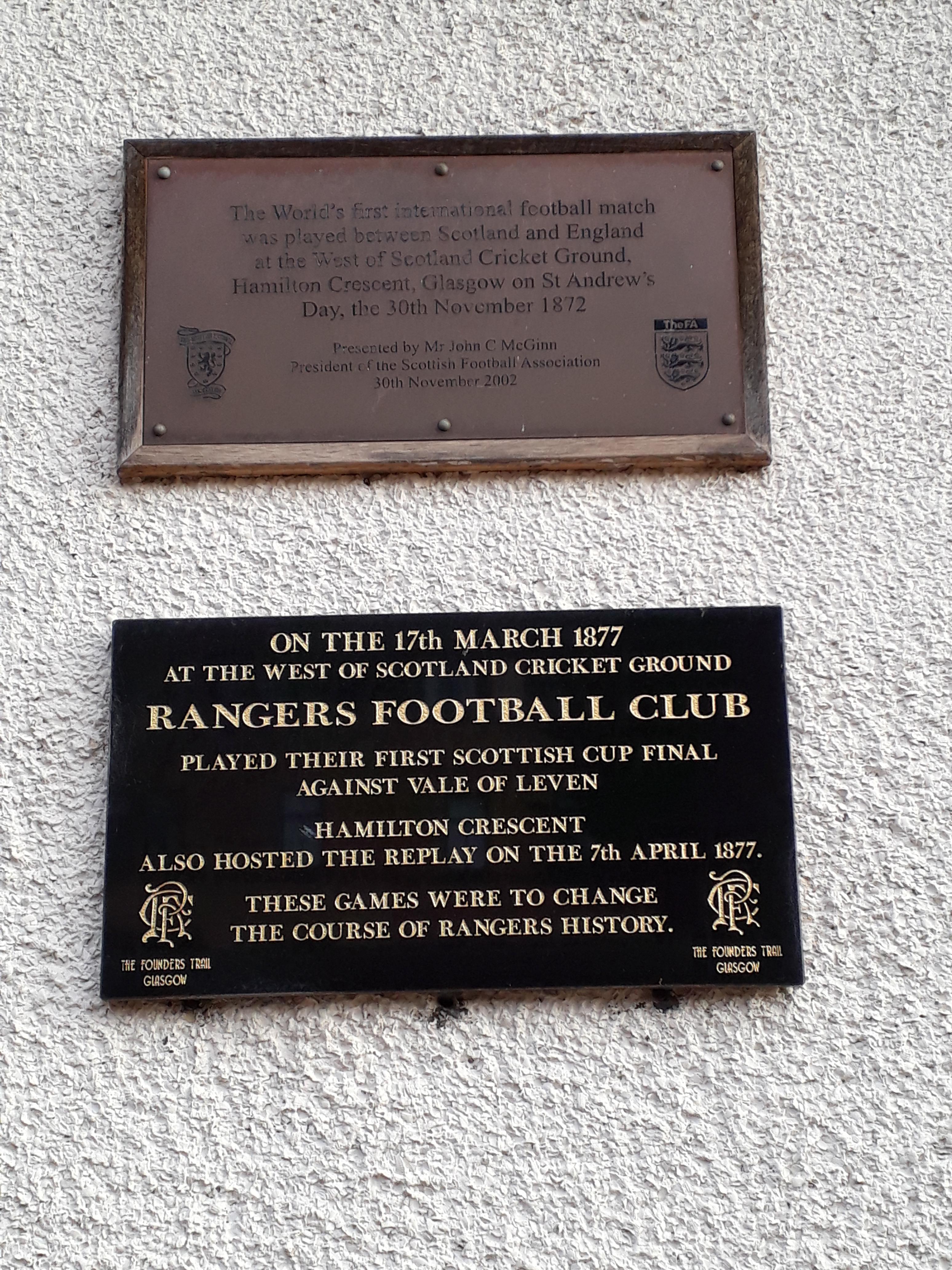
The significance of the ground (for football) is now indicated by two plaques that have been placed on the clubhouse wall in the period since my initial visit. The upper one reads:

“The World’s first international football match

was played between Scotland and England

at the West of Scotland Cricket Ground,

Hamilton Crescent, Glasgow, on St Andrew’s

Day, the 30th November, 1872.

Presented by Mr John C McGinn,

President of the Scottish Football Association,

30th November 2002.”

The plaque is neatly presented, albeit with its wooden frame showing some signs of wear after two decades of west of Scotland weather. It is also unobtrusive. Indeed – to the casual observer – it is dominated by the second plaque placed just below it (in 2018), which commemorates the first appearance of Rangers Football Club in a Scottish Cup Final: a match (and its replay) against Vale of Leven on the same ground in 1877.

The inscription on the latter states triumphantly that: “[T]hese games were to change the course of Rangers history”. As a symbolic representation of the hegemonic role that the Old Firm of Rangers and Celtic play in Scottish football, the dual-plaque display says a great deal, I think.

The Scottish Football Association has maintained a low-key approach to this latest anniversary, apart from announcing a commemorative Scotland-England fixture at Hampden Park in September next year. (The SFA website gives far more prominence to the 50th anniversary of the inaugural women’s international in 1972). This appears to follow the lead of Scottish Rugby. I noted that in Plan B that there was nothing at the Edinburgh Academical sports ground at Raeburn Place to mark the 150th anniversary of rugby union’s first international, whilst the stone monument commemorating the centenary in 1971 is currently at the edge of a large pile of rubble on the far side of the field.

Accordingly, when I took the train into Partick this morning to visit the cricket ground, I expected that I might be largely alone, perhaps to walk around the boundary edge and take a couple of photographs before wandering back to Dumbarton Road in search of a coffee shop. How wrong I was. It was not long before I learned that The Hampden Collection – a group of volunteers celebrating the pioneering role Scotland played at the dawn of association football – had spent some considerable time with the West of Scotland CC and others preparing for the 150th anniversary.

By one o’clock, a sizeable number had gathered on the terracing of the clubhouse – boosted by a substantial media presence – as two teams of primary school footballers attired in the respective kits of 1872 (though without the caps and cowls) replayed the inaugural fixture. There was only limited space for 11-a-side on the truncated pitch, but there was no little skill shown – the England goalkeeper made a splendid first-half save – as well as sound positional awareness. There was also some bravery; the teams were both comprised of boys and girls and one of the latter, having inadvertently taken the ball full in the face, continued on as if nothing had happened (though I did notice that the referee kept an eye on her to check she was ok).

The day’s event closed with a short ceremony at 2.15pm when there was a “kick-off” involving two of the great grandsons of Joseph Taylor, one of that first Scotland team.

During the course of the day, I spoke at length on separate occasions to three of the volunteers, beginning with Will Moffat of the Hampden Bowling Club, with whom I had an enjoyable chat on entering the ground. Each in turn demonstrated their informed enthusiasm for the group’s work and their detailed knowledge of the first international. Thus, I was able to supplement that which I had previously acquired from Wikipedia with the information that the pitch had run north-south (the Scots playing downhill in the first half towards the imposing façade of Partick Burgh Hall, which had been completed earlier that year) and that the kick-off had been delayed from its 2.00pm scheduled start due to the sheer numbers of spectators.

My interests are not only in watching sport in the present day and in reflecting on the sport that I have watched in the course of my lifetime. I am also drawn to the circumstances surrounding those defining occasions – and the associated venues – in the history of sport that have been the key milestones on the long journey of sports spectating (and playing) that has brought us into modern times. In terms of international football, this is a journey that has – to date – run from the West of Scotland CC in Scotland 1872 to the Lusail Iconic Stadium in Qatar in 2022.

And the result of the primary school pupils’ soccer match? Not quite the exact replication of the goalless draw of 150 years ago. A late goal gave victory to England: 1-0.

[For completeness, I did later find my coffee shop on the Dumbarton Road. The excellent Caffé Monza on my way back to Partick Station].

“Nos illuc in fine”

14th November 2022

If and when I am eventually raised to the House of Lords, I shall arrange for the motto of my coat of arms to read “Nos illuc in fine”. We get there in the end.

I suspect that there are many participants in the current Rugby League World Cup – players, coaches, administrators, spectators – who would recognise the sentiment. The tournament was originally scheduled for the Autumn of 2021, but was postponed midst much controversy and (between some) ill-feeling – see “Same Time Next Year (Perhaps)”, 19th November 2021. It has now completed the semi-final stage with Australia and Samoa scheduled to meet next Saturday at Old Trafford to decide the winners. (I shall focus here on the men’s tournament; there have been separate women’s and wheelchair events).

I wonder if, in retrospect, the tournament organisers might wonder if having 16 sides in the competition might have been too many. At the elite level, the sport’s talent is spread fairly thinly, notwithstanding the scope for “heritage” players in Australia and England opting to represent the countries of a parent or grandparent.

In the group stage of the tournament, there were a number of very one-sided matches. England racked up 94 points against Greece, whilst Tonga scored 92 against the Cook Islands and Australia 84 against Scotland. The sides at the bottom of the 4 groups played (and lost) a total of 12 games in the process of which they registered a total of 76 points, but conceded no fewer than 618: an average score-line of 6-51.

(I am prepared to acknowledge that there is a counter-argument suggesting that the countries in which the fledgling sport of rugby league has scope to grow and prosper might need to go through these painful rites of passage. In the group stage of the 1995 Rugby Union World Cup, played in South Africa, New Zealand defeated Japan by 145 points to 17. Whilst it is claimed by some that this result held back the development of the sport in Japan by many years, it was nonetheless the case that, by the time of the 2019 tournament (which Japan hosted), the home side had reached the standard at which it could defeat both Ireland and Scotland in the group stage and progress to the quarter-final).

As far as the current Rugby League World Cup is concerned, most pundits would have predicted Australia and New Zealand to take their places in the semi-final and this was indeed how it transpired. On Friday evening, I went to Elland Road in Leeds to watch these teams face off.

In advance of the match, I did wonder if Australia’s relatively trouble-free passage to this stage might act against them. In their four games (including the quarter-final against the Lebanon), they had registered 240 points – including 43 tries – and conceded only 18. By contrast, New Zealand had been battle-hardened in their compelling quarter-final match with Fiji, in which they only took the lead for the first time within the last 10 minutes.

I mentioned this when I fell into conversation with a middle-aged man wearing an Australian rugby shirt as we walked towards the ground before the match. “Do you fancy your chances?” I asked him. “I think Australia will win”, he replied in a broad Yorkshire accent. “New Zealand were a bit clunky in their last match”.

In the event, Australia were fully engaged from the opening kick-off and New Zealand were far from clunky. The tone was set in the latter’s haka, the amplified sound of which swept through the stands. Thereafter, from beginning to end, it was an absolutely pulsating encounter of unremitting action, high skill and physical confrontation. New Zealand took the lead after 10 minutes with Dylan Brown’s smartly judged cross-kick to the try-line, which Joseph Manu leapt to catch and pass back for Jahrome Hughes to gather and score.

We waited for the inevitable Kangaroo response. It came a few minutes later and was a try of absolute brilliance. The half-back-cum-hooker Ben Hunt sent a high 50 yard punt spiralling deep into New Zealand territory which Josh Addo-Carr, having sprinted down the left wing, caught on the full at full speed without breaking stride on his way to the try line. The kick was inch-perfect and Addo-Carr timed his arrival to meet it with absolute precision. As the winger walked back to take his place for the New Zealand re-start, I wondered how many long hours on the training field had been invested – by both kicker and recipient – in order to generate such a breath-taking outcome.

Both sides added tries before half-time, when New Zealand led 14-10. In the second half, the battle continued unabated with, on several occasions, the spectators around me gasping (or perhaps wincing) in astonishment – and admiration – at some of the physical challenges they were witnessing.

It was perhaps somewhat ironic, therefore, that Australia’s winning try was a relatively soft affair. Having been awarded what I thought was a contentious penalty 10 yards from the New Zealand line, the Australian captain, James Tedesco, instructed the playmaker Nathan Cleary to take a tap kick rather than an attempt at goal. Cleary duly did so and passed the ball to Cameron Murray, who charged through a couple of would-be tacklers to score under the posts. At the time, it seemed to have been an unexpected breach of the New Zealand defensive line; looking at the television replay later, it was clear that Tedesco, with a clinical assessment of the state of play, had sensed a vulnerability in his tiring opponents which his side could ruthlessly exploit. Cleary’s conversion made it 16-14 and, even though there were still over 25 minutes left to play, that turned out to be the final score.

In contrast with the ersatz Australian I had met earlier, the majority of the local supporters seemed to favour the New Zealanders. A chant of “Kiwi, Kiwi” rang round the ground in the closing minutes as the “neutral” locals realised that the players’ diminishing reserves of energy were approaching complete exhaustion. Australia held on, however, despite a couple of late scares, their status as tournament favourites vindicated.

It being 11th November, the traditional colours of the two sides’ shirts – green and gold, and black and white – were supplemented with the design of a poppy, in Australia’s case on one of the sleeves and for New Zealand on the chest. As it happened, earlier in the day, along with a couple of hundred other people – including the whole of the Kangaroos’ squad of players and staff – I had attended the short Remembrance Day service in Victoria Square, where the Leeds War Memorial is situated.

James Tedesco’s day had begun with him laying a wreath at the ceremony. By the end of the evening, he had led his side into the Rugby League World Cup final.

Welcome to Glasgow

21st October 2022

In 1992, I moved from London to take up a new job in Glasgow. Although I had a long-deceased grandmother who had been born in the city, any family connections had been lost in that part of the world. For me, it was a strange and unfamiliar place.

My new office colleagues had a range of soccer interests, which included, in one case, going down to Manchester every fortnight to watch United. When they learned that I hailed from Leeds, they revealed an impressive knowledge of the Elland Road sides of old. This was not surprising, given the number of Scots who had featured prominently in the Leeds teams of our formative soccer-watching years – Bremner, Lorimer, the Gray brothers, Harvey, McQueen, Jordan et al.

And then, in October, Glasgow Rangers met Leeds United in a two-legged tie in the European Cup.

In those days, it was only a country’s champion side that competed for European club football’s top prize. Rangers had lifted the Scottish title the previous year for the fourth consecutive time (in the unbroken run that would eventually end at nine). Leeds had taken the last of the (pre-Premier League) English First Division honours, heading off my colleague’s Old Trafford favourites by four points in the final league table of 1991-92.

Looking back from today’s perspective of the hugely bloated Champions League, it seems mildly incredible that one of these sides – both of which had lifted European silverware in their time – should face elimination in the season’s autumn. However, by this second round stage, there were only 16 teams left in the competition. (If I have understood the chronology correctly, it was at this season’s group stage that the rebranding to the UEFA Champions League took over).

The stage was set for the “Battle of Britain”. (Or perhaps another “BOB”, given that I recalled that the nomenclature had also been used for the epic Glasgow Celtic-Leeds United European Cup semi-final of 1970). And – after all this time, I’m still not at all sure how – someone in the office acquired the tickets for a group us all to go to the first leg, which was to be played at Ibrox Stadium.

Of course, in addition to having impressive European pedigrees, the two clubs had other – less savoury – reputational baggage, not least the presence of their hardcore hooligan elements. For this reason – plus the recognition that there would be an overwhelming demand for tickets for both games – it was decided that visiting supporters would not be allowed to attend either match.

We sat in the Govan Stand with its excellent view across the pitch. In the minutes leading up the kick-off, with the ground full – and no away support to disturb the proceedings – the intensity of the crowd’s expectations reached a fever pitch. This was no doubt partly due to the importance of the fixture. More pertinently, however, the fact was that over 43,000 Rangers supporters were gathered in the one place. The roar was absolutely deafening – one of the loudest I have ever heard at a sports stadium. The Sash and Billy Boys – the latter with reference to being “up to our knees in Fenian blood” – rang out around the ground.

I watched – and heard – all this with a bewildered astonishment. And I realised that my understanding of the city of Glasgow – or, at least, of one half of it – was increasing apace.

More drama followed immediately. Within a minute of the kick off, on their first attack, the visitors won a corner on their right. The ball came into the Rangers penalty area and was headed out to the Leeds captain, Gary McAllister. In a textbook demonstration of the skill – angling his body, taking his weight on his non-striking leg and keeping his head over the ball – McAllister volleyed the ball into the top corner of the Rangers net.

In its own right, it was undoubtedly one of the best goals I had ever seen. However, in the context of the occasion, it was – literally – breath-taking. (In An Ordinary Spectator, I listed the McAllister goal amongst my “First XI of Sporting Nano-dramas” that I had witnessed during half a century of sports spectating).

The Leeds players mobbed McAllister to the sound of the proverbial pin dropping somewhere in the ground. Or, at least, it would have been, had not the goal elicited a joyful response from a small knot of Leeds United supporters – probably no more than a dozen altogether – further down the stand on my right-hand side.

This only added to the home supporters’ grief. Not only had their side fallen behind before the opening skirmishes had been properly engaged – and conceded a precious away goal into the bargain – but the sanctity of the ground had been invaded by those who were not welcome. There was a rising chorus of vitriolic hostility towards the Leeds supporters, who, after obviously concealing their identity in order to gain entrance to the ground, were now completely open in their allegiance. I thought it wise to keep my counsel: not a hard decision, if I’m honest.

To their credit, Rangers kept their composure and recovered well. They had a fair sprinkling of big match players – Richard Gough, Ally McCoist, Mark Hateley – who, after the early setback, did not panic, but calmly and professionally set about trying to turn things around. They were aided by Ian Durrant – the best player on the pitch – who shaded his midfield duel with the aggressive David Batty and, most noticeably, consistently used the possession that came his way intelligently and efficiently. The action around him was frenetic, but he did not waste a pass.

Roared on by the home support, Rangers had taken the lead by half-time, courtesy of a John Lukic own-goal and a timely demonstration of McCoist’s close-range predatory instincts. As there were no further goals in the second half – a fiercely contested affair conducted against an unrelenting cacophony of sound, the noise seemingly amplified by the acoustics of the stadium – the tie was left tantalisingly poised (at 2-1 to Rangers) in advance of the Elland Road re-match two weeks later.

In the event, the Glasgow side progressed into the next stage of the competition with something to spare. Hateley scored an early goal from long range in the second leg and, on the hour mark, laid on another for McCoist, leaving Leeds well beaten. The Elland Road faithful had to settle for a late consolation goal by Eric Cantona (who, three weeks later, became a Manchester United player).

Following the completion of the tie, back in the office, I took it like a man. My half-hearted protestations – “I’m more a rugby follower, really” – cut no ice at all with the McCoist and Durrant supporters. Meanwhile, the Celtic contingent amongst my colleagues kept their own counsel whilst, I sensed, at the same time being seriously aggrieved that Leeds had not done them the obvious favour.

The 1992 “Battle of Britain” really did feature some of the best British players of the era. In addition to the names already checked, the contest involved Trevor Steven and Gordon Strachan, Andy Goram and Gary Speed, Stuart McColl and David Rocastle… Only Cantona and the Rangers substitute, Pieter Huistra, were foreign internationals. In this respect – as with the concurrent farewells to both the old-style European Cup and the English First Division – the match does now seem to represent the end of an era.

I am bound to fall back on a reference I have used before (most recently in “The Coronavirus provides a reminder”, 2nd May 2020) from H.G. Bissinger’s Friday Night Lights. The author reflects on an incongruous visit made to a high school (American) football game in Marshall, Texas, by a delegation of Russians who had been visiting a nearby US Air Force base: “[T]hey don’t understand a lick of football, but… their understanding of America by the end of the game will be absolute whether they realise it or not”.

By the time I got home that evening, my understanding of Glasgow – and Scotland – had certainly been enhanced.

October 21st1992. Thirty years ago today.

Even Longer Times Between Visits – Part 2

18th August 2022

In the previous blog (“Even Longer Times Between Visits – Part 1”, 17th August 2022), I reported on my attendance at last Friday’s Super League encounter between the Castleford Tigers and Catalan Dragons at The Mend-a-Hose Jungle. The 57 years and 110 days since my previous visit to the ground – when it was simply called Wheldon Road – for the Castleford versus Hunslet fixture in April 1965 represented a personal record for the longest period between visits to the same sports venue.

On Sunday afternoon, I beat the record again.

My visit to what is still generally called Mount Pleasant (although the sponsors would certainly prefer the Fox’s Biscuit Stadium) – for the Championship match between the Batley Bulldogs and Barrow Raiders – took place 58 years and 167 days after I had seen Hunslet defeat Batley on that ground in a second-round Challenge Cup tie in February 1964.

Batley’s association with Mount Pleasant makes Castleford’s presence at Wheldon Road (where they have played since 1927) seem like a recently arranged tenancy. It dates from 1880, some 15 years before the “Great Split” within English rugby and the formation of what was initially called the Northern Rugby Football Union, of which the club – then affectionately known as the “Gallant Youths” rather than the Bulldogs – was a founder member. It was those early years of the Northern Union that provided Batley with its richest haul of silverware; the club won the first Challenge Cup final in 1897 and landed the trophy twice more in the next four years.

I arrived at the Batley bus station (from Leeds via circuitous route through Morley) with plenty of time before the kick-off. I was fairly sure of the route to the ground, but I decided to check with a middle-aged man wearing a Batley replica rugby shirt, who was standing near the station exit. “Through the Market Place, left at Fox’s Biscuits and then right, up that bloody great hill”. His directions were spot on.

The Market Place is an impressive public space. Its principal buildings – notably Batley Town Hall and the former Carnegie Library (now the Batley Library and Art Gallery) – date from Edwardian times. These are complemented by the Methodist Church at the bottom of the square, next to which is the neat three-storeyed Jo Cox House, part of the Yorkshire Children’s Centre and named in honour of the town’s former MP, who was murdered in 2016. The external façade of an Italian restaurant is presented in sympathy with the surrounding architecture.

I still have the match programmes for the 1964 fixture – purchased for the princely sum of three old pence – the contents of which neatly captured the vastly different hold on the public’s attention that the early rounds of the Challenge Cup had in that era, compared with today. The introductory paragraph opened with: “The day which has been eagerly anticipated by thousands of sports fans for some time has dawned at last”. I remember that the attendance was indeed sizeable – 11,500, a figure that has not subsequently been surpassed for a Batley home fixture.

As with my visit to Castleford a year later (reported yesterday), I have a clear memory (I think) of where I was in the ground. My recollection is that, in order to see the action – as a 9-year old boy of below average height – I stood near the touchline behind a fence or railing, with my father and uncle some distance behind me up the crowded banking. I also recall that the playing surface was raised slightly, compared with where I was standing, so that, when the action was in front of me, I was looking up at the players. (For completeness, Hunslet won the match 14-6).

In the last two decades, the Batley Bulldogs have been a solid presence in the Championship – the professional game’s second tier – and this consistency has been maintained this season, as they began Sunday’s match in fourth place in the league table. With Barrow occupying sixth position, the game – as with the Super League encounter two days earlier – was of some significance for the end-of-season play-offs (which apply to the top 5 in the Championship).

By the close of play, Batley were still fourth in the league table, but Barrow had moved up into fifth – only one point behind – thanks to a convincing 30-12 win. The visitors made an impressive start and were 14-0 up after 20 minutes, thanks to two tries by full-back Luke Cresswell. At half-time, the visitors’ lead was 18-6 and the key question was whether, with the ground’s noticeable slope now in their favour, Batley could turn round the deficit in the hot, draining conditions. The answer was given emphatically in the first ten minutes of the second half, when two sweeping tries ensured that the lead of the impressive Barrow side became unassailable.

It was a good game, keenly contested – but also fairly, as far as I could see – and well refereed by Robert Hicks. Even though the game was beyond them, the Batley players kept going to the end, defending their line resolutely in the closing minutes. It was also a tribute to the fitness of both sets of players that there was no real diminution in the tempo on an afternoon when the reading on the thermometer breached 30 degrees.

After the match, I engaged an elderly man in conversation at the corner of the ground. I asked him if he had been coming to watch Batley for a long time and he replied that he had, as he was now aged 78. His recollection was that there had been banking along one touchline before the construction of what is now called the Glen Tomlinson Stand (in which I had spent most of the afternoon before watching the closing stages from the terraces behind the posts near the entrance to the ground). His memory might be faulty – as might mine – but I was content that his testimony meant that I could mentally re-visit my vantage point of 58-plus years ago.

I walked back down the hill to the bus station. There, also waiting for the Leeds bus, was the Batley supporter who had given me the instructions for reaching the ground. He said that he had been disappointed with his team’s performance, but – as had the elderly man at the ground – he paid due tribute to the Barrow side’s all-round excellence.

We enjoyed a pleasant conversation on the return journey. I suggested that Batley seemed to be a well-run club and he agreed. I learned that the club owned the ground and did not have any debt. There was also a longstanding tradition of the board not to dismiss the coach when results did not go well: a contract might not be renewed, but there was no dismissal. We shook hands when he departed from the bus in Hunslet. Not for the first time, I reflected on the innate capacity of the casual sports watcher – the Ordinary Spectator, whether at the cricket at Headingley, soccer at Tynecastle, rugby league in Batley, high school American Football in San Antonio et al – to compare notes in a (temporary) connection with a like-minded enthusiast.

And so, 58-plus years. I am bound to ask myself: does re-visiting a venue after all this time actually mean anything? Or does it simply represent the passage of a very long period in which my attention has been elsewhere? Or again, to present these questions in a slightly different way, what would I say to the friend I had at age 9 if we were next to meet aged 67?

My sense – for what it’s worth – is that there is something there. That there is a sense of closing a circle – of tidying up a loose end that my father and uncle had unwittingly, but lovingly, created all those years ago.

If that’s the case, another question arises. Can the record for the longest unbroken gap between my visits to a sports ground – now held by Mount Pleasant/the Fox’s Biscuits Stadium in Batley – be beaten?

The answer is yes. On the rugby league circuit, Wakefield Trinity offers a possibility. Assuming that the club does not move from what is now called the Belle Vue Stadium (where, as with Batley, it has been since before the establishment of the Northern Union) – and given that my previous visit to the venue was in October 1966 – I would need to attend a match there some time after 24th March 2025 (though not before).

Unlikely, but not impossible.

Other sports venues might also provide possibilities. The next cab in the rank is the Welford Road Stadium of the Leicester Tigers rugby union club (which was the Leicester Football Club when it hosted the England/France Schools rugby international that I went to see on a school trip in April 1967). This would require a trip to Leicester sometime after 19th September 2025.

As far as football or cricket are concerned, the contenders are some considerable time after that – Bramall Lane (courtesy of my detour to watch Sheffield United play West Ham United in March 1975 when visiting friends at the university) and Old Trafford (Lancashire versus Yorkshire in August 1976) – for which the relevant future dates would be 6th September 2033 and 14th February 2035, respectively. (I realise that this is all somewhat anorakian and, moreover, that I am encroaching into territory usually occupied by the astronomer. For example, the path of Halley’s Comet will next take it closest to Earth on 29th July 2062).

The Bramall Lane and Old Trafford outcomes assume, of course, that I hadn’t visited either the Belle Vue Stadium in Wakefield nor the Welford Road Stadium in Leicester in the meantime (after their relevant dates) and set the bar even higher. This would be taking me into my 10th decade.

Even more unlikely, therefore, even allowing for the quirky madness of the Ordinary Spectator. Though still more likely than seeing Halley’s Comet pass by.

Even Longer Times Between Visits – Part 1

17th August 2022

“On my first (and only) visit to what was then called Wheldon Road, I was both mystified and disconcerted by what seemed to be a huge expanse of soap bubbles stretching out by the side of one of the neighbouring roads, the locals either ignoring it or walking through and around it. Looking back, I assume that it was something to do with the discharges from one of the local chemical or other industrial sites: at the time, it was something from another – and harsher – world than the boy from suburban north Leeds was used to”.

[An Ordinary Spectator, page
58].

In “A Long Time Between Visits” (15th July 2018), I reported on going to watch a Keighley Cougars home rugby league match with the Oldham Roughyeds. I noted that it was my first visit to that particular ground – named the Cougar Stadium since 1991, but known before that as Lawkholme Lane – since September 1965, a gap of 52 years and 10 months. 52 years and 298 days to be precise.

Last Friday evening, I beat that record, when I attended the Castleford Tigers versus Catalan Dragons Super League encounter at what is now called The Mend-a-Hose Jungle in Castleford. On the occasion of my only previous visit – in April 1965 for a Top 16 Championship play-off match between Castleford and Hunslet – the ground had again been known simply by its location: Wheldon Road. That was 57 years and 110 days ago. (For clarity, this is not just the period that has elapsed since my first visit to the ground; it is also the length of time since my last visit).

My excursions in the mid-1960s to watch Hunslet’s away fixtures took place within a relatively narrow window of a couple of years. In addition to the matches in Keighley and Castleford, there were trips to Belle Vue, Fartown and Craven Park – the home grounds of Wakefield Trinity, Huddersfield and Hull Kingston Rovers, respectively. In addition, there were the local fixtures at Bramley and Leeds and, not least, a Challenge Cup tie in February 1964 at the Mount Pleasant ground of Batley (of which more tomorrow).

This was a period in which my Uncle Bob – a keen motorist and a fearless navigator in foreign parts – shared my father’s support for the Hunslet team with some enthusiasm and adopted the role of more-than-willing chauffeur. (My father and I also saw a fixture at the Blackpool Borough ground in August 1967, when we happened – by coincidence, I’m sure – to be on the west coast for a family holiday). It was a relatively short-lived phase, however, though not from any diminution of interest on my uncle’s part. By the autumn of 1966, I had entered grammar school and selection for the Under 13s XV – rugby union, of course – limited my availability for sports spectating on Saturday afternoons.

As noted above, my principal recollection of the first trip to Castleford was the disconcerting sight of the “huge expanse of soap bubbles” that was evident in some of the streets in the town itself, about which the local inhabitants appeared to be totally indifferent. I was subsequently to learn that this was not an uncommon sight in the Castleford of that time and resulted from the volume of detergents that the local industrial processes had deposited into the town’s River Aire.

I do not recollect much about the 1965 match itself other than that the visitors gave a below-par performance and that Castleford won quite easily – by 18-7, as the records show. (It would have been understandable, perhaps, if the Hunslet team had had half an eye on their forthcoming Wembley appearance – two weeks later – in the Challenge Cup final against Wigan). However, I do recall that we were seated in the upper tier of the Main Stand and that my views of the pitch were hindered by the series of horizontal metal bars that were placed on the tier’s balcony at the foot of each of the rows of steps that led further back into the stand.

On Friday, my walk from the railway station to the ground took me through Henry Moore Square – named after the town’s most famous son. The square is dominated by the solid red-brick building of the former Castleford and Allerton Mutual Industrial Society – “Established 1871” – from which a series of large colourful flags proudly denoted both the modern town and its origins as a Roman army settlement, Lagentium. On the other side of the road are a couple of desperate box buildings from the 1960s or 1970s: sad intrusions in a public space named in honour of a creative genius.

It was a warm evening, following several days on which the temperature had hovered around the 30 degree mark, but this didn’t seem to dissuade the customers ordering their burgers and chips from one of the temporary retail outlets lined up in the busy area behind the Main Stand. At the end of the row, in the beer tent, an informal panel discussion featured three Castleford players from the 1980s and 1990s – Lee Crooks, Bob Beardmore and Graham Steadman – who, between them, represented the club on over 750 occasions. I listened for a while before returning to the burger van and ordering a tea.

You want a what?” responded the girl behind the counter with an undisguised – and apparently genuine – incredulity. “In this weather?”

I replied that drinking tea could help you to cool down. (I could have mentioned the afternoon rituals of the British in India, but didn’t). The girl was not persuaded.

The Castleford-Catalan match had promised to be a close affair, as the previous occasion on which the sides had met at the Jungle, earlier in the season, had only been decided in Castleford’s favour by a single-point drop-goal in sudden-death extra time. At the start of the evening, I judged that, at fourth place in the league table, Catalan were fairly safe in securing a top 6 play-off place in the quest for the Super League title. However, Castleford, although only one place behind the visitors, were six points adrift of them and in a scrap with four other sides for the two remaining play-off berths.

It was predictably hard-fought game. Both sides scored two tries, but the Castleford goal-kicker, Gareth O’Brien, added three penalties to his two conversions, whereas the Catalan touchdowns went unconverted. I thought that the home side’s victory owed much to the controlled aggression of their defensive effort: there were three occasions in the first half when the impact of the tackle legitimately dislodged the ball from the Catalan attacker’s grasp close to the Castleford try-line and, again, after the interval, their defensive systems remained resilient in the face of sustained pressure from the visitors. 18-8 was the final outcome.

I could be confident that my seat for the match on Friday was on the same side of the ground as it had been in 1965 as the Main Stand is the only one with seating. I had an old-fashioned solid wooden tip-up seat in the lower tier – about six rows from the front near the half-way line behind the visitors’ dug-out – and it gave an excellent view of proceedings, particularly after the setting sun had fallen below the junction of the roofs of the stands in the far corner. (I was aware that this lower tier had not been a seating area in 1965: Trevor Delaney’s The Grounds of Rugby League, published in 1991, notes that it had been a standing room paddock with the seats not being installed until 1970).

After the game, I went up into the upper tier, where the seating is now of the modern plastic tip-up variety. The horizontal metal bars – their supports embedded in a wooden base – are still there. For confirmation, I asked an elderly steward – who had earlier kindly escorted me all the way to my seat – how long he thought the bars might have been in place: “decades” was his reply. I cast my eye along the rows of seats three or four places back and, with a frisson of recognition, pictured my 10 year-old self looking out on to the pitch and watching Alan Hardisty and Geoff Gunney in action.

Trevor Delaney refers to the “comprehensive improvements” that were made at Wheldon Road in the period after my first visit. But his authoritative work was published over 30 years ago, of course, and time has moved on. An article in the August 2022 edition of the excellent Roar – the Castleford Tigers’ official monthly magazine – quotes Mark Grattan, the club’s Managing Director: “It has long been recognised that Wheldon Road needs a serious upgrade”.

Plans are in place. Currently, there is a formal consultation process on the proposals for a comprehensive overhaul of the stadium, the club’s planning application for which (to Wakefield Council) is – crucially – in partnership with a firm of real estate developers which also seeks permission for a separate “new employment development” at the Castleford junction of the M62.

I doubt that the wooden tip-ups seats or the metal bars will survive the overhaul. But, having enjoyed my visit to Wheldon Road on Friday, I hope that, in seeking to meet Mr Grattan’s wish “to significantly improve the experience for supporters”, the re-designed ground also maintains the intimate atmosphere of the current version.

I walked back through Henry Moore Square to the railway station in the knowledge that the Wheldon Road ground/The Mend-a-Hose Jungle of Castleford Tigers RLFC had attained a new (strictly personal) record: 57 years and 110 days.

And then, on Sunday, I went to Batley.

A More-than-useful Outfit

30th July 2022

New Zealand were too streetwise and professional and, quite clearly, more skilful. Scotland batted first and made a modest total and New Zealand easily reached the target by mid-afternoon. It was a pleasant half day in the sunshine in the company of a couple of friends from Milngavie, but the result was never in doubt and, by tea time, we were in one of the pubs near Haymarket station watching the soccer play-off match from Wembley between Watford and Bolton Wanderers, from which the former emerged to take that season’s final promotion place into the Premiership”.

[An Ordinary Spectator, page 272].

These are difficult times for Cricket Scotland, the sport’s governing body north of the border. Last Sunday, its Board resigned en masse in advance of the publication the following day of an independent report, commissioned by Sports Scotland, which concluded that the body was “institutionally racist”. This was an unfortunate prelude to my long-anticipated visit – with friends – to the attractive Grange cricket ground in Edinburgh yesterday for the second of two T20 games between Scotland and New Zealand. However, this is likely to be my only attendance at a cricket match this year and so I shall concentrate on the action on the field.

The two encounters are of some significance for both sides, given their participation in the T20 World Cup in Australia in October/November. New Zealand’s preparation for the tournament has already included the three matches played in Ireland last week (along with three 50-over One Day Internationals) with more to come in the Netherlands and the West Indies next month before they host a T20 Tri-Series involving Pakistan and Bangladesh.

For Scotland, the build-up to the World Cup has been somewhat different. The matches against New Zealand constitute this year’s only games in this format prior to meeting the West Indies in their opening Group B fixture of the tournament in Hobart. Instead, their efforts have been focused on the 7-team ICC Cricket World Cup League 2 – a long drawn-out competition played over 3½ years – from which the top three sides will go through to the (50 over) 2023 World Cup Qualifier tournament in Zimbabwe next summer. (Scotland are currently well-placed at second in the table behind Oman with a large number of games in hand).

I had seen Scotland play New Zealand at the Grange before. The extract from An Ordinary Spectator – given above – reported on the Group fixture in the 1999 World Cup. Given the sides’ current rankings in T20 cricket – New Zealand 5th, Scotland 16th – there was obviously some risk of a similar mismatch. (New Zealand had won the first fixture on Wednesday by 68 runs).

And, indeed, this is what transpired. New Zealand registered 103 in their first 10 overs and 151 in their second to post a total of 254 for 5, their record score in a T20 fixture. The core of the innings was an impressive 83 by Mark Chapman, which was supplemented by a series of belligerent innings from the middle-order, notably Michael Bracewell, whose 61 from 25 deliveries came after he had been dropped – a straightforward chance – before he had opened his account.

The Scotland captain, Richie Berrington, marshalled his troops with some imagination, changing the bowling after virtually every over, and Mark Watt took three fine catches in the outfield. However, the dominant features of the New Zealand innings were the cleanliness of the batsmen’s striking – there were a total of 18 sixes in the innings, most of which cleared the boundaries by some margin – allied to the skilful placement of the strokes along the ground.

Incidentally, the T20 format of the game does seem to have dispensed with the traditional concept of a batsman “playing himself in”. Finn Allen, the New Zealand opener who had scored a century in the previous fixture, deposited his first ball into the trees behind us at long-on (though he was dismissed four deliveries later).

The Scotland supporters’ spirits were raised when George Munsey struck three fine off-side boundaries in the first over of the reply. However, he was out shortly afterwards, one of two wickets in the over bowled by Jimmy Neesham, whom I had seen playing in my last cricket-spectating encounter – for the Welsh Fire in “The Hundred” at Headingley last summer (“Cricket-Watching Resumed: Part 2”, 28th July 2021). When a run out then reduced Scotland to 37 for 4 in the fifth over, the game was effectively done and dusted. There was some resistance from Chris Greaves, who made 37, but the Scotland innings drifted to its conclusion at 152 for 9. A win for New Zealand by 102 runs.

I trust that Cricket Scotland will have judged that the occasion had been a success. An entertaining match had been watched by a capacity crowd – a diverse capacity crowd, note – that had fully respected the efforts of both sides. I sensed that, whilst most might have been disappointed at the margin of Scotland’s defeat, they would also have recognised that their opponents were a more-than-useful outfit (which will be strengthened even further for the World Cup by the likes of Kane Williamson, Martin Guptill and Trent Boult).

Afterwards, we walked along the path next to the Water of Leith and then up into the city centre. Our conversation drifted – the attractiveness of the housing in this formerly industrial part of town, the health of another of our friends, the short-listed candidates for the Conservative Party leadership… Normal life, really – in which an afternoon in the warm sunshine watching the cricket had been a very pleasant part.