Funding Priorities

26th March 2018

That Kieron Achara is a big man – 6 feet 9 inches and 240 pounds – is probably a help to him in his current occupation. He is a professional basketball player with the Glasgow Rocks, who compete in the top tier in the sport in the UK: the British Basketball League (BBL). Next month, he will captain Scotland in the men’s basketball competition in the Commonwealth Games on the Gold Coast.

In Scotland, the principal BBL franchise has moved around somewhat since the establishment of the Edinburgh Rocks in 1998 with their base at Meadowbank. They were transformed into the Scottish Rocks on moving to Braehead in 2002 and then into the Glasgow Rocks on taking up residence at the city’s Kelvin Hall in 2009. Since 2012, the Rocks’ home has been the Emirates Arena in Glasgow’s east end, which is where I saw them take on the Leicester Riders on Friday evening.

This was only my second-ever basketball match. Over 30 years ago – as reported in An Ordinary Spectator – I took advantage of a free evening on a business trip to the US East Coast to watch the New York Knickerbockers play the Cleveland Cavaliers in the MadisonSquareGarden. One might as well start at the very top, I thought. I noted that there was “something balletic in the speed and grace of these big men and the skills that they possess… There would be the careful working of a position and then a sudden flurry of fast action as the scoring play was attempted and defended”. I also recorded that one of the Knicks – Patrick Ewing – was a mere 7 feet tall and that the match programme included an endorsement for a natural control hairspray by a New York rabbi!

Compared with other sports, basketball appears to be well down the pecking order in this country. Media coverage is limited – though I recently caught the two-hour coverage of a BBL match on the Free Sports satellite channel – as is, crucially, the central funding from UK Sport. I return to the latter point below.

To its credit, the BBL does attempt to ensure that, for domestic basketball players, there is a pathway to the top level so that the elite sides are not dominated by imports from overseas. There is a limit of three players from outside the European Union in a team’s roster for the season with a maximum of five non-British players being allowed in any particular game.

The Leicester Riders fixture was a good one to choose. The visitors are on course to win the BBL Championship for the third consecutive year, having established a clear lead in the league table above the franchises in Newcastle and Glasgow. The Rocks’ current third place – the position they finished in last season – is under some threat, the side having played more games than their nearest rivals, but they are easily on course to be one of the top eight (out of 12) sides that will contest the separate knock-out Play-Off tournament in May.

The tempo of the game was swift and upbeat and established by the relentless countdowns on the arena’s electronic clock: the 10-minute quarters (with the last single minutes counted down to the tenth of a second); the one-minute time-outs (when the Glasgow Rockettes enthusiastically went through their routines in the centre of the arena); the 25-second limitation on a side’s possession before it would attempt a shot at the basket.

The urgent rhythm was compounded by continual bursts of upbeat music – Status Quo’s Rocking All Over the World and Van Halen’s Jump being predictably prominent – and the speed with which, for both sides, defence would be transformed into attack when the opponents’ assault was halted and possession regained. The Rocks’ Nate Britt, for one, was impressively quick over the court, whilst the Riders’ Pierre Hampton stood out with his skill and physicality.

That every second counts was emphatically confirmed in this match. Two penalty shots enabled the Riders to take the score to 80-77 with the clock ticking down to the end of the last minute. A final Rocks attack then saw Gareth Murray land a three-point basket from some distance. The ball passed through the net to a huge roar from the crowd – by now all on its feet – and, by the time I looked up at the clock again, it had counted down to 0.00. This was proper sports drama, of the type that has reeled me in over these many years.

The five minutes of overtime passed very quickly, even allowing for the tactical time-outs. At the close of play, it was the Riders who had edged home by 90-88: their ability to inch over the line perhaps indicative of being the league’s leading team.

The visitors’ success was all the more impressive, not only because they had only a handful of supporters in the crowd, but because the whole atmosphere was geared in support of the Rocks. This extended to the systematic stamping of the crowd’s feet – prompted by the mc – as the Riders attempted a penalty throw at the basket and the subsequent playing of ironic duck quacks if the attempt were missed. It was not exactly Corinthian Casuals, though – I emphasise – it was not hostile, just orchestrated to be heavily biased, and I assume that this is the norm throughout the league. I also noted that the players shook hands with all their opponents (and with the referees) before the match – and did so warmly, not in the cursory manner usually seen before a soccer game.

It is clear that the Glasgow Rocks organisation is heavily involved in schools and community work. The match programme stated that the players had delivered roadshows in 87 schools in the current season. For the Riders match, the crowd in the arena was of all ages, including organised groups from three primary schools as well as teenagers, couples, families and office groups.

At half-time, a long queue of (mainly) youngsters formed on the court to take shots at the basket. Given the weight of the ball, it was not surprising that some struggled to reach half the height of the net – including a fully-attired Superman aged about seven – but others raised loud cheers from the crowd for their accurate throws. One young girl – probably aged about 11 or 12 with her ginger hair in a ponytail – addressed her shots with poise and calmness and nailed three out of four from the penalty line, each of her successes barely touching the rim of the basket.

Let us return to UK Sport, whose criteria for a sport’s financial support are clearly set out on its website: “The primary role of UK Sport is to strategically invest National Lottery and Exchequer income to maximise the performance of UK athletes in the Olympic and Paralympic Games and the global events which precede them”. Hence, for example, the website reveals that sailing will receive over £25 million and equestrianism over £14 million in the run up to the 2020 Tokyo Olympics. By contrast, basketball will receive £630,000: the British men’s and women’s teams came 9th and 11th, respectively, in London in 2012 and neither qualified for Rio de Janeiro in 2016.

Of course, there have to be some criteria for the allocation of funding – and UK Sport is fully transparent on the course that it has decided – but this particular methodology is not without its critics. It places all its eggs in the basket of winning medals, rather than taking into account any broader impacts – economic, social, health – that a sport might have at the grassroots level. Thus, in the case of basketball, it does not take account of the low cost to the individual of taking part or its accessibility to potential participants in the major urban (and other) centres, where (again for example) options such as sailing and equestrianism might be less readily available.

It is a characteristic of modern democracies that there should be a continual debate about the allocation of public resources, the availability of which will always be limited. At the macro level, this involves big decisions: health or education or defence… etc? But the same principle applies throughout the hierarchy of public expenditure.

Hence, we should regularly ask: is the allocation of the (limited) public funds available for the support of sports participation and achievement the most appropriate that we can devise? I looked at the half-time queue on the court at the Emirates Arena on Friday evening – including the 7-year old Superman and the 12-year old girl with the ginger ponytail – and I did wonder if the current priorities were correct.

In the meantime, things move on. Good luck to Kieron Achara and Gareth Murray and their five Rocks colleagues representing Scotland in the Commonwealth Games. And to their other colleague, Kofi Josephs, and two of the Leicester Riders – Shane Walker and Andrew Thomson – who will be in the England squad for the first of their Pool B preliminary matches in Townsville on 5th April. That match is England versus Scotland.

Even Better Times at Rugby Park

12th March 2018

I am not sure what the psychologists would make of this. On Saturday, despite not having any particular allegiance to either team, I was drawn to Rugby Park to watch the Ladbrokes Scottish Premiership match between Kilmarnock and RossCounty. It was the third time I had seen these two sides play on this ground in 2017-18: see “Difficult Times at RugbyPark” (2nd October 2017) and “Better Times at RugbyPark” (22nd January 2018).

I can only put this down to a curious interest in the “journeys” – to use a term familiar to viewers of Strictly Come Dancing or The X-Factor – that the two sides have made over the course of the season.

In the autumn, Kilmarnock were bottom of the league, their then-manager (Lee McCulloch) was dismissed the day after the match and Ross County (who won 2-0) looked to be a well-organised side that might prosper under their new manager, Owen Coyle.

However, by the time of the 4th Round William Hill Scottish Cup tie in the New Year, it was Ross County who were propping up the league; by contrast, a run of Kilmarnock successes under the experienced Steve Clarke had taken the home side well clear of the relegation threat. The respective league fortunes were echoed in the cup-tie, when a debatable 87th minute penalty secured the victory for Kilmarnock.

In the period between these two RugbyPark fixtures, the sides had also met once in a league fixture at the Victoria Park ground in Dingwall: a 2-2 draw in mid-December. Within the narrow confines of this particular rivalry, therefore, last Saturday’s match could have been considered the season’s “decider”.

At the start of play, Kilmarnock were in fifth place in the league table. Beaten only once in the 16 games played in all competitions since the beginning of December, their impressive recent record had included home victories over both Celtic and Rangers. The Scottish Cup run was also still in progress; tomorrow’s replay against Aberdeen will decide the semi-final opponents for Motherwell.

By contrast, RossCounty remained rooted in twelfth and last position, three points below the side above them. The club having parted company with Coyle following his unsuccessful five months in charge, joint-managers – Stuart Kettlewell and Steven Ferguson – had been appointed on an interim basis until the end of the season.

I am a creature of habit: a latte consumed on the train journey from Glasgow; a quick lunch in the internet café in King Street; a walk to the ground followed by the purchase of match programme and lottery ticket; a (now familiar) place taken in the Frank Beattie Stand. (I am still mystified as to how I managed to lose a pair of gloves during my own journey from the turnstile to my seat).

Until five minutes from the end of the match, the action on the pitch was as if set out in the pre-ordained script. A flowing move down the right brought Kilmarnock’s opener from Lee Erwin after a quarter of an hour; the veteran Kris Boyd hammered in his 125th goal for the club within a minute of the second-half re-start (thereby taking him closer to the 138 that he registered in his periods at Rangers); with 15 minutes to play, the substitute – “birthday boy Eamonn Brophy”, as introduced by the stadium announcer – scored a third almost immediately after having taken the field.

Kilmarnock were three goals up and cruising. The near-end-of-match announcements began: the man-of-the-match award (the home side’s Rory McKenzie), the size of the crowd (4,001), the number of visiting supporters in the Chadwick Stand (103, generously applauded by home fans near me)…

Then, in the 86th minute, a complacent back-pass from the Kilmarnock midfield enabled Billy McKay to secure a goal for the visitors. Shortly afterwards, a run and cross down the left wing by the persistent Michael Gardyne brought a second for Alex Schalk. With the stadium clock showing 90 minutes played, it was announced that there would be three minutes of added time. The sudden nervousness in the home crowd – which had previously been enjoying their side’s complete supremacy – was palpable.

There was to be no final sting in the tail, however. Kilmarnock duly secured the winning points and took another step towards consolidating their place in the top 6 (see below). Success against Aberdeen tomorrow would bring a first Scottish Cup semi-final for over 20 years. These are even better times at RugbyPark.

The home point that Partick Thistle gained against Aberdeen on Saturday means that RossCounty are now four points adrift at the bottom of the table. It will be a difficult task for joint managers Kettlewell and Ferguson to steer the side away from relegation at the end of the season’s “journey”. In this match (as in the cup-tie in January), RossCounty had their fair share of possession, but did seem to lack the decisive cutting edge “in the final third” (to use the analyst’s jargon). On the plus side, the squad has some experience – including a couple of members of the Inverness Caledonian Thistle team that I saw lift the Scottish Cup at Hampden Park three seasons ago – and also, clearly, some spirit. At 0-3 down with a few minutes left, away from home and playing into a lashing rain, other sides might have thrown in the towel.

There is a possible footnote to this season’s Kilmarnock/Ross County saga. In the unlikely event that Kilmarnock were to slip back into the bottom 6 of the league table by the time of the Premiership’s “split” in April (after which the teams in the top and bottom halves play only each other in the final 5 matches), they would meet Ross County again. Moreover, notwithstanding that Kilmarnock have had home advantage in two of three league meetings this year, there is no guarantee that Ross County would host that final game. (It would depend on how the other fixtures within the bottom group happened to fall). I might have to make another visit to RugbyPark before the end of the season.

700-plus years after Edward I – a two-all draw

26th February 2018

The 2018 Calcutta Cup match was played on Saturday – Scotland versus England at Murrayfield. The annual rituals of national identification were presented: Flower of Scotland, swirling bagpipes, the red rose, Swing Low, Sweet Chariot… Scotland succeeded in sending their visitors homeward, tae think again: 25-13.

By the time the game kicked off (in the early evening), I was about to begin my return journey to Glasgow from a place with a history of far more serious – and bloody – conflict between the Scots and English. Over the centuries, Berwick-on-Tweed was the location of continual and bitter dispute – including sacking and massacre – the town changing hands more than a dozen times in the 400 years before it was finally retaken for England by the future Richard III in 1482.

Thankfully, the occasion of my visit was for more peaceful matters: Berwick Rangers versus Montrose in the Ladbrokes Scottish Professional League Division 2.

20180224_165623

The later border tensions of the (first) Elizabethan era are revealed in the town’s extensive defensive ramparts that date from that time, the restoration of which now provided an invigorating walk on a sunny, but chilly, day. I was following in good company. A plaque on the walk’s route noted that LS Lowry had been a frequent visitor to Berwick and that one of his pen and pencil sketches – Football Match – captured an impromptu soccer game being played in one of the dry moats. Sure enough, when I reached the top of the rampart, I had a clear view of two teams battling it out on a pitch in the middle distance – red and yellow, as if Manchester United were playing Wolverhampton Wanderers – the shrill blasts of the referee’s whistle and the cursing of frustrated players carried towards me on the stiff breeze coming off the sea.

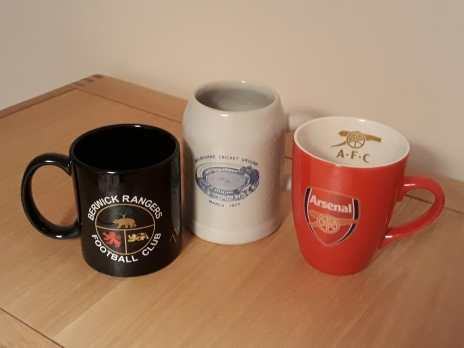
After a quick lunch in a cafe near the Town Hall (1754-60) – a cheese and tomato toastie followed by a slice of a rather good toffee cake – I walked over Berwick Old Bridge (1610-24) and down the road to Shielfield Park. I paid my £7 senior’s entrance fee and then a further £7 for a Berwick Rangers coffee mug in the club shop, fully recognising that this would not assist in my wife’s current desire to rationalise our stock of kitchenware. The Berwick drinking vessel has thus been added to an eclectic list that includes Arsenal FC, the Washington Redskins and Melbourne Cricket Ground.

20180225_115557.jpg

Montrose are having a good season. Prior to Saturday’s match, they were 5 points clear at the top of the league – chasing the automatic promotion slot – albeit that they had played one game more than their nearest challengers, Peterhead. For them, this is unfamiliar territory: the club has been nestled in the fourth tier of Scottish football for over 20 years.

By contrast, Berwick began the day third from bottom of the 10-team division, although they were probably already sufficiently well clear of bottom-placed Cowdenbeath to be concerned about the end-of-season play-off match with the winner of either the Highland League or Lowland League to decide next year’s league status. An away draw at Peterhead in the previous match had aided their cause.

Montrose’s championship challenge has been assisted by their excellent away form, which has gathered in more league points than in their home fixtures. Before Saturday, 9 matches had been won out of 13 played with only 8 goals conceded. It was a surprise, therefore, that it was a pair of defensive lapses that twice allowed Berwick to draw level after Montrose had taken the lead.

After Berwick had conceded an early own goal, it was a defensive misjudgement between the Montrose centre backs and the goalkeeper Allan Fleming, when a high kick downfield was held up in the wind, that allowed the skilful Ousman See to nudge home the first equaliser. Then, midway through the second half, a Berwick free kick taken by Paul Willis from wide out on the left was allowed to pass through a crowd of players and into the far corner of the goal. At 2-2 with 25 minutes left, there was all to play for – and both teams did indeed search enthusiastically for the winner – but the score remained unchanged, the end result being a fair reflection of the afternoon’s efforts. The nearest to a winning goal came from another (and closer) Willis free kick, which was splendidly saved by the acrobatic Fleming.

Just as at Murrayfield – indeed, just as at virtually any regularly held sporting event – the events at Shielfield Park provided all the participants with their own rituals and customs, to be drawn upon as they wished. The plastic cup of Bovril from the fast-food stall; the 50-50 half-time draw (a Mr Harrison won £126); the manager’s reflections in the excellent match programme on the unjust defeat in the previous home game; the black and gold woolly hats; the announcement of the man-of-the match (Berwick’s Darren Lavery); the reporting of the attendance (417)… It is the comfort of the familiar. I also noted that both managers shook the hands of all their respective players at the end of the game, that the stewarding was pleasantly low-key, and that the referee (Craig Charleston) had a sound match.

And so this was Berwick on a Saturday afternoon. A town of about 12,000, of whom a very small percentage had ventured out to watch their soccer team. A town with its cafes and pubs and hairdressers and charity shops…all seeking to keep themselves afloat in a challenging economic climate. A town with a history.

I think it’s the sense of place and time that I always have difficulty putting into context. Above the steps leading down to the platforms at Berwick railway station is a large plaque marking the spot where, in 1292, Edward’s I’s arbitration in favour of John Balliol (rather than Robert Bruce) in the contest for the Scottish crown was announced.

I walked down the steps towards the waiting room. The ruins of the castle were just a little way over to the left. It was 700-plus years later and I had just been to see a football match about a mile and a half down the road.


Nationality

7th February 2018

The 2018 Six Nations Championship began on Saturday with comfortable wins for Wales and England over Scotland and Italy, respectively, and a dramatic last-minute victory for Ireland in Paris. Over the next six weeks, there will be the familiar annual cocktail of drama, skill, hype, excitement and frustration for the supporters of the national teams.

One issue that had interested me for some time is the composition of those “national” sides. A couple of statistics. For last weekend’s matches, 20 out of the 90 players in the six starting XVs were not born in the country they were representing. The same applied to 13 of the 48 players on the replacement benches. This meant that 33 out of the 138 players – 24% – were born outside their country’s borders. (The same applied to 4 of the 6 head coaches). For 5 of the countries, the foreign births accounted for either 4 or 5 of the 23-man match-day squads; in the case of Scotland, the figure was 10, including 8 of the starting XV.

Of course, the circumstances surrounding the players’ places of birth will have varied considerably and, for this reason, it must be emphasised that this is a very crude measure of national “attachment”.

In many cases, the strength of the players’ national and cultural identification cannot be in any doubt. For some, the place of birth simply reflects the (temporary) employment of one or both parents. For others, it was the family’s location prior to the player’s migration and full assimilation into his new environment. Hence, for example, Ross Moriarty of Wales was born on Merseyside at the time that his father, Paul (himself previously capped on 21 occasions by Wales), was playing professional rugby league for Widnes; George Biagi of Italy was born in Scotland to a Scots/Italian father and Scottish mother and went to school in Scotland, but attended university in Italy and stayed on in that country to play his first club rugby.

However, there are also other factors at play – and, as discussed below, it is some of these that have recently come under scrutiny, not least from World Rugby, rugby union’s world governing body.

(As an aside, I shall simply note in passing that the qualifications issue is one that has also exercised the minds of the followers of other sports – both team and individual – for some time, ranging from the Ireland football team and the England cricket side to the East African-born middle-distance runners representing Middle Eastern countries).

The current eligibility criteria for playing international rugby union (apart from ability) are based on either the place of birth of the player (or his parent or grandparent) or a residency qualification of three years.

To some extent, the impact on eligibility of the residency qualification is linked to straightforward market forces. The Australian and New Zealand rugby unions have long benefited from the higher overall living standards that their countries offer to promising rugby players from the PacificIslands. Similarly, in those cases where the visa requirements can be met, the wealth of English and French rugby clubs constitutes a powerful magnet to players from overseas. A prime example here is the case of the Auckland-born Denny Solomona, part of whose 3-year qualification period for England (it has turned out in retrospect) was spent playing rugby league for Castleford prior to his switch of codes with Sale; he was selected for the England rugby union side last year as soon as he was eligible.

Some countries have attempted to work within the existing rules to offset the advantages of size and wealth that the larger rugby-playing countries possess. Two complementary strategies have been followed. The first has been to spend resources systematically identifying young talented rugby players in other countries who would be eligible for selection via the parent or grandparent route. In Scotland – to give one example – an upgraded Scottish Qualified Programme was launched last autumn with agents in the rest of the UK, Europe, Japan, South Africa, Australia and New Zealand.

Second, when the ancestral route is absent, there is the option to identify so-called “project players” to qualify on residency. These players are offered contracts with regional professional sides in the hope or expectation that they will graduate to international level at the 3-year mark. It is noticeable that media discussions of overseas-born players in the Irish and Scottish professional teams often include reference to the countdown to their international eligibility.

At this point, the question should be asked: does any of this matter? After all, the rules are the same for everyone.

In my view, the main danger does not lie with the likely attitude of the players. There is no reason to view the on-field commitment to their respective causes of the 24% (as calculated above) to be any different to the other 76% representing their countries.

Rather, the potential risk is to the credibility of international rugby – and therefore to its status as a source of spectator interest and identification. At what point does the proportion of players born outside the country mean that it is not really the “national” team that is being represented? If one-in-four is roughly the currently starting point, is it two-in-four or three-in four, or what? At what stage does the England versus Scotland Calcutta Cup match cease to be the sport’s equivalent of an England/Scotland soccer match and become analogous to the old-style Football League versus Scottish League contests? The latter were representative matches, whose teams were drawn from those (in theory of all nationalities) playing in England and Scotland, irrespective of their places of birth. The fixture dated from 1892, but was discontinued due to lack of spectator interest (and club support) in 1976.

The issues surrounding international rugby player eligibility have been debated for some time. (I note, in particular, an excellent article by Sarah Mockford – “How rugby’s eligibility rules must change” – in the August 2015 edition of Rugby World). And World Rugby has responded. In May 2017, it announced that the residency qualification period for international players would be extended from three to five years from the end of 2020, thus ensuring that players have a “genuine, close, credible and established link with the nation of representation”. The same theme was picked up by the WR chairman, Bill Beaumont: the reform is an “important and necessary step to protecting the integrity and credibility of international rugby”.

The change from three to five years is a significant one: it is a long time for someone to commit to a new country and develop their career in the hope of making an international squad other than that of the country in which they were born. It will also represent an increased financial commitment by the home union on those marquee players that have been identified.

However, it will also have the effect of raising the importance of the parent/grandparent route as a means of identifying potential talent. (Those involved with the Scottish Qualified Programme can expect an increased pressure to deliver results). On this point, my view is that the grandparent criterion should be abolished and that only the parental link should be retained. For many players, it must be difficult to justify an emotional or cultural link with an ancestor who was born perhaps 80 years earlier and whom they might not have even met.

In the meantime, the 2018 Six Nations bandwagon moves on – this weekend to Dublin, Twickenham and Murrayfield.

A Keen Contest on a Dreich Afternoon

29th January 2018

Scottish Rugby has announced a significant set of changes to the structure of club rugby from the 2019-20 season. There will be six semi-professional clubs in a tier below the two current fully professional outfits (the Glasgow Warriors and Edinburgh Rugby). Below the “Super Six”, all the other clubs will participate in amateur leagues, at the head of which will be a 12-team Scottish Championship.

The principal aim of the changes is to smooth the pathway for players graduating from the leading Scottish club sides into the professional ranks – currently something of a chasm.

The existing clubs (or syndicates of clubs) have until 30th March to submit their bids to Scottish Rugby to become one of the new elite group. The franchises, which will be announced on 1st May, will run for five years at a time and there will be at least one Super Six team in each of Scottish Rugby’s four regions.

The new system will face a number of challenges. For example, much will depend on whether Scottish Rugby can also negotiate with one or more of the other Unions for a suitable competition in which the Super Six could participate. (There would be little attraction in them just playing each other all the time). I wonder, also, about the extent to which Glasgow Rugby and/or Edinburgh Rugby might use their Super Six “partners” as convenient teams in which to ensure that members of their own squads have the opportunity to gain playing time when not in the first team or returning from injury. (This issue is not dissimilar to that in rugby league, when Super League sides use the “dual registration” arrangements with lower league clubs to parachute in players for certain matches, thereby risking team morale and continuity within the recipient sides). And, not least, history suggests that the policing of the amateur status below the Super Six – indeed “wholly amateur”, according to Scottish Rugby’s press release last autumn – might be a combination of the difficult and the casual.

On Saturday, I went to watch Peebles visit West of Scotland at Burnbrae in the National League Division 2. This is the third tier of the present club hierarchy and so their respective positions of 5th and 9th in the league placed the two sides at 27th and 31st within the overall nationwide standings. We can probably assume that neither club will be one of the selected half dozen.

It was evident from the first scrum that West were in for a tough afternoon. Their forwards were shunted yards backwards at the set-piece: a pattern that was to repeat itself throughout the game. West’s sources of possession were more productive from the line-out and from a continual stream of Peebles infringements at the breakdown, but they were not sufficient to stem the tide. Peebles ran in their first try after six minutes and, aided by a strong breeze on a damp afternoon, were 26-0 ahead at half-time.

West did not give up, however, and kept scrapping right to the end: literally so, as some fine handling in the match’s last passage of play led to their second try and a reduction in the final deficit to 12-36. (This had been immediately preceded by an anguished cry by one of the Peebles players – which seemed to echo around the main stand – when one of his colleagues had kicked the ball down the middle of the pitch instead of safely out of play over the touchline to end the match: “What the f… are you doing?”)

I enjoyed the afternoon. For part of the second half, I joined the handful of spectators on the banking behind the lower touchline, where the sharp gusts of a swirling wind would occasionally blow into our faces. We formed a small group of camp followers close to the action as the play moved back and forth down the field. I had a good view of the commitment of the players and of the many small-scale examples of their courage and skill.

It is unlikely that either Peebles or West of Scotland will move out of Division 2 this season. As one of the league’s sides (Aberdeenshire) has dropped out, there is only one relegation place and West seem to be comfortably clear of the Whitecraigs side currently occupying 11th place, whilst Peebles will probably fall just short of the two promotion slots. As the new Scottish Championship will presumably be comprised of 12 sides drawn from next season’s Premiership and National League Division 1, this means that both clubs would remain within the new National League structure at its inauguration in 2019.

Scottish Rugby has stated that it hopes the absence of player payments will allow Scottish Championship and National League clubs to build stronger community ties and invest in developing their infrastructures. In the cases of both West of Scotland and Peebles, it could be argued that the local ties are already strong, as given, for example, by the former’s extensive commitment to providing facilities and coaching for “micro”, “mini” and “midi” rugby – i.e. from pre-school to the Under 16s of Bearsden and Milngavie – on a Sunday morning.

I wonder, therefore, how much club rugby at this level – as revealed by the competitive action on the pitch – will be affected by Scottish Rugby’s bold plans. Relatively little, perhaps. And for this casual spectator looking to attend a keenly contested match on a dreich afternoon, that would be no bad thing.

Better Times at Rugby Park

22nd January 2018

In Difficult Times at Rugby Park (2nd October 2017), I reported on the Kilmarnock versus RossCounty fixture in the Ladbrokes Scottish Premiership that I had attended on the last day of September. The visitors had deservedly won – 2-0 – and I remarked that they had reminded me of the Inverness Caledonian Thistle team that I had seen play at St Mirren in November 2014 (as reported in Still An Ordinary Spectator) on their way to winning that season’s William Hill Scottish Cup. I made a note to check out the bookmakers’ odds when the top-tier teams entered this season’s competition in January.

For Kilmarnock, things had not looked so promising. The referee’s half-time and full-time whistles had been accompanied by crescendos of booing from a sizeable proportion of the home supporters in the main stand. The manager – Lee McCulloch – had been relieved of his post the following day. I had concluded that “a long and gruelling journey through to Spring” was in prospect for the Ayrshire club.

But what do I know? In the subsequent 3½ months, Kilmarnock – under the new manager, the experienced Steve Clarke – have won 6 and drawn 5 of their 13 league fixtures and risen to sixth in the table. By contrast, RossCounty have won only 2 games out of 14 and slipped to bottom place, three points behind the side above them, Partick Thistle.

As promised, I duly checked out the bookmakers’ assessments prior to the 4th Round of the Scottish Cup – with the Premiership teams now included – being played this weekend. One of the fixtures was Kilmarnock versus RossCounty at RugbyPark. Their odds on lifting the trophy this season were 33 to 1 and 40 to 1, respectively.

On Saturday, following a soup and sandwich in the internet café in King Street and a 20 minute walk to the ground along the icy pavements, I took my place in the same seat of the Frank Beattie Stand that I had occupied in September. The seats along from me were taken by two middle-aged women with their young sons, one of whom – aged about 7 or 8 – was on my immediate right.

The atmosphere was much more supportive of the home team that it had been on my previous visit. The Kilmarnock support clearly included the boy next to me, whom I assumed to have been on a sugar-rich diet, as he anticipated the kick-off by repeatedly jumping up and down and clapping and shouting. His activity level then seemed to rise a couple of notches after the game had started. When his mother asked if he was disturbing me, I took the opportunity to suggest that they swap seats, which she kindly did. She asked me to let her know if she herself starting bouncing up and down; I then made a reciprocal request.

It was a close-fought match. Both sides were well-organised and sound in defence allowing few chances to be created; both were wasteful of possession at crucial times. Kilmarnock did hit the post in the first half and, after the interval, RossCounty’s best move of the match created the opportunity for an unopposed close-range header from Jason Naismith, which he duly guided wide of the goal. The game drifted towards what seemed to be its inevitable stalemated closure and a replay on Tuesday evening. “They played better against Rangers” – a recent 2-1 victory – said my neighbour.

And then, as so often happens with football matches, we had five minutes of drama at the end of the tie. In the 87th minute, the Kilmarnock midfielder, Rory McKenzie, attempted to reach a floated pass in the visitors’ penalty area. In my line of sight, he was running away across the six-yard box with the RossCounty player, Tim Chow, in attendance. McKenzie stumbled as the ball bounced away off his outstretched foot and went past the post. The referee, Bobby Madden, pointed to the penalty spot and issued a red card to Chow. The Kilmarnock substitute, Lee Erwin, converted the kick. The crowd – led by the woman to my right – roared its approval.

There was still time for the 10-man RossCounty to mount a rescue attempt. The stadium clock had stopped at 90 minutes when, showing rather more urgency than hitherto to get the ball into the Kilmarnock penalty area, the visitors forced a corner. The incoming kick was headed on by County’s goalkeeper, Aaron McCarey – pressed into service by the circumstances as an auxiliary (and unlikely) attacking weapon – and saved on the line by the sprawling Jamie MacDonald in the Kilmarnock goal. McCarey furiously protested to referee Madden that the ball had crossed the line; Madden responded by blowing the final whistle.

And so the revival of Kilmarnock FC continues. They have been drawn at home against a Highland League side – Brora Rangers – in the next round of the Cup. Compared with the occasion of my previous visit, these are better times at Rugby Park.

A Prisoner of His Time ?

11th December 2017

[Disclaimer:
This blog contains historic quotations of an offensive nature, which are
pertinent to the subject under discussion].

It is a familiar (and unoriginal) theme within these occasional blogs and the books of sports spectating reminiscence that preceded them – An Ordinary Spectator and Still An Ordinary Spectator – that, in any given period, sport is a barometer of the broader society around it. This applies not only to the playing and watching of sport – with its rules, rewards, technologies and morals – but also to the reporting of it.

As further evidence to support this proposition, let me refer to Farewell to Sport by Paul Gallico (1897-1976), which was first published in 1938 and reprinted in paperback by First Nebraska in 2008. I purchased a copy in the excellent The Sport Gallery in the Distillery District of Toronto.

Gallico is well-known as the author of fiction, notably The Snow Goose and The Poseidon Adventure. However, he made his name as the sports editor of the New York Daily News for the 14 years from 1923. In 1937, he gave up this prominent – and highly paid – position to travel and to concentrate on his fiction. Farewell to Sport was a collection of essays written at this time which, as the title suggested, offered some reflections on the sports he was leaving behind.

Given the newspaper for which he was writing, it is not surprising that Gallico focused on sport in America, especially boxing, baseball and golf. The book contains one favourable reference to soccer – “one of the greatest of all spectator sports from the point of view of sustained action and wide-open play” – and nothing on rugby or cricket. Some of the essays straightforwardly capture the admiration – indeed, hero-worship – that the author had for three sportsmen in particular: the heavyweight boxing champion Jack Dempsey, the baseball star Babe Ruth and, especially, the golfer Bobby Jones. In each case, this was partly an acknowledgement of their exceptional sporting prowess; equally, however, it was a reflection of their respective characters and the way in which fame and adulation did not change them.

Gallico was no mean sportsman himself – a rower at ColumbiaUniversity and, later, a fencer of some note – and he was one of the first sports journalists to engage directly with the stars on the field of play (a branch of journalism that spawned other well-known practitioners, notably George Plimpton). Most dramatically, he sparred with Jack Dempsey (for all of 97 seconds) until the inevitable stoppage: “I learned…that the fighter rarely, if ever, sees the punch that tumbles blackness over him like a mantle”. I liked his description of a Dempsey training camp at Saratoga Springs: “…the grand, exciting, bawdy atmosphere. There were sparring partners with bent noses and twisted ears…boxing writers, handsome state troopers in their gray and purple uniforms, doubtful blondes…and blondes about whom there was no doubt at all”. Gallico was at pains not to drift into sentimentally, however; he knew that prize-fighting was a tough sport and that an unhesitatingly vicious instinct was required for ultimate success. Dempsey was “a jungle animal [with] hatred in his eyes…He was utterly without mercy or pity”.

Gallico also saw himself as a crusader. He railed against what he saw as the hypocrisy of the administrators of what were supposed to be amateur sports – athletics, tennis and, especially college (American) football – whose major events attracted vast crowds and gate receipts. He was brave in naming the shady characters associated with many of the boxing promotions, notably in the post-Dempsey era of heavyweights. And he felt himself a helpless onlooker at the inferior status conferred on black boxers, as reflected in their treatment by hotels and restaurants, including the members of a Golden Gloves team from New York that he managed in Chicago.

In the final essay – “The Next Fifty Years” – Gallico attempted to look into his crystal ball to the sporting environment of 1987. He was correct to argue that the records of his time would be eradicated, though, in most cases, he significantly underestimated the speed of progress. He wondered if the then world record for the mile (4 minutes 6.7 seconds held by Glenn Cunningham) might be reduced to about 4 minutes 3 seconds. (As we know, Roger Bannister took it below 4 minutes as early as 1954). Likewise, he reckoned that the high-jump record might be raised to 7 feet and that the pole-vaulters might reach 15 feet. (In 1987, world records were set in these events by Patrik Sjoberg and Sergey Bubka at 7 feet 11¼ inches and 19 feet 9¼ inches, respectively).

In this connection, it is worth noting that Gallico had views about the regimes that he thought likely to be producing the record-breakers of the future. He predicted that the stranglehold that the US had on track and field athletics was likely to be broken by “the new generation of youngsters, regimented and trained from infancy in Germany and Italy and other Fascist states [in which there was] the athletic and military training of youngsters under ten years of age, teaching them the fundamentals of sports and drill”. His caveat to this forecast was chillingly prophetic: “The early sports training may make them a nation of athletes far surpassing anything that we have ever known before – or it may make them cannon-food”.

So far so good. However, even allowing for the Sports Illustrated and other accolades (see below), Paul Gallico’s sports writing has fallen out of favour with many present-day commentators due to the shadows of sexism and racism. The relevant examples jump off the page in Farewell to Sport.

Gallico undoubtedly admired the spirit and determination of the top-class sportswomen. But his overall attitude to the “muscle molls” was captured in a couple of sentences: “[T]hey are at best second-rate imitations of the gentlemen…A man has swum a hundred yards in fifty-two seconds. A girl takes one minute three seconds for the same distance, and so it goes. No matter how good they are, they can never be good enough, quite, to matter”.

Gallico’s descriptions of specific women’s sports were dominated by his assessments of the participants’ physical attributes. Hence, for example, the female track athletes were “flat-chested most of them, with close-cropped hair. Not much on looks either. Most of them had hard faces”. By contrast, “what lovely legs and bodies those figure skaters have”. Farewell to Sport contains many passages in this vein.

The examples of racism also cause unease for the modern reader. Whilst Gallico recognised that the formidable Joe Louis was a bone fide world heavyweight champion with his exquisite skill and thrilling efficiency – aided by his being “exceptionally well managed and handled by a hard and capable crowd of people of his own race: a lawyer, an ex-numbers man and an ex-convict” – he also made the curious assertion that Louis had been “carefully trained in the sly servility that the white man accepts as his due”.

In many ways the most bizarre example relates to the sport of basketball in New York, which “for the past years Jewish players on the college teams…have had…all to themselves. [T]he reason…that it appeals to the Hebrew with his Oriental background is that the games places a premium on an alert, scheming mind and flashy trickiness, artful dodging and general smartaleckness”. We should remember that Farewell to Sport was published in 1938: the year of Kristallnacht in Germany.

Eighty years on from Farewell to Sport, it is difficult to rationalise the many unacceptable (to us) forms of words that Gallico used. However, arguably, they partly reflected the milieu in which he was operating: the alpha-male world of competitive sports reporting on the East Coast of the 1920s and 1930s. He was writing for a mass audience which, at that time, clearly did not have anything like the social sensitivities that we take for granted in the 21st Century. In this sense, he was a prisoner of his time. He knew his market and he reported back on terms that were familiar to it.

Farewell to Sport was allocated a place in the “Top 100 Sports Books of All Time” by Sports Illustrated magazine in 2002. Justifiably so in my view – for two reasons – notwithstanding that it is in places a distinctly uncomfortable read.

First, there was Gallico’s descriptive prowess, which – for modern readers – continues to provide an evocative picture of the good and the bad of the major American sports and their elite practitioners in the 1920s and 1930s. For example, on the positive side, his affection for baseball was clearly unbounded. A game could produce “half a dozen split-second races between a running man and a thrown ball, in which the hundredth part of a second is all the difference between success and failure, dozens of examples of skill triumphant, skill defeated, traps baited and snapped shut upon victims, human folly, and human cowardice, narrow escapes, heroes, villains, individual deeds that verge upon the miraculous…”

Similarly with individuals. The portrait Gallico painted of Babe Ruth consisted of a rich combination of fine details within the overall composite: “He was kneaded, rough-thumbed out of earth, a golem, a figurine that might have been made by a savage…with an unshapely body that features a tremendous, barrel-shaped torso that tapers down into too small legs and an amazingly fragile and delicate pair of ankles… His nose is flat and pushed in. Nobody did it for him; it grew that way”.

On the downside, Gallico’s assessment of the corruption of the heavyweight boxing scene that took Primo Carnera to the world championship title – “Pity the Poor Giant” – concluded dramatically: “He was just a big sucker whom the wise guys took and trimmed… All this took place in our country, Anno Domini 1930-1935”.

Second, Gallico himself was aware that he was writing in a particular time and that what he observed on the sports field reflected the wider society around it. He noted more than once that the huge crowds for sports events – notably boxing – that had occurred during the prosperity of the 1920s had not been maintained with the onset of the Great Depression. Indeed, at one point, he also doubts the validity of his own hugely-rewarded profession at a time when many American families were in desperate straits: “Many of us felt a little silly, still writing in the flamboyant post-war style of highly paid professional and amateur athletes at a time when most people were wondering where their next pay-check or meal was coming from”.

Gallico’s linkage of sport to society extended from the economic to the cultural. I was struck by a key paragraph describing the crowd’s reaction when the black American (Joe Louis) was knocked out by the white German (Max Schmeling) in Yankee Stadium, New York, in 1936. Notwithstanding that Louis was fighting on home soil, “…an even lustier and more joyous [yell] went up from the unpigmented spectators… The white brother is fickle and tires very quickly of seeing a Negro triumph too often”.

It is in this context that the damning flaws in Paul Gallico’s sportswriting should be considered by modern readers. Their very presence should be seen as part of the overall package – in other words, as complementary with the evocative (and acceptable) descriptive passages in not only contributing to our understanding of American sport in the inter-war period, but also providing a window on the broader social context in which that sport took place.

Concussion

1st December 2017

In a recent blog on the Glasgow Warriors-Leinster game in the European Rugby Champions Cup (A Tough Pool”, 23rd October 2017), I noted that, during the course of the match, four players left the field for Head Injury Assessments (HIAs). One of these – the Glasgow captain, Ryan Wilson – departed the scene under some protest and had to be restrained by the medical staff from rejoining the action. Even for a non-expert such as me looking on from a distance, it was clear that he was not fully aware of his circumstances and was suffering from some form of concussion.

Events within the last fortnight or so seem to have confirmed that most high-profile rugby matches – of both codes – include similar incidents. In the Rugby League World Cup quarter-final between England and Papua New Guinea in Melbourne, the latter’s star player, David Mead, received a heavy blow to the head after only a couple of minutes and took no further part in the match. England’s Kevin Brown similarly received a head injury a few minutes before half-time; he was allowed to continue until the interval – during which time he moved sluggishly on to a pass and dropped the ball – but did not re-appear for the second half. On the same day, in the rugby union international at Murrayfield, the Scotland prop forward Zander Fagerson was concussed against New Zealand and obliged to miss the following week’s match against Australia. In last Saturday’s Wales-New Zealand game, it was clear from the television coverage that the Welsh scrum-half Rhys Webb had been dazed after being tackled and hitting his head on the turf; play continued for some time afterwards, with Webb apparently recovering his wits and participating again in the Welsh attack, before he was taken from the field at the next stoppage of play. In the same match, the New Zealand centre, Ryan Crotty, went off for a HIA after 20 minutes and did not return. And so on…

It is widely agreed that these incidents are important not only because of the immediate injuries incurred by players, but because of the possible long-term implications for health and well-being. Indeed, such links are becoming part of the conventional wisdom: The Scotsman’s obituary of David Shedden, who died in October at the age of 73 after a decade-long battle against an aggressive form of early-onset dementia, noted that, in addition to his 15 Scottish rugby caps in the 1970s, he had suffered from no fewer than a dozen concussions on the field of play.

In the period since the Glasgow-Leinster encounter, I have read Truth Doesn’t Have a Side: My Alarming Discovery about the Danger of Contact Sports (2017)by Bennet Omalu.

Dr Omalu was the neuropathologist with the Allegheny County Medical Examiner’s office in Pennsylvania who conducted an autopsy on Mike Webster, a former American Football player with the Pittsburgh Steelers, who had died in September 2002 at the age of 50. He became aware of Webster’s post-career history of mental illness, memory loss, depression, disorientation and spontaneous anger episodes, but, initially, could not find the evidence of blunt force trauma on the brain that he had expected to see with the naked eye. Nor was the deterioration of Webster’s brain consistent with the dementia pugilistica that is seen in punch-drunk boxers. Instead, “many [brain cells] had died and disappeared and many appeared like ghost cells… [There were] spaces in the substance of the brain… like a partially demolished building stripped of its windows”.

Eventually, Dr Omalu concluded Webster’s decline and demise were the result of the brain disease Chronic Traumatic Encephalopathy (CTE) and brought about by the repeated blows to the head (concussive and sub-concussive) that Webster had incurred playing his sport. The wearing of a helmet had been irrelevant, in Dr Omalu’s view, because it had not prevented the brain bouncing around inside the player’s skull and suffering impact on the skull’s inner surfaces.

The fascination of Dr Omalu’s book is not only in the medical detective story that he presents – with its references to tau tangles and amyloid plaques – but in the broader circumstances in which he conducted his research and then presented his findings. He was born in Biafra at the height of the civil war in 1960s Nigeria and had made his way to the USA on a medical scholarship. After publishing his conclusions on CTE, he was widely attacked as an outsider seeking to undermine the sport that plays a central role in defining American society and culture. Perhaps naively, he was shocked by the counter-response, notably by some of the NFL franchises and the National Football League itself.

A feature film of Dr Omalu’s story, starring Will Smith, was released in 2015. Ironically, its title – Concussion – cuts across one of his central findings: that damage to the brain is done by repeated incidents of “mild” trauma as well as obvious concussions in which a player temporarily loses consciousness: “the fundamental issue is not concussions, but repeated blows to the head without or without concussions”. And once that damage is done, it is permanent and irreparable: “the human brain does not have any reasonable capacity to regenerate itself”.

I was interested in what the author had to say about rugby. Not surprisingly, he did not differentiate between the union and league codes, so one assumes that it is the former with which he is the more familiar. The references in the book are relatively brief, but still very clear: participation in other “high impact, high contact” sports, in which repeated blows to the head are prevalent, also increases the risks of CTE. Rugby is included in this list.

It is not only American Football and rugby, of course. With regard to soccer, there has been much media comment in the UK following the recent broadcast of the very good BBC documentary – Alan Shearer: Dementia, Football and Me. The medical researchers interviewed in that programme echoed an important point made by Dr Omalu: there is the potential for brain damage from repeated heading of the ball – as Shearer reckoned he used to do about 100 times a day in training – as well as from the clashes of players’ heads. A poignant episode in the programme was Shearer’s interview with his first manager, Chris Nichol – a robust and committed centre-half in his own 20-year playing career – who bravely admitted that his memory was “in trouble” and, on occasion, that he forgot where he lived.

It is clear that, across many sports involving physical contact, the authorities are increasingly conscious – if you’ll pardon the pun – of the potential long-term dangers of head injury. In rugby union, the HIAs procedures have been tightened up, though many medical experts would argue that they do not go far enough. The Football Association announced last month (jointly with the Professional Footballers Association, PFA) that experts at the University of Glasgow had been commissioned to conduct research on the incidence of degenerative neurocognitive disease in ex-professional footballers. In the USA, in 2015, heading a ball was removed from the soccer played by under 11s and heading practice limited for 11-13 year olds. (Dr Omalu would extend this ban to under 18s, given that the brain is still maturing to that age). The NFL has banned helmet-first tackling and has established new protocols for dealing with concussed players.

Although these developments suggest that a clear direction of travel is evident, it is also the case that there is far from unanimity about the linkages between sport-related blows to the head and the long-term health of the brain. (Part of the problem faced by researchers is that, currently, CTE cannot be diagnosed until after death). The counter-argument was made, in a soccer context, in another interesting recent documentary – Sky Sports’ Concussion: The Impact of Sport – in which it was noted that modern footballs are much lighter than the heavy rain-sodden leather balls of old and that, in any case, “there don’t seem to be hundreds of Jeff Astle cases out there”: a reference to the former West Bromwich Albion and England centre-forward, whose death in 2002 at the age of 59 was judged by the coroner to have been due to an industrial disease i.e. football-related. In turn, the short answer to that is that we simply don’t know how may “Jeff Astle cases” there are – a point acknowledged by the PFA chief executive, Gordon Taylor, in the Shearer documentary. An important aim of the FA/PFA-commissioned research will be to determine whether the incidence of long-term brain disease amongst ex-professionals is statistically different to that within a control population on non-players.

Where do we go from here? I find it very difficult to forecast what the sports of rugby and football (soccer) might look like in 10 or 20 years time. However, I think we can be reasonably confident of a number of things. First, there will be continued further lobbying for significant rule changes in many sports by some branches of the medical profession. In addition, parents will continue to pay close attention to activities that affect the well-being of their children (and, in large numbers, will prevent participation in sports that they judge to be too risky). We can also be sure that the lawyers will be painstakingly examining whether sports authorities and clubs are meeting their duty of care towards the participants of those sports.

And, finally, we can be certain that – irrespective of the perceived risks – many people will wish to continue playing “high impact, high contact” sports.

A Tradition Maintained

7th November 2017

I turned up at the Etihad Stadium on Sunday knowing that Manchester City had made an impressive start to the 2017-18 season: maximum points from their 4 Champions League games to date, 9 wins (and one draw) out of 10 Premier League matches and safely through to the quarter-final of the Carabao (or League) Cup. In the Premier League, they were five points clear of second-placed Manchester United and nine points ahead of Arsenal in fifth spot. As Sunday’s game was against Arsenal – and United were playing fourth-placed Chelsea – there was the possibility that City would put further daylight between themselves and their title rivals.

I had wondered what to expect. The latest (2017) estimates of Forbes magazine are that the ManchesterCity and Arsenal corporate entities each have a value of approximately $2 billion. They are global brands in a global market. City are owned by the Abu Dhabi United Group; Arsenal’s major shareholders are an American sports tycoon and a Russian billionaire. The respective managers are a Spaniard (or, more accurately in the current political climate, a Catalan) and a Frenchman. Both clubs spent over £50 million on single players during the last transfer window. In the starting XIs, City fielded four Englishmen and Arsenal none (though there was one Welshman).

The question in my mind was whether – for the home supporters on this occasion – there was still a local connection. Do the City faithful still have a sense of identification with a club that will mark its 125th anniversary in 2019: the club of Billy Meredith and Bert Trautmann and Colin Bell?

There was plenty of evidence to indicate that the ties between club and supporters are still very strong. In this regard, the appeal to tradition is clearly significant. It was no coincidence that my seat was actually in the Colin Bell Stand. Moreover, the player described by the mc as probably the greatest ever to wear a Manchester City shirt was present to take his place before the kick-off in a guard of honour for Sergio Agüero who, in the previous match against Napoli, had become the club’s record goalscorer. Agüero’s total of 178 had taken him past the 78 year-old record of Eric Brook, whose daughter was on hand to make a pre-match presentation. She was accompanied by Mike Summerbee, a “club ambassador” and, of course, a colleague of Bell’s in the great City side of the late 1960s. In turn, Summerbee’s article in the match programme having made reference to Remembrance Day, a separate piece recognised some of the City players killed or wounded in the First World War trenches 100 years ago.

When Agüero scored his 179th goal – a soft penalty awarded five minutes after half-time to give his side a 2-0 lead – it looked as if the floodgates might open, given Arsenal’s occasional tendency in recent years to concede large scores to sides at or near the top of the table. Instead – prompted by the Welshman, Aaron Ramsey – they enjoyed their best spell of the match and a goal by the lively substitute Alexandre Lacazette duly reduced the arrears. For the third City goal, the naked eye suggested that David Silva was at least three yards offside before setting up the tap-in for Gabriel Jesus: the later television replay indicated it was perhaps half a yard, but offside nonetheless. 3-1 was the final score.

Much is made of ManchesterCity’s playing style: a passing game, built up from the goalkeeper and the back four, so that the skilful presence of Silva, Kevin de Bruyne and Leroy Sane can threaten in the final third of the pitch. De Bruyne was announced to have been the man-of-the-match – he had struck the first goal and posed a danger throughout the afternoon – though Silva must have run him close, as also Fernandinho. The last of these is generally less-heralded, I suspect, but is clearly a vital component of City’s midfield machinery.

Earlier in the day, I had visited the NationalFootballMuseum in the city centre. I had been meaning to go for some time, partly because, when it had previously been located in Preston (as it was from 2001 to 2010), one of the trustees was the late Brian Booth, whom I got to know when I was a Scottish Executive civil servant and he was a non-executive director of the Glasgow-based Student Loans Company. Brian was a proud advocate of the Museum and its Lancastrian location.

The Museum, which is free to enter (and invites donations), is well worth a visit. For the traditionalists and historians amongst us, there is some fascinating older material, including a hand-written version of the Rules of Association Football (from 1863) and an England shirt from the first international football match (against Scotland in 1872). One should be prepared to be overwhelmed, however, as there is scarcely an aspect of (English) football history that does not seem to be covered. I’m not really sure if the exhibits need to include the shorn locks of Robbie Savage’s hair or the pickled knee cartilage of Willie Cunningham, though I suppose one of John Motson’s sheepskin overcoats just about qualifies.

The “sport-in-society” theme of my occasional blogs was certainly captured in some of the Museum’s displays, not least the dreadful array of knives carried by some of the members of the 1980s football gangs. On a more uplifting note, I was taken by the small model of the old Wembley Stadium – sculpted out of concrete – the concrete itself having been rescued at the time of the demolition of the old Wembley Stadium.

The usual rules apply, I think. If one seeks to understand the current state of affairs of something – in this case, of football in general or a club such as Manchester City in particular – it is immensely useful to start with its history. Some traditions are maintained, others are re-interpreted, yet others are broken.

For the present, ManchesterCity go from strength to strength. By the close-of-play on Sunday, their lead at the top of the Premier League had stretched to eight points, courtesy of Chelsea’s 1-0 win over Manchester United. There is still over two-thirds of the league season to run, of course, but it is looking ominous for the rest of the field.

As for Arsenal, the traditions of my personal relationship with the club have been maintained. I have seen them play three times – against Leeds United at Elland Road in 1971, against Manchester United at Highbury in 1985 and now against ManchesterCity at the Etihad Stadium in 2017. They have lost on all three occasions.

A Tough Pool

23rd October 2017

The Glasgow Warriors have been drawn in a tough pool in this season’s European Rugby Champions Cup. In addition to the Exeter Chiefs (the English champions), their section includes Leinster (three times winners of the competition in its previous guise as the Heineken Cup) and Montpellier (currently third in the Top 14 championship in France). For their part, Glasgow had begun the season by winning their first six matches in the Guinness PRO14 championship.

Having already lost at Exeter on the previous weekend, Glasgow met Leinster at Scotstoun on Saturday.

The game was played in proper rugby conditions with dampness in the air and a tricky, swirling wind. It was clear that attention to detail – a sine qua non for a professional player I would have thought – would be important. I could imagine the frustration of the Glasgow coaches, therefore, when the scrum half, Ali Price, kicked the ball directly into touch from just outside his 22 on the first play of the game. It was from this advantageous field position that a Johnny Sexton penalty kick opened the scoring for the visitors. Later in the first half, with Glasgow leading 10-3, a massive punt downfield by Stuart Hogg took the ball all the way over the Leinster deadball line. The resultant scrum, brought back to 10 yards from the Glasgow line, led to the first of Cian Healy’s two close-range tries. On such fine margins are matches won and lost.

Healy was one of 5 British Lions who took the field for Leinster, two of the others also being prop forwards: Tadhg Furlong and Jack McGrath. They were instrumental in the Leinster forwards gaining the upper hand in the tight exchanges. For their part, Glasgow often looked dangerous when moving the ball swiftly to the wider channels, where Hogg could time his intrusions from full-back into the three-quarter line. I thought that the accuracy of their passing was not all it might be, however, and there was also the commonly-seen fault of the runners drifting across the pitch.

It all added up to a very interesting contest with both sides demonstrating skill as well as muscular strength. Stuart Hogg’s try required him to chase a bouncing ball over the try line and touch it down before either he or it went over the deadball line. The way that he managed to keep his feet in bounds as he stretched forward reminded me of one of the fundamental skills of a wide receiver in the National Football League, where a catch for a touchdown in the end-zone requires that both feet touch the ground in the field of play.

From 3-10 down, Leinster took a lead of 24-10 mid-way through the second half. A penalty goal by Finn Russell and a well-worked try by Tommy Seymour – along with Hogg the Glasgow Lions on view – gave the home supporters some hope before Leinster’s late surge extended the final margin to 34-18.

As expected, the game was somewhat feisty at times, but it was well handled by the referee. This was equally anticipated, as the man in charge was Jerome Garces of France, one of the world’s best. (It was Garces who dismissed Sonny Bill Williams of New Zealand from the field during the Lions’ Second Test in July). It was a pleasure to see him in action.

Garces was especially efficient in stopping the game immediately when a couple of players received head knocks. In the cases of Ryan Wilson and Callum Gibbins these appeared to involve concussive injuries, even to this non-medical expert sitting in the depths of the stand. There is undoubtedly a serious problem for rugby union concerning this issue and I shall return to it in a future blog.

Experience suggests that teams’ performances in the early rounds of the European Rugby Champions Cup can be deceptive. In Still An Ordinary Spectator, I reported on the hugely disappointing Bath side that lost 10-37 to Glasgow on the same ground in October 2014; Bath went on to win the pool. Conversely, the apparently all-conquering Toulouse team that won their first four matches in the same group that year somehow failed to qualify for the quarter-finals. But, having lost their first two fixtures in this year’s competition (and without the consolation of any bonus points), it must now be long odds on Glasgow reaching the next stage.