News Blog

The Wolfpack and the Cheesy Dog

27th August 2017

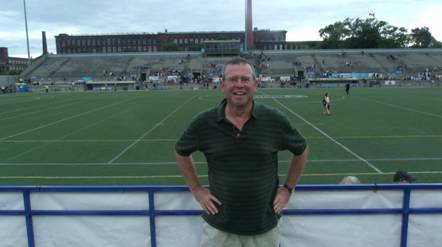
Last Saturday, in order to get to the Allan A Lamport Stadium from downtown Toronto – a distance of just over two miles – I took the 504 streetcar along King Street heading directly west. I arrived early and went for a beer in the nearby Shoeless Joe’s, where the Toronto Blue Jays were in action on the screens in the second of their weekend triple-header against the Chicago Cubs at Wrigley Field. However, the purpose of my journey was not televised Major League Baseball, but live rugby league in the (British) Kingstone Press League 1: Toronto Wolfpack vs Newcastle Thunder.

We do live in times that are, occasionally, slightly bewildering.

The division has now entered the Super Eights phase of the season, in which the top 8 sides play each other to decide (eventually) which two teams will be promoted to the Championship. As the points accumulated during the season are carried forward, Toronto Wolfpack are in a strong position, as they lead the table from Barrow and Whitehaven. For their part, Newcastle were in 7th position, with an outside chance of finishing in the top 5 and engaging in the final rounds of knock-out play-offs.

I suspected that the match might be somewhat one-sided. Toronto have recruited ambitiously in their playing and coaching staff – the former Great Britain coach, Brian Noble, is the Director of Rugby – and had lost only one (and drawn one) of their 18 league and Super Eight matches to date, averaging 57 points per game. And so it proved. The left-winger Liam Kay went over for the first of his three tries inside two minutes and the home side ended up scoring a total of nine tries in a 50-0 win.

(A curious statistical aside. I have seen Newcastle Thunder play three times: once here and twice in their previous guise as Gateshead Thunder against the Hunslet Hawks at the South Leeds Stadium. On each occasion, they have conceded exactly 50 points).

The outcome of the match not being in much doubt, I was more interested in the presentation of the game and the local response to it. It was all pleasingly encouraging. The Lamport Stadium has several tiers of elevated open seating, running the full length of both touchlines, which provide good views of the action: ideal for a warm and sunny afternoon such as this, less so if Toronto experiences one of its occasional summer thunderstorms. The row of concession stands populating the King Street end of the ground, behind the goalposts, was also heavily patronised throughout the afternoon.

The sizeable crowd – over 7,500, according to the Wolfpack’s website – enjoyed the home side’s dominance, the volume of cheering not seeming to diminish as the later tries were run in. Interestingly, many spectators stayed around in their small groups after the game had finished, remaining on the seating or at the edge of the pitch: it was a social gathering on a pleasant Saturday afternoon.

As at other sporting venues in North America, there were a plentiful number of beer-sellers doing the rounds up and down the terraces. Food and drink is a significant component of these events and so I treated myself to a Big Mamma’s Cheesy Dog (with tomato sauce) from one of the fast-food stalls. It was as delicious as the name suggested.

The demographics of the crowd covered all ages with many family groups, a significant proportion of women and – it seemed to me – a plethora of Canadian accents, rather than those of casual visitors from Britain or the Antipodes. The loudest gasps were heard at the collisions between the respective prop forwards, perhaps not surprisingly as one of those wearing a Wolfpack shirt was the formidable Tongan, Fuifui Moimoi – a veteran of 10 seasons in the Australian Rugby League – who was typically aggressive both with the ball and in defence. (It struck me that Moimoi’s clear emergence as a local cult hero was not unlike that attained by the similarly-sized Ian Van Bellen in the latter stages of his career at the newly-formed Fulham club in the 1980s).

I talked to one or two of my neighbours. Of the two young men on my right, one was familiar with rugby union in Canada – a well-established sport in some areas of the country – and seemed to be accurately explaining the rules of rugby league to his friend. He remained nervous about the Wolfpack’s promotion prospects, quoting to me the narrow leads over Barrow and Whitehaven (2 and 4 points, respectively) in the league table. When I asked about the local media coverage, the second man acknowledged that rugby league was a “second tier” sport, but noted that soccer (through the Toronto FC) was succeeding in making its own inroads from a similarly low base. He made an interesting point about the need to keep the entry price at a competitive level, compared with soccer: the cost to me (as an adult with no discount for seniors) was $30 Canadian (about £20).

The middle-aged couple seated in front of me were attending for the first time with their young children. The father told me that his preferred sport was lacrosse and his awareness of the Wolfpack had been raised by press reports of some of the injuries that the players had sustained (which partly answered the question about the local media). He seemed to thoroughly enjoy his afternoon and, I’m sure, they will be repeat visitors.

If professional rugby league is to take root in Canada, Toronto seems to be the best place to start. It is a large, prosperous and cosmopolitan city with a liberal attitude to outside influences: we were informed on the city bus tour that one-half of its inhabitants were born outside Canada. The sport might also be able to take advantage of the growing concerns across North America – including amongst the parents of high school and college students – about the potential effects of head knocks incurred playing American Football on long-term health and wellbeing.

It is a summer sport, however, and the main challenge in raising general awareness of the local rugby league is undoubtedly the blanket media coverage given to baseball. The Toronto Blue Jays have regular season fixtures in Major League Baseball on 160 of the 183 days between 1st April and 30th September. That said, the local television station did report the Wolfpack’s win in a single by-line on the screen, whilst Monday’s Toronto Star gave all four of the weekend’s Super Eights results and an updated league table. It might be expected that the local media coverage will increase when there is a larger domestic presence within the Wolfpack ranks: the 25-man squad listed for the Newcastle game had 18 players from the British Isles, 3 from Australia or the PacificIslands and 4 from Canada or the USA.

The other major challenge will be on the playing field, of course. If and when the Wolfpack are promoted, they will incur much tougher challenges than those posed this season by the Gloucestershire All Golds and Hemel Hempstead Stags and, indeed, Newcastle Thunder. Next season’s opponents should include the skilled (and grizzled) campaigners of Featherstone and Halifax and Batley. All being well, this enhanced competition – and the higher standard of rugby league on offer – will lead to the further progress of the Toronto Wolfpack club.

More immediately, I noted from the match programme (price $2 Canadian) that the Toronto Wolfpack have three home fixtures remaining in this year’s Super Eights. Two of these are against Barrow and Whitehaven.

Let’s Go Blue Jays

26th August 2017

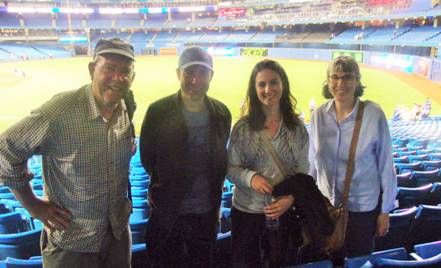
The Toronto Blue Jays baseball team plays at the Rogers Centre – popularly known by its original name of the SkyDome – next to the famous CN Tower. This downtown location meant that, for my family and me, it was only a short walk from our hotel for one of last week’s matches against the Tampa Bay Rays. It was a safe walk too, provided that we respected the pedestrian traffic signals and avoided the automobiles, buses, streetcars, joggers and cyclists as we crossed Queens Quay West; some of the last group, in their dedicated lane, would undoubtedly give Chris Froome a run for his money.

It was our first baseball game, so why not start with the Major League, in which the Blue Jays are the sole Canadian team. They entered the match with a record of .483 (from 57 wins and 61 defeats so far this year), which placed them in fifth position (out of five) in the American League East. However, with one-third of the regular season still to play, there was still a chance of a wild-card place in the play-offs, if they could put together an impressive run from their 40-odd remaining fixtures. The Tampa Bay Rays were third in the same division with a record of 59-61 (or .492).

As the game progressed, the four baseball novices started to work out the narrative from the plethora of statistics that flashed out of the multi-coloured scoreboard – notably the numbers of balls, strikes and outs in each inning. On the far side, another board registered the mounting score. The Rays stretched out to a 6-1 lead, but a home run by the Blue Jays’ Josh Donaldson cut the deficit to 6-4 by the completion of the latter’s fifth inning – the bottom of the fifth, as we baseball experts call it (I think). It turned out that this was the final score, some impressive pitching in the closing stages by the Dominican Republic–born Alex Colome denying the Blue Jays hitters any chance of overturning the deficit.

It was a spectacle that assaulted all the senses. The sights of the action on the pitch and the general bustle in the crowd and the colour of the advertisements were complemented by the loud cheering of the Blue Jays fans whenever one of their hitters made it to first base or a catcher secured a skier in the outfield. The scoreboard’s instruction to “Make Some Noise” did seem somewhat superfluous, as the roars of over 33,000 spectators echoed around the stands. Our taste buds were satisfied by the foot-long hot dogs covered in tomato – pronounced tomato – sauce, which (for two points of information) officially come in at 860 calories each and are disconcertingly difficult to eat when one is also holding a plastic glass of beer.

The SkyDome had the distinction of being the first sports stadium in the world with a retractable roof – open on this occasion, a warm summer’s evening. High in the stands is the “Level of Excellence”, which honours some of the key personnel in the Blue Jays’ 40-year history; this select group includes not only former players but also the radio play-by-play announcer, Tom Cheek, who called every Blue Jay game from the team’s inaugural fixture in April 1977 until the beginning of June 2004. Looking down from above the hitter’s plate, “42 Jackie Robinson” recognises the shirt number that was retired by every Major League Baseball team in April 1997.

From our excellent vantage point – square to the wicket in cricket parlance, in the Field Level Bases – we got a sense of the speed of the pitchers, who hurled their missiles at up to 95 mph, as instantly recorded on the scoreboard. (I gather that over 100 mph is regularly attained in the Major League). We were also impressed by a couple of spectacular catches – even allowing for the giant mitt in the catching hand (my cricketing background betraying itself again) – and, of course, by the huge hits that produced the evening’s three home runs. I also admired the speed and accuracy of the throwing from the outfielders and by the infield custodians of each base.

In terms of cricketing analogies, I must also refer to the capacity of both sports for producing some

wonderfully obscure statistical facts. When the Ray’s Steven Souza Jr went out to bat, the scoreboard stated that his first 25 home runs had all been struck against right-handed pitchers and that he was the first “righty” to have achieved this feat since 1961. Test Match Special, eat your heart out.

About half way through the game (which lasted for just under 3¼ hours), I took a walk round the stadium on the raised concourse. On one side were the beer stalls and fast-food vendors and merchandise outlets and rest rooms and, on the other, a clear view of the continuing action on the field of play. At one point, I struck up a conversation with a young cop and asked him if he expected any trouble on an evening such as this.

His answer was firmly in the negative: there might be the occasional drunk, but such a potential felon would usually see sense “when confronted by 6 or 7 of us”. I thought back ruefully to the Carlisle United-Hartlepool United football match that I had attended last autumn (reported in Still An Ordinary Spectator) when a sizeable police presence had been required to marshal the respective tribes at a fourth-tier English soccer match. Admittedly, there were only a few Tampa Bay Ray fans at the Rogers Centre (though there were some), but that is hardly the point.

The policeman and I talked for a few minutes about Toronto and baseball (which he said he absolutely adored) and soccer (which he found a bit slow) and Niagara (which he hailed from and also loved). I wished him a quiet evening and we shook hands. It was a pleasure to meet him; he was a credit to his city.

The Blue Jays played two more fixtures at home to the Rays on the following two days, by which time we had moved on to test out (and confirm) the cop’s enthusiastic promises of Niagara Falls and Niagara-on-the-Lake. The consecutive victories in these games duly raised the post-season play-off hopes. Unfortunately, the three games played over the following weekend – all against the Chicago Cubs at Wrigley Field – were lost, as was the next match against the Rays (in Tampa), so the prospects of post-season glory have promptly receded again. The Blue Jays’ World Series titles of 1992 and 1993 edge a little further into the past.

But no matter. Our allegiances within the significant component of Americana that is Major League Baseball are secured. And we bought the tee-shirts – Let’s Go Blue Jays.

Good Company and Chance Encounters

10th August 2017

For such as me, traditionalists – or conservatives or old fogies (delete as appropriate) – of English cricket, it is a source of some concern that the England and Wales Cricket Board (ECB) have hollowed out the CountyChampionship season so that, in Yorkshire’s case, only one 4-day match is being played this year between 6th July and 5th September. Of the 14 Championship fixtures (reduced from 16 last year), no fewer than 8 are being played before the end of May or from the beginning of September. The days of mid-summer are largely allocated to the powerful beast that is Twenty-20 cricket.

There was a certain inevitability, therefore, that George Farrow – a near(ish) neighbour (though resident in the wilds of Strathblane) – and I should plan to attend the four days of the Essex fixture at Scarborough. We had pencilled in the engagement some time ago, given George’s allegiance to the visitors, and the decision had been notably prescient, as Essex had established a healthy (29 point) lead at the top of Division 1. Yorkshire started the match in 4th position, 38 points behind the leaders, though perhaps equally relevantly only 36 points above the Somerset side occupying the second relegation place (and having played one more game).

We were joined for the Monday’s play – the second and, as it turned out, final day – by Andrew Carter, an old schoolfriend, whose co-presence following Yorkshire’s fortunes was a nice throwback to many a yesterday, as noted in An Ordinary Spectator. On the Tuesday evening, in the hotel, George and I had a drink with Dick Davies – the respected cricket correspondent of BBC Radio Essex – and his wife Sarah, the latter also an expert on her county’s side.

Good company.

Amongst the other spectators (around 5½ thousand on both days), there was a supporting cast of new faces who became increasingly (and eerily) familiar. On the outward train journey from York to Scarborough, George and I fell into conversation with two Essex supporters (one living in Hove and the other a native of Dundee!) and a Yorkshire member from Redcar. The latter was pessimistic, not only about the form of the home side’s batting line-up, but about the likely quality of the B&B to which the Hove man had committed. Towards the end of Sunday’s play, we met a Derbyshire supporter and his elderly father in the Scarborough ground’s tea room, whilst watching the closing overs and being fortified by the thick slices of a rather good fruit loaf. On the Monday afternoon, on the front row of the raised stand opposite the Scarborough ground’s entrance, my neighbour to the left was middle-aged man explaining the finer points of the game – in a locally prep-schooled accent (as I later learned) – to his wife.

The Redcar man’s pessimism was (partly) justified. Yorkshire’s batsmen couldn’t cope with the speed and control – and general excellence – of the Pakistani left-arm pace bowler Mohammad Amir, who took 10 wickets in the match and was ably supported by Jamie Porter who claimed 7 victims. (It is a sign of trouble when, 40 minutes into a 4-day match, the score stands at 25 for 5). Yorkshire’s totals of 113 and 150 all out rested heavily on an outstanding first innings 68 by Adam Lyth and an impressive 70 on the last afternoon by Jack Leaning. Aside from these two efforts, the runs scored in the 10 innings played by Yorkshire’s top six batsmen totalled exactly 31.

By contrast, when Essex batted, all of the top six made double figures and, batting at number 6, the captain Ryan ten Doeschate scored a well-constructed 88 to earn his side a decisive first innings lead of 118. If Essex do win this year’s CountyChampionship – and their lead at the top of the table at the end of this round of fixtures has stretched to 41 points – they will undoubtedly look back on ten Doeschate’s innings as one of the season’s defining contributions. On this occasion, Essex duly knocked off the 33 runs required for victory for the loss of two second innings wickets.

It’s a small world. As George and I walked to the ground down North Marine Drive on the second morning, we met the Hove-based Essex supporter and his mate. They had been suitably impressed by the welcome given by the Scarborough club (and by their B&B) as well as the performance of their side. Later in the evening, we also met the Derbyshire man and his father in the dining room of the hotel. The following morning – the game having finished and our plans now revised to take in a visit to Beverley Minister – we met the Hove man for a third time on our way to Scarborough railway station.

It poured with rain in Beverley and it was with some relief that we completed the short walk from the station to the Minster. The first people we met on entering the church were the pleasant prep-schooled man and his wife.

The visit to the Minster completed, George and I went for a long walk through the driving rain out to Beverley racecourse and then returned, about an hour later, to the centre of the town. There seemed to be about 25 tea rooms in which to find suitable refreshment and to dry out. We chose one on Ladygate where, seated at an upper-floor table, were Mr and Mrs Prep-School. Almost inevitably, after George and I had rested for another hour and decided to take the long sweep past the Minster on the way back to the station, we met the same couple coming in the opposite direction.

It goes without saying that, back at the hotel, the man from Derbyshire was sitting in the hotel lobby with his parents.

Perhaps these opportunities for acquaintance and re-acquaintance take place all the time and we simply don’t notice them. (I reported in Still An Ordinary Spectator of a similar experience with a neighbouring spectator at a Leeds Rhinos/Castleford Tigers Super League match in 2014, who on the following lunchtime sat down at the adjoining table in the café at LeedsCityArtGallery). It could be that the element of chance is not in the encounter itself, but in the ability to recognise it when it occurs.

For the county cricketers of Yorkshire and Essex, the opportunities for re-acquaintance are already mapped out. At present, the respective directions of travel are clearly evident: for one, the look over the shoulder to the relegation places; for the other the progress towards a Championship pennant. The final 4-day match of the season is Essex versus Yorkshire at Chelmsford.

The Wrong Ground – But A Good Game Nonetheless

26th July 2017

A Saturday afternoon in Leeds presented me with the opportunity to take in some amateur rugby league. A look at the fixture list revealed that the Hunslet Club Parkside were playing at home to the Milford Marlins: second versus third (with the top three sides separated only by points difference) in the Kingstone Press National Conference League Division 1 (which is the second tier of the nationwide amateur game). A tight match in prospect, I thought.

A 45 minute walk from the centre of the city through post-industrial Hunslet – past the warehouses and the clutch repairers and the Grade II-listed gateposts of “Boyne Engine Works, 1858” in Jack Lane – took me to the Hunslet Club, where a well-attended children’s gala was in full swing. From there, it was a short walk past some open ground to the main rugby pitches, where the two teams were warming up.

A glance at the scoreboard informed me of my location. I was at the home ground of the Hunslet Warriors, who were about to take on the Lock Lane club – in the same division as HCP and the Marlins.

Having effectively entered the Warriors’ ground through the (unguarded) back entrance, I asked the man taking the gate money where Hunslet Club Parkside were playing. He patiently explained that their ground was about a quarter of a mile away, down a path through some trees, and asked if I was still heading that way. No, I thought: this is where I have ended up and so here I will remain. I duly paid my £1-50p entrance fee plus £1 for a neat programme.

It was a good game. Playing down the slope, Lock Lane – a famous amateur club, based in Castleford – started the brighter with their prop forwards making a lot of ground. A 10-0 lead quickly opened up and I did wonder whether a half-time change of scenery to the match down the road might be in order. But the Warriors then had a period of consistent possession, aided by some ill-discipline from their visitors, and went into a 12-10 lead. Lock Lane edged in front just before the interval: 16-12.

In the second half, with the slope to their advantage, the Warriors took control and the final score of 28-16 was about right on the balance of play. Having started the day fourth from bottom of the division – with three sides to be relegated at the end of the season – this was a timely result for the home side, although it turned out that two of the three sides currently at the foot of the table also won on Saturday.

It was a hard – but, as far as I could detect, fair – game. The players looked to be well coached – running strongly, tackling aggressively and moving the ball competently through the hands. Standing behind the barrier close to the touchline provided me with a close view of the physical – and verbal – confrontations between the players, but the young referee kept a good control and only needed to brandish one yellow card towards the end of the game. The Lock Lane full back left the field temporarily with a shiner of a black eye and one of his colleagues was (uncomfortably) carried off after sustaining a first-half leg injury. He seemed to recover, however, walking gingerly down the touchline and reassuring his mates behind the barrier that he would still be fit for their planned Saturday night out.

Not all the invective was directed at the opposition. When, following a play-the-ball, a Warrior passed the ball to one of his colleagues on the narrow short side – only for him to be heavily tackled – a plaintive cry rang out from the middle of the pitch: “Will you stop doing that f…..g move?” I thought this a bit harsh: both sets of half-backs varied the play well and both hookers also distributed effectively to their willing runners.

After the match, I took a different route back into Leeds, stopping off briefly for a pint in The Garden Gate public house – another building with Grade II listed status – which houses the Hunslet RLFC Heritage Room, the opening of which I was pleased to attend in October 2014.

Later, I sought out the result of the Hunslet Club Parkside/Milford Marlins game. 24-0 to the home side: as it turned out, not such a tight match after all.

A Cricket First

25th July 2017

I was present at Headingley on Sunday when a piece of English cricket history was made. In a T20 match, Ross Whiteley of the Worcestershire Royals – a Yorkshireman, as it happens – struck 6 sixes in an over from the Yorkshire Vikings left-arm spin bowler, Karl Carver. It was the first time that this had occurred in a senior cricket match in England – Gary Sobers’s famous achievement in a CountyChampionship game in 1968 took place in Swansea – and only the fifth time anywhere, the last example being in 2007.

I hesitate to say that I could it coming. But I could – sort of – see it coming. At the beginning of the over – the 16th of the innings – Worcestershire required 98 to win from 30 deliveries, a near-impossible task, so some extraordinary striking was required. It was a good batting wicket with the shorter boundary favouring the left-hander’s shots to the leg side. I knew that Whiteley is a renowned powerful hitter, who has a track record against Yorkshire – he hit 11 sixes in an innings of 91 not out on the same ground two years ago. Moreover, he had had a sighter with the last ball of Carver’s previous over, which he also hit for six. (The unfortunate bowler was therefore dispatched over the ropes for 7 consecutive legitimate deliveries; he also bowled a wide, so that his fateful over cost 37 runs). When the second six landed in the Western Terrace, I did begin to wonder.

The Yorkshire crowd acknowledged the achievement with polite applause, no doubt whilst also doing the mental calculations as to whether their side’s apparently impregnable match-winning position was about to be lost. (It wasn’t. Whiteley was out in the next over and the home side went on to win by 37 runs). At the same time, there was undoubtedly a general feeling of sympathy for Carver; even from my distant perspective in the East Stand, it did seem that his shoulders visibly sagged as he walked away to his fielding position at the end of the over.

Earlier, David Willey had struck 118 from 55 deliveries – including 8 sixes – in Yorkshire’s total of 233 for 6: the county’s individual and team records in this form of the game. Willey and Whiteley are similar types of player: left-handed with aggressive stances at the wicket and the ability to hit cleanly, especially in the arc from long-off through to mid-wicket. Willey had warmed up for his innings by scoring 70 (from 38 deliveries) in Yorkshire’s 29 run win over the Birmingham Bears on the previous Friday evening; only 6 sixes on that occasion, but some of them massive blows, including one that disappeared over the top of the Western Terrace and out of the ground.

There were 44 six-hits over the course of the two T20 matches and these accounted for over one-third of the total number of runs scored. This suggests that there isn’t too much room for subtlety in this form of the game but, in fact, all is not lost. On Sunday, I was impressed by the range of shots played by Joe Clarke, the controlled slow bowling of Mitch Santner and Adil Rashid and the excellent “death” bowling of Steve Patterson. In both matches, the quality of the fielding and catching in the deep reflected the skill and athleticism of professional cricketers in the modern age.

And – within the broader landscape of bat versus ball and the pendulum’s swings between the one and the other – I continue to be attracted to the fine detail. At the end of Carver’s over, a number of Yorkshire’s players went over to offer support. Likewise, when Ed Barnard finally took Willey’s wicket, after the Worcestershire attack had been flayed around the ground, the bowler graciously shook his tormentor’s hand as he departed for the pavilion. Good for him, I thought.

Still An Ordinary Spectator

19th July 2017

We marked the publication of Still An Ordinary Spectator: Five More Years of Watching Sport by hosting an “All Blacks vs British Lions Breakfast” earlier this month.

The author is pictured (in the middle of the back row) with some of his guests at the launch.

The Lions’ victory in the Second Test meant that it was a double celebration.

It has to be said that a glass of Buck’s Fizz at 10.30 in the morning is a very civilised way to start the day.

An Ordinary Spectator: 50 Years of Watching Sport (2012)

Still An Ordinary Spectator: Five More Years of Watching Sport (2017)

www.anordinaryspectator.com

www.silverwoodbooks.co.uk

Elite Sportsmen at the Top of Their Game

16th November 2016

It is appropriate – for three reasons, I think – that the last in this series of post-An Ordinary Spectator blogs should be on last Sunday’s England-Australia rugby league international in the Four Nations Tournament at the London Stadium.

First, the event. It was a rugby league match between Great Britain and Australia – at Headingley in November 1963 – that was the first international sporting contest I attended. As noted in An Ordinary Spectator: 50 Years of Watching Sport, it was a violent affair, which left a deep impression on the 9 year-old boy:

“The game was one of unremitting ferocity, notwithstanding the stern discipline imposed by the referee, Eric Clay from Leeds, who sent off two Australians and the British prop, Cliff Watson. I remember sitting in the stand and being awed – and, it has to be said, somewhat frightened – by the violence of grown men”.

Second, the venue. An early entry in this collection of blogs – “Olympic Games Football: What Do I Know?” (August 2012) – recognised Glasgow’s contribution to the 2012 Olympics by reporting on two of the matches in the football tournament played at HampdenPark. This blog completes an Olympic circle by ending the collection at the main venue of that successful Games.

[An
aside. It is under some sufferance
that I refer to the venue as the London Stadium. For me, it remains the Olympic Stadium,
which, let us not forget, was funded by taxpayers across the UK, not
just in the capital. However, it
does now seem to have been fully colonised by its football tenants – West Ham
United FC – as evident in the external signage, the Bobby Moore and Sir Trevor
Brooking Stands, the listing of club honours on the balcony and the use of
claret and blue colours throughout the stadium].

But, back to the rugby. This year’s Four Nations Tournament has been contested by New Zealand and Scotland, as well as Sunday’s combatants, the England/Australia match being the last in the round-robin stage. Following the earlier matches – which, crucially, included England’s one point defeat by New Zealand – the hosts had to avoid defeat (i.e. to win or draw) in order to qualify for next Sunday’s final in Liverpool.

England were still in the game at half-time, trailing by only 6-10, having earlier taken the lead through a well-worked try by Jermaine McGillvary on the right wing. However, Australia were too good after the break, when a lethal combination of power, skill and precision produced 18 points in one 12 minute spell. Three of their five second half tries could be attributed to the strength and technique of individual players close to the England line. England scored a couple of good tries of their own through Gareth Widdop and Ryan Hall, but succumbed to the continual pressure exerted by their superior opponents. The final score of 36-18 properly reflected the contest.

It had been over 20 years since I had seen the Australian rugby league team in the flesh: a test match with Great Britain at Elland Road in 1994. Throughout this period – as also for the 20 years before that – they have generally been the sport’s dominant international team, albeit with some occasional dents in their crown from New Zealand. In the second half on Sunday, the game having been effectively decided, I was able to sit back and admire the excellence of the team – its accuracy, cohesion and relentlessness – and the individual players within it.

And so to the third reason for this being an appropriate juncture at which to draw this collection of blogs to an end. At various times in the last five years – as during the half-century before that captured in An Ordinary Spectator – I have been reminded of the pleasure in watching elite sportsmen at the top of their game. Throughout this long period, I consider myself fortunate that, even when the side I had been supporting – whether Yorkshire CCC or the European Ryder Cup team or the England rugby union side – have been second best, I have been able to recognise the brilliance of their opponents: Alvin Kallicharran and Jack Nicklaus and Gareth Edwards et al.

In terms of the rugby league players of Australia, this acknowledgement of excellence stretches back to seeing the great Reg Gasnier in that turbulent match at Headingley in 1963. It extends through Bobby Fulton in 1973 and Mal Meninga in 1982 and Brad Fittler in 1994 with others in between. And, in the present generation – on Sunday – it has now been extended to Johnathan Thurston and Greg Inglis and Cameron Smith: each now probably in the latter stages of his international career, but amongst the best to have ever played the game.

For the presentation of a series of sports blogs, that’s not a bad place to stop. If only temporarily.

A Stramash in Paisley

1st December 2014

On Saturday, I resumed the occasional tour of the football grounds of the west of Scotland that, having commenced towards the end of An Ordinary Spectator: 50 Years of Watching Sport, has been extended intermittently since the book’s publication. This time, I ventured to St Mirren Park in Paisley for the home side’s fourth round William Hill Scottish Cup tie against Inverness Caledonian Thistle. The day had begun at the annual Christmas tree festival at St Paul’s Church in Milngavie, where the musical accompaniment included a recital by Rachel Rutherford on the clarsach.

In my childhood, St Mirren was one of those names on my mother’s football pools coupon that I could not locate in the Philips’ Modern School Atlas. There were several of them across Scotland, of course – where exactly were Raith, St Johnstone, Hibernian, Third Lanark et al ? – and the subsequent discovery of their respective locations always gave me a feeling of achievement.

The St Mirren club was located in Love Street in Paisley for the 115 years from 1894. On selling the ground to Tesco in 2009, they moved to a new 8,000 seat stadium in FergusliePark. The ground is neat and compact and the spectators are close to the action. For Saturday’s cup-tie, it was barely one-quarter full, however, and, during those periods when the crowd was relatively quiet, the players’ voices echoed around the stadium. In the opening minutes, the stentorian – and quite colourful – instructions to his defence from the Inverness goalkeeper were clearly heard by those of us in Row J of the Main Stand.

The course of the game reflected the two sides’ respective positions in the Scottish Premier Football League. St Mirren are second bottom and separated from Ross County only on goal difference, having won only 2 of 14 league games so far; by contrast, Inverness are joint top of the league, behind Celtic again only on goal difference. However, although the visitors had the better of the early exchanges, it was St Mirren who took the lead just after the quarter-hour thanks to a crisp finish from Marc McAusland after Inverness had failed to deal with a corner kick.

In the second half, Inverness attacked for long periods, prompted from the midfield by the effective combination of the energetic James Vincent and the skilful Ryan Christie. I thought the latter was particularly impressive with his excellent close control and the vision for a penetrating pass with his cultured left foot. At 19 years of age, he is a player of rich promise: rather like Rachel Rutherford, perhaps, albeit in a different field. The visitors managed an equaliser with half an hour to go, but they were profligate with their other chances. The replay is in Inverness tomorrow.

My neighbour in the stand was a burly middle-aged man who was attending with his young son. After Inverness scored their goal – following another corner, when there were two headed challenges, two shots cleared off the line and another shot hitting the post before Josh Meekings fired the ball into the net – he spoke to me in an accent that originated somewhere in the Western Isles: “What a stramash! As Arthur Montford would have said: ‘What a stramash!’”. It was a comment that was absolutely fitting. It described the goal perfectly and, knowingly, it was a nice acknowledgement of the great Scottish broadcaster, who died last week at the age of 85.

I enjoyed my visit to St Mirren Park. The club remains rooted in its community and recognises the circumstances faced by many in the locality. The advertisements on the big screen included an awareness campaign for lung cancer fronted by Sir Alex Ferguson (though I don’t know if this campaign is also being rolled out across all clubs) and an appeal on behalf of one of local charities helping people “at this difficult time of the year”. The MC’s half-time pitch interview was with the four members of a local rock band – Lemonhaze – whose (quite impressive) new video was also played on the screen. “What’s next?” the MC asked, perhaps expecting a music-related response to follow up the earlier references to the band’s new single, the video and a couple of forthcoming gigs. The answer was probably more focused on the short-term that he had expected: “We’ll go for a pint after the game”.

After the match, I walked into the centre of Paisley. The evidence of post-industrial malaise is not hard to find, ranging from the derelict former home of the Paisley Provident Co-operative Society Limited, just down the road from the ground, through to the vacant areas of wasteland opposite the car-wash centre and the wholesale suppliers. But – I was reminded – this is also a town with a proud local history and architectural heritage; in the case of my walk, the latter started with St James’ Church in Underwood Road and extended through to PaisleyTown Hall, both buildings dating from the civic confidence of the 1880s.

The jewel in the crown is Paisley Abbey, of course. I entered through a side door and came across a rehearsal of that evening’s performance of Mozart and Mendelssohn by the Orchestra of Scottish Opera with the City of Glasgow Chorus. I stood for a few minutes as the notes soared high into the abbey’s upper reaches. Later, I reflected on my day’s music sampling – a clarsach rendition, a Lemonhaze video and Die Erste Walpurgisnacht: a pleasantly eclectic collection.

Later still, in the evening, BBC Scotland’s Sportscene showed the two goals from the St Mirren/Inverness match. The pundit Pat Nevin said that Arthur Montford would have described the Inverness equaliser as a stramash.

The “nano-drama” I would most like to have witnessed

6th December 2012

In An Ordinary Spectator: 50 Years of Watching Sport, I list a “First XI” of Sporting Nano-dramas that I have witnessed over the last half-century. I refer to these as “the drama of the moment – of the micro-second – in which a defining characteristic of the sporting contest is revealed… It is in these moments that sport really makes the heart pound and causes the sharp intake of breath to be made”. The book’s examples cover incidents from rugby league, rugby union, cricket, football and golf and they involve, amongst others, Geoff Boycott, Martin Offiah and Payne Stewart.

An obvious question to ask, given the contents of the list, is: “Which sporting nano-drama would I most like to have seen, live and in the flesh, either during my period of sports spectating or in earlier times?”

There is a long list of possible candidates, of course: Jesse Owens crossing the line to win gold at the Berlin Olympics of 1936, Don Bradman’s duck in his final test match innings at The Oval in 1948, Roger Bannister breasting the tape for the first sub-four minute mile in 1954, Geoff Hurst’s controversial goal in the World Cup final of 1966, Johnny Wilkinson’s winning drop goal in the Rugby World Cup final of 2003… An impossible task to select only one, perhaps.

And yet I have a clear favourite. I would go back to Saturday 26th July 1947: the first day of the Fourth Test Match between England and South Africa at Headingley.

This was the first post-war test match to be played at Yorkshire’s headquarters, the previous game having been against Australia in 1938 when Bradman had made a mere 103 to follow his Headingley triple centuries of 1930 and 1934. The series stood at 2-0 to England with two matches to play. Norman Yardley, a Yorkshireman, captained the England team.

South Africa batted first and were bowled out for 175 allowing the England openers – Len Hutton and Cyril Washbrook – to begin the home side’s innings with an hour to play on the first evening. The scene is beautifully described in John Marshall’s Headingley, published in 1970:

“Hutton and Washbrook walked, apparently quite unconcerned, to the wicket. The crowd gave them all the encouragement of which a fervent Yorkshire crowd is capable, and that is plenty. After applauding the pair all the way to the wicket, there was a very special burst, taken up all round the ground, as Hutton took guard”.

The nano-drama I would most like to have witnessed is that moment when Len Hutton takes guard and the applause rings out from all corners of Headingley. 65 years on, I find it both immensely moving and hugely symbolic.

At one level, it was about Len Hutton and Yorkshire cricket. Although he had made his record test match score of 364 as long ago as 1938, the Second World War had of course severely interrupted Hutton’s career and the 1947 South Africa game was his first test match at Headingley. The Yorkshire crowd had come to cheer on their own son, much as they would do in a slightly different way – and as described in An Ordinary Spectator – when Geoff Boycott made his 100th first class century on the same ground against Australia in 1977.

But there was more to it, I think. It was also about a sporting occasion reflecting the society around it. By July 1947, the war in Europe had been over for over two years, but, for the British, there was now a stark realisation about the long economic struggle ahead. It was a time of austerity and rationing. The heavy rain that interrupted that year’s Headingley test match was an apt reflection of the greyness of the times.

However, it was also a period of hope. Hitler’s Germany had been defeated. Families had been re-united. A baby boom was underway. People could look forward to peaceful times. The policies being enacted by the post-war Labour Government – including the nationalisation of key industries and the creation of a National Health Service – would lead, it was believed, to the New Jerusalem.

Marshall’s “special burst” of applause, as Hutton was taking guard, reflected all these aspects of the Headingley crowd’s psyche: the pride in the local hero, the gratitude that they had survived the long ordeal of war, the desire that things revert to what they had once been, the hope for the future…

This particular nano-drama dates from some 14 years before the beginning of the narrative of An Ordinary Spectator. It was also 7 years before I was born, so I have some excuse for not being present. However, the writings of another readily create a poignant mental image of the occasion and its central character.

Postscript

Len Hutton was dismissed for exactly 100 on the following Monday. (Sunday was a rest day). John Marshall states that, when Hutton reached his century, “[t]he noise of [an earlier] thunderstorm was a gentle rumble compared with Yorkshire’s tribute to the Pudsey lad”. England won by 10 wickets on the third day.