A Good Day in Morley

1st October 2018

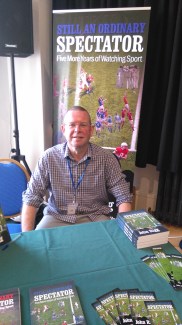
Last Saturday, Angela and I were in the Church of the Nazarene in Morley for the Indie Book Fair, part of the 2018 Morley Arts Festival. It was a good day – well-organised, nice venue, friendly people – and I was delighted to give a short reading from An Ordinary Spectator. A few sales added to the warm glow.

Of the 20 or so tables around the inside of the church, mine was one of 4 or 5 non-fiction displays. To complement the Yorkshire murder mysteries, stories for children and poetry collections, there were offerings on living in Africa, coping with a parent’s dementia and (clearly knowing its immediate audience) the pros and cons of independent publishing. Inspection of the products on show – confirmed by chats with the individual authors – left one in no doubt that all the books represented considerable effort and dedication; they were, by turn, imaginative and well-researched and attractively packaged.

The Church is situated at the top end of a large supermarket car-park and so there was some passing interest from the more inquisitive of the Saturday shoppers as well as the obvious support from those with connections to the authors themselves, many of whom were locally based.

I think it was the eclectic nature of our casual engagements during the day that I enjoyed the most: the middle-aged woman whose father had been a keen supporter of the Batley rugby league club; the eight-year boy who showed us a story he had made up, complete with illustration, involving goalkeepers and zombies; the elderly lady, pushing a shopping trolley, who informed us that her cataract operation had been postponed three times; the polite schoolboy who played at prop forward for one of Morley RUFC’s junior teams; the ex-Army man, whose book related his friend’s family stoically coping with their daughter’s Rett Syndrome… We learned some things during the day and we were the better for it.

One man – about my age – spent some time examining copies of An Ordinary Spectator and Still An Ordinary Spectator. He read the back cover blurbs closely and studied the contents pages and glanced at some of the text. He checked the price list I had on display, which included the discount for a double purchase. He then replaced both books and nodded politely and set off on a tour around the Church to look at the other wares. Some time later, on completing his circuit, he returned to my table, smiled gently and duly bought both books. As I signed them for him, I must have given a knowing smile myself; his cautious approach to considering and reflecting on and then completing the purchase was exactly as I would have done.

It was just before 4 o’clock that we dismantled the table and banner and, carrying lighter boxes than when we arrived, made our way back across the car-park. As we did so, I heard the brief – but discernible – roar of a crowd. It turned out that Scatcherd Lane – the home ground of Morley RUFC – was only a couple of streets away and that there was a match in progress.

I looked up the details later. Morley now play in the Northern Division’s North 1 East League: the sixth tier in the hierarchy of English club rugby. On Saturday, they defeated Driffield by 39 points to 7. The young prop forward would have been pleased.

Hier Stehe Ich

22nd September 2018

There is a tenuous sporting connection to this blog, as discussed below.

My sister, Rosie, and I have recently spent several days in the Niedersachsen (Lower Saxony) Land of Germany visiting some of the places associated with our family history. Our grandfather, Alfred Edgar Niblett, was born in Osnabrueck in 1888 to an English father, Charles James Niblett, and a German mother, whose maiden name was Anna Karoline Borstelmann.

It was a highly successful trip. I knew that Anna Karoline Borstelmann died in Ludwig Strasse in Osnabrueck in 1938 at the age of 84. The city’s cemetery authority had previously informed me that the street no longer exists, but, in a local bookshop, I came across a map of the Osnabrueck tram system of 1906 on which the location was marked. It is now called Ludwig Baete Strasse (after a 20th Century writer and historian) and is a pleasant tree-lined street of post-Second World War housing.

In the small town of Elze, to the south of Hannover, we visited die Peter und Paul-Kirche, in which Charles and Anna had married in 1873. It was curiously empty on the Sunday lunchtime, apart from two middle-aged women – the organist and a singer – who held a long practice session, perhaps 40 minutes or so, for the time we were there. The melodic sounds resonated down from the balcony and around the clean white walls of the church’s interior.

Outside, I found the statue of Martin Luther, erected in 1883 on the 400th anniversary of his birth, to be both powerful and moving. The inscription read: Hier stehe ich. Ich kann nicht anders. Gott helfe mir. Amen! “Here I stand. I can do no other. God help me. Amen!”. This is reputed to have been Luther’s statement to the Holy Roman Emperor, Charles V, at the formal hearing in Worms in 1521. (In his monumental A History of Christianity, published in 2009, Diarmid MacCulloch notes that the phrase was only attributed to Luther after his death by the editor of his collected works).

For the following day, we had hired an excellent local guide – Almuth Quehl – to show us around the village of Kirchwalsede and the town of Visselhoevede, including the two beautiful parish churches. At the former, Almuth had arranged for us to see some of the original church records. We started by finding the baptism record of Anna Margreta Marquardt – the mother of Anna Karoline Borstelmann’s father, Johann Friedrich Borstelmann, (and my great (x3) grandmother) – in 1772. I felt the lump in my throat as I saw her name on the page: I just about held it together.

I have previously spent some time examining the comprehensive online database of Lutheran church records in Niedersachsen and was familiar with the long direct family line that goes back through the Marquadt, Lange, Dieckhof and Henke families to the baptism of Harm Henke in 1582. We looked up some of the other original records: the burial of Gert Dieckhof in 1713, the burial of Casten Henke in 1691, and so on.

An unexpected bonus was that the written records contained additional information. Even in the Lutheran church, the type of service was, to some extent, dependent on the amount spent by the worshippers. Hence, the burial of Anna Marie Henke in 1711 was accompanied by “a sermon from the pulpit”. Elsewhere, the causes of death were given: the unfortunate Johann Lange died at the age of 56 three weeks before the Christmas of 1686 when a stone fell on him as he was digging a hole (presumably in the graveyard).

The baptism of Harm Henke in 1582 was, of course, relatively early in the history of the Protestant Church; it had been only two generations earlier that Luther had nailed his 95 Theses to the door of the Castle Church in Wittenberg. Or, to put it another way, it was six years before Philip of Spain sent his Armada into the English Channel. As I looked around the church in Kirchwalsede, its interior neatly decorated with flowers from a recent wedding, I was aware that, even though it had been modified and repaired many times over the centuries, this was still the space in which my great (x9) grandfather had lived and breathed. And it was now, in a different context to Luther, that here I stood.

On the Tuesday, our family researches completed for the time being, Rosie and I did the tourist run in Hannover. The bus tour took us past the Eriebnis Zoo and out to the Royal Gardens of Herrenhausen. Towards the end of the route we passed the HDI Arena – the home of the Bundesliga 1 side, Hannover 96 – the street in front of which is called Robert Enke Strasse.

Robert Enke was a goalkeeper who played for Hannover 96 for five years from 2004. He also played for Benfica and Borussia Muenchengladbach, amongst other clubs, and won eight caps for Germany. He took his own life in 2009 at the age of 32. (The excellent A Life Too Short: the Tragedy of Robert Enke by Ronald Reng, published in 2011, is a detailed and poignant biography).

After the bus tour, Rosie and I briefly went our separate ways and I paid my three euros to take the escalator to the top of the dome of the Neues Rathaus (the New Town Hall) for the views across the city and the surrounding plains. Then, in the late afternoon, I walked back to the football stadium, even though I knew that the gates were closed and access was not possible. (This was an obvious flaw in the schedule I had planned: Hannover 96 are at home to Hoffenheim next Tuesday). As I returned to the hotel, I attempted to marshal the conflicting themes that the overall visit had generated in the back of my mind.

There is an obvious point about continuity and longevity, even amongst the turmoil and destruction that the centuries have brought to this part of the world. The Rathaus in Osnabrueck, heavily damaged in the Second World War, has been repaired to the Late Gothic design of the 1512 original; it was where one of the treaties of the Peace of Westphalia was signed in 1648 to bring an end to the Thirty Years’ War. In Bad Muender am Deister (where my great (x2) grandmother, Anna Perlasky, was born in 1829), the door of the imposing Steinhof is dated 1721 and names the family who owned the property at that time. Even in the Marktkirche in Hannover, also destroyed in the War and impressively rebuilt in red brick subsequently, the striking triptych at the altar dates from 1480.

The theme of continuity is also evident in the robustness of the family line in Niedersachsen, irrespective of whichever of the various armies – Swedish or Napoleonic or Hannoverian or Prussian – have marched through the territory to claim the land. The local inhabitants – farmers, shepherds, builders, et al – got on with their lives and raised their families and prayed to God and kept going from one generation to the next.

At the same time, I am conscious that there is also transience and fragility. In this respect, although I have mentioned the late goalkeeper of Hannover 96, I doubt that – on reflection – this is a blog about sport at all, not even tenuously. If it is, it is only a reflection of sport’s peripheral place in the much grander scheme of things.

Rather, I might suggest that the blog is principally about connections and relationships and how, against the deep background of the long centuries, there is an inevitable impermanence to our being – whether 32 years for Robert Enke or 56 years for Johann Lange or 84 years for Anna Karoline Borstelmann. We all dip our hand in the flowing stream – some just a finger, others up to the wrist – and, in the rippling of the water, we leave the memories and traces for those that are left behind.

Geographical Shifts

4th September 2018

“We went to the terraces that were situated in front of the Lowfields Road stand… I was immediately struck by how green the grass was and how boldly the whitewash and the goalmouth stood out…

…Once the match kicked off, I noticed that the spectators around me did not seem to have much patience with the Leeds [United] team’s efforts. They were not interested in fancy routines or intricate manoeuvres. They wanted instant results. Specifically, they wanted the ball to be deposited in the Charlton net and, when Leeds eventually put it there, it triggered a paroxysm of unbridled celebration from everyone on the terrace. It was the only goal of the game, but it was sufficient to meet the demands of the local supporters”.

[An Ordinary Spectator, pp 103-104]

I was relatively late coming to live soccer. My father had given me my rugby league baptism (Hunslet vs Whitehaven) at the age of 6 in 1961 and taken me to watch Yorkshire play cricket (in the Roses match at Headingley) in 1966, but it was not until 1968 that I caught up with Leeds United at Elland Road . September 4th 1968 to be exact – 50 years ago today.

Dad had no real interest in soccer – and was certainly not a Leeds United supporter – and so it was with some friends after school that I attended a relatively low-key match: a second round Football League Cup tie with Charlton Athletic.

I described my initial impressions of the occasion in An Ordinary Spectator. My main interest was in seeing the individual players and, unlike the major clubs’ approach to the equivalent tournament today, there was little doubt that Leeds would field a near full-strength side. I duly made a mental note of the famous names – Bremner, Charlton, Hunter et al – that I was seeing for the first time, live and in the flesh.

In the book, I also recognised how the match programme (price one shilling) now registered as a historical record of the times. In particular, the Club Notes included a piece on how the arrangements for the second leg of Leeds’s Inter Cities Fairs Cup final – the away tie with Ferencvaros of Hungary – which had been held over from the previous season, were somewhat uncertain because of “the Czecho-Slovakia-Russian political events of the last few weeks”. (The Russian tanks had rolled into Czechoslovakia a fortnight earlier). The club was using all the available means “to ascertain the situation, by telephone and cable”.

I will return to the Leeds/Charlton match programme below.

If I were to summarise my approach to watching soccer over half a century, I would describe it as opportunistic. I have not had the pleasure (or burden, delete as appropriate) of fervently supporting a particular side and so most of the games I have attended have been from a genuinely neutral perspective.

The venues have been determined by a variety of factors: where I happened to have been living (Cambridge United at the Abbey Stadium, Wimbledon at Plough Lane ) or visiting ( Ipswich Town at Portman Road ) or just passing through ( Leicester City at Filbert Street on the way back to Cambridge after playing cricket in Loughborough). There have also been the occasional sojourns on foreign holidays (for home fixtures of Bayern Munich, Hertha Berlin and Espanol in the respective Olympic Stadiums of Munich, Berlin and Barcelona ). These days, I have an eclectic approach to day-trips from my Milngavie base, mainly to Scottish venues (Dumbarton, Stirling Albion, Albion Rovers), but sometimes further afield (Carlisle, Newcastle, Berwick).

Looking back at the Leeds/Charlton match, one point that is of interest is the status of the two teams at the time. Leeds United were the current holders of the League Cup – their first major trophy – having defeated Arsenal at Wembley the previous Spring. The side would go on to lift the Football League Championship for the first time that season. Charlton Athletic came into the match as leaders of the old Second Division, though they were to finish third and outside the promotion places. In 2018-19, fifty years on, Leeds have been outside the top division for 15 years, whilst Charlton are now in League 1 (or League Division Three in oldspeak).

More generally, half a century of promotion and relegation has produced its inevitable churn in the hierarchy of English football. Of the 22 teams in the 1968-69 First Division, 13 are in the 20-side Premier League of 2018-19, 7 in the Championship and two (Sunderland and Coventry City) in League 1. Further down the pyramid, the fates of the teams in the Third Division of 1968-69 vary from those now in the Premier League (AFC Bournemouth, Brighton and Hove Albion, Watford) to the 6 clubs that are no longer in the Football League at all.

The drop-outs are particularly revealing, I think, because their composition is an echo of the broader economic shifts in the country as a whole over the last five decades. Of the 92 teams in the Football League in 1968-69, 15 are no longer in these top four divisions and, of these, 12 were situated above the Wash-Severn line. Their replacements include only 6 sides from this large region, the remainder being found largely in the more affluent South East.

We can stay with this theme. Yorkshire has lost three clubs from the Football League of 50 years ago – Bradford Park Avenue, Halifax Town and York City – without replacement, whilst several of the other departures have been from geographically remote locations (from the rest of the League’s perspective) such as Barrow, Workington, Darlington and Torquay. (The accession of Yeovil Town slightly redresses this point).

I make these observations without comment, as it could be argued that the “old” Football League was top-heavy with sides in the North of England and some sort of regional re-balancing was needed. Moreover, the arrangements for promotion and relegation to the League have been based on a meritocracy for many years, rather than the old system of election or re-election by the other member clubs.

Finally, back to the match programme for Leeds United vs Charlton Athletic in 1968. I mentioned in An Ordinary Spectator that stapled within it was the “Official Journal of the Football League” – the Football League Review – which I assumed to have been attached to all clubs’ programmes in a given week. It looked worthy and dull and, at the time, I didn’t read it.

I did look at this for this blog, however, and some of its contents are not a pleasant read. Quite apart from examples of casual sexism, there is one reference – in the “Opinion” column of Walter Pilkington of the Lancashire Evening Post – to the population of Bradford which is frankly grotesque.

I mention this not to make an obvious point about the social mores of a past age and the differences in what was/is considered acceptable then and now. Rather, it is to illustrate how difficult it is – from the perspective of today – for me to make sense of the occasion of my first exposure to live soccer 50 years ago.

On the one hand, much remains absolutely crystal clear, as if I had watched Leeds United play Charlton Athletic yesterday: the state of the pitch, having to continually jerk my head to get a line of sight from the shallow terrace, the passion of the crowd…

And yet, in other respects, it does seem such a long time ago.

A Unique Sporting Career

1st September 2018

The concurrence of the Rugby League and Association Football seasons for most of the 20th Century suggests that one would struggle to find players who had combined the oval ball with the spherical one at the professional level. However, there is one example from over a century ago which is quite remarkable.

David “Dai” Davies, born in Llanelli in 1880, was a teenage rugby prodigy. He was a member of his home town rugby union side that lost only one of its 31 matches under the captaincy of Owen Badger in the 1896-97 season, playing at half-back. He signed for Swinton (for £20) in 1899, playing his first match in a winning side at Widnes. (Badger had preceded him to Swinton, having signed for £75 in 1897, though he had subsequently returned to Wales).

Within a year, Davies was a member of a victorious Northern Rugby Football Union Challenge Cup final team. Swinton won the trophy on 28th April 1900 by defeating Salford 16-8 at the Fallowfield Stadium in Manchester, Davies himself scoring one of Swinton’s four tries.

The following Monday’s Manchester Courier and Lancashire General Advertiser reported that the final had been “a great struggle” on “a fine day of bright sunshine with a breezy coldness in the air”. A “vast crowd of good-humoured and light-hearted sportsmen” – just under 18,000 paying spectators – had seen Davies score “a clever try”, which had been the last of the match and taken Swinton to their unassailable lead. However, perhaps the key moment in the game had been in the first half when, after a “regrettable incident” of “rough play”, the Salford forward William Brown was sent from the field.

In his authoritative Rugby’s Great Split (1998), Tony Collins has reported that the Swinton players’ winning bonuses ran to ten shillings in the first round, £1 in the subsequent rounds and £5 in the final. These were the rewards, therefore, for accounting for Eastmoor, Holbeck, Oldham, Broughton Rangers and Leeds Parish Church before the victory over Salford.

As ever, the contemporary newspaper reports enable us to place this major sporting occasion within its proper context. The dominant feature of this edition of the Manchester Courier was its detailed update on the progress of “The War” – the Second Boer War (1899-1902) – under a series of stirring sub-headings: “Fighting North of Bloemfontein”, “Dalgety’s Dramatic Stand”, “The Flight of the Boers”…

Remarkably, Dai Davies changed sports in 1902 and played for the next seven years in goal for Bolton Wanderers. What prompted his shift in allegiance is not clear – especially as he is reported to have had no previous experience of soccer at all – though one suspects that household economics came into it. He married Annie Salt in 1902 and they were to have a son the following year Tony Collins notes that, in the early years of the century, rugby league was in a generally poor financial state, whilst soccer was enjoying a boom period.

Bolton were relegated to the Second Division at the end of Davies’s first season, but they reached the FA Cup final in April 1904, when they were beaten by Manchester City. Another Welshman, Billy Meredith, scored the game’s only goal. The Bolton Evening News reported that “Davies made one or two daring saves that at once made him popular… [though] he was helpless with Meredith’s scoring shot”.

As he guarded the Bolton goal, Davies must have had a clear awareness of the contrast in the size of the respective sports’ premier events. The crowd at Crystal Palace was in excess of 61,000. Moreover, whereas the 1900 Challenge Cup had been presented to the winners by the wife of the President of the Northern Union, the guest of honour at the football showpiece was none other than the Prime Minister, Arthur Balfour.

It was also in 1904 that Dai Davies became a soccer international, playing for Wales against Scotland and Ireland in the British Championships. He followed this up with an appearance against England at the Racecourse Ground in Wrexham in 1908. The circumstances of the last of these were highly unusual for the time, as Davies, having only attended the match as a spectator, came on as a half-time substitute. The Welsh goalkeeper Leigh Roose was injured in the first half and Davies was allowed to fill in with the home side 0-4 down; the final score was 1-7. The Manchester Courier reported that, although he was beaten three times, he “brought off some capital saves”.

The soccer databases reveal that Davies played 123 times for Bolton Wanderers between 1902 and 1909: contemporary reports state that he was a “tough individual” who had an “indifference to cuts and bruises”. During this period, Bolton were the archetypal “yo-yo” side: promoted back to the First Division in 1905, relegated in 1908, promoted as Second Division champions in 1909. By the time of the next relegation in 1910, Davies had reverted back to rugby league, having re-signed for Swinton. He re-entered the team in a 0-16 defeat at home to Wigan on New Year’s Day.

Davies had represented his adopted county of Lancashire three times in 1900-01 and his return to rugby league brought him further honours. In December 1910 – playing with his brother and Swinton club colleague, Dan – he scored a try for the Wales side that lost to England by 13-39 in Coventry. (The England-Wales fixture was an regular event in the pre-First World War period, the former winning 7 of the 9 fixtures between 1908 and 1914). In the same month, Davies captained Swinton in their first Lancashire Cup final, when they were narrowly beaten by Oldham in Broughton.

The 1901 Census of England and Wales formally records the 20 year-old David Davies as a “fitter’s labourer” resident as a boarder in a house in Swinton. However, for the corresponding entry 10 years later, his sporting prowess was given full rein: a “publican and professional footballer” living in Salford with his wife Annie, younger brother Garfield and 8 year-old son, also Garfield.

In September 1913, Davies was transferred on a player exchange to Leigh for whom he made his debut (again against Wigan) that month in a game that, according to the Leigh Chronicle and Weekly District Advertiser, “provided a series of sensations which kept 9,000 spectators at fever pitch”. (An aside. The newspaper also provided a report on the reciprocal ‘A’-team match between Wigan and Leigh, where the attendance was no less than 3,000).

Although Wigan – with “a very strong Colonial and South Wales element in their team” (i.e. 4 New Zealanders and 5 Welshmen) – won the match 25-14, the Leigh Chronicle was clearly impressed with the local side’s new acquisition. Davies was “…a master of strategy… not only does he pass beautifully, but he has a tremendous kick with him”. Interestingly, the match report also referred to Davies’s build – which was sizeable for a half-back at 5 ft 11 ins and 13 stone – as being “very useful”.

Unfortunately, Davies’s career was brought to an end by injury not long afterwards. By the time of its end of season review in April 1914, the local newspaper had revised its opinion of the early-season player exchange: “Dai Davies… only played in about five matches. Leigh had the worst of the bargain by a long way”.

Davies remained in Lancashire in later life. He died in Salford in June 1944 at the age of 64, two months after the death of his wife. They are buried in Swinton Cemetery.

Dai Davies was not only a dual international in rugby league and soccer, but also a participant in the two major Cup Finals in these sports. His was a unique and extraordinary sporting career, the high-level versatility of which – arguably – approaches those of his near-contemporaries Andrew Stoddart (1863-1915) and CB Fry (1872-1956).

Today, it is Stoddart and Fry who are much better known. Their attainments were indeed mightily impressive – the former a dual captain of England at cricket and rugby (before the Great Split of 1895); the latter variously England cricketer and footballer, FA Cup runner-up with Southampton FC (in 1902, two years before Davies’s appearance in the final) and one-time world record holder for the long jump – and, unlike Davies, they duly have their column inches in the voluminous Oxford Dictionary of National Biography.

Of course, Dai Davies was operating in a different social milieu. By definition, his was not the world of the “Amateur” or the “Gentleman”, but the hard-nosed professional. It is clear that, in terms of national recognition for sporting achievement in that environment, the bar was deemed to have been set much higher.

The details of Dai Davies’s exploits are not lost, however. Some of the information presented here – rugby as well as football – comes from Gareth Davies and Ian Garland’s excellent Who’s Who of Welsh International Soccer Players (1991) and this has been supplemented by useful data sources such as Michael Joyce’s Football League Players Records, 1988 to 1939 (2004) and the splendid website of the Swinton Lions Supporters Trust (www.swintonlionsrlc.co.uk).

It is something of a detective exercise to put the complete picture together, however. Dai Davies’s is a remarkable story of sporting achievement and it deserves to be better known.

Two Wheels Good – Part 2

13th August 2018

In Still An Ordinary Spectator, I note that my attendance at some sports events over the years has been based on a straightforward principle: the event was in the general vicinity of where I was living and there was no excuse not to go. Hitherto, the most extreme example occurred in April 2015, when I walked to the end of our street – literally – and crossed over the Auchenhowie Road to the Milngavie and Bearsden Sports Club, where I watched a couple of matches at the Western Wildcats Hockey Club.

For last Wednesday’s Women’s Time Trial at the 2018 European Cycling Championships, I did not even have to go that far, as the course actually included Auchenhowie Road, which I did not need to cross.

It was 9.30 in the morning. We were in a group of about 50 – adults in their cycling gear (“Newcastle West Cycling Club”), young children with their bikes and crash helmets (and parents), some elderly ladies, a keen photographer crouching on his haunches – together with the volunteer stewards and a couple of policemen.

The junction with Glasgow Road was a good spot from which to observe the race. It was a tight right-handed bend, which forced the cyclists to decelerate as they came up from Waitrose before speeding up again along another fast stretch. The light rain and dampened road added to the technical requirements. A couple of riders misjudged the turn and brushed their arms against the spectator barriers.

The 34 competitors had set off at one-minute intervals from the centre of Glasgow, but a number had already changed their places in the irregular procession before they reached us, just over one-third of the way along the 31 kilometre course. One of these was the winner of the event for the last two years – Ellen van Dijk of the Netherlands – who had been the last to depart. After we returned home, we learned that Van Dijk had completed the hat-trick, defeating her compatriot, Anna van der Breggen, by two seconds.

For the Men’s Time Trial, after lunch, we had to walk about 100 yards further on to the Glasgow Road to observe the cyclists make their way towards the traffic lights at St Paul’s Church and up the hill leading to Strathblane. (Their route was 45 kilometres). Although our phase of the race was greeted by pleasant sunshine and a light breeze, the local vagaries of the weather meant that the final run into Glasgow was met with squally rain. As with the morning’s race, the defending champion held on to the title by a very narrow margin: Victor Campenaerts of Belgium was judged to have outpaced the Spaniard, Jonathan Castoviejo, by less than one second after more than 53 minutes of racing.

An obvious feature of the week’s cycling at the Championships was the huge variety of events that were included. For example, although the participants in the Time Trials had their advisors in the support cars and their on-bike computers to inform them of their progress, I sense that it is essentially a solitary pursuit: the rider by himself/herself over a long haul, judging the conditions, sensing whether the speed is fast enough, coping with the pain, dealing with the inner demons…

Contrast that with BMX Cycling. On Friday, we took in the Qualifying rounds of that sport’s European Championships at the Glasgow BMX Centre in KnightswoodPark.

Previously, I had only caught glimpses of BMX racing on television, where it comes across as fast and frenetic and intimate, with the rider in a chaotic maelstrom with the other competitors. I can report that it comes across as exactly the same when viewed in the flesh, but also with its own requirements for skill and control and – in a slightly strange way – with its own elegance.

The stands were nicely full in the early afternoon sunshine and I was not surprised to see many young children – boys and girls – eagerly and attentively watching with their parents. The prospects for the sport look good, if these are the enthusiasts of the future (as well as the present), perhaps to the detriment of the numbers participating in older traditional ball games.

The course started with a precipitous 8 metre descent – I’m afraid that I wouldn’t have got beyond that point, especially at the riders began by pedalling furiously on the way down to build up their momentum – and then ran over 400 metres of variable humps and bumps on four parallel straights bounded by three 180 degree curves. In these Qualifying rounds, the Men’s heats (or Motos) comprised 3 series of ten races; the Women had 3 series of four.

The MC provided a running commentary from the side of the track, his enthusiasm consistently revealed. The British rider Kye White won one of his heats having “crept up like a tiger stalking his prey”. Later, another rider “just got squashed at that corner a little bit”. However, I did think that, at times, the presentation was somewhat rushed; it would certainly have benefited from having individual introductions of the riders and their nationalities before their first appearances.

The races came thick and fast: 42 in an hour and 20 minutes, even with a lengthy hold-up after the rider representing Germany, Liam Webster, had taken a heavy fall. Indeed, one race started before the previous one had technically finished, as another faller had remounted his bike and was just completing the final straight when his pursuers were hurtling out of the start-gate. Incidentally, I was captivated – somewhat morbidly, I admit – by the start itself: the release of the gate following the dull tone of the hooter sounded as if the executioner had pulled the lever of the trapdoor.

Both the Men’s and Women’s World Champions – Sylvain Andre of France and Laura Smulders of the Netherlands – were present and both won their three Qualifying races, although the latter’s younger sister, Merel, did seem to ease up when favourably placed against her in two of them. The following day, the elder Smulders retained her European title. In the Men’s final, Andre finished third behind the tiger, Whyte, and Kyle Evans of Great Britain, who took the gold medal.

My appetite for the Men’s Road Race around central Glasgow yesterday had been whetted by the Women’s race on the previous weekend. (“Two Wheels Good – Part 1”, 7th August 2018). It was the same 14 kilometre course, though the men had to complete 16 laps rather than nine: the equivalent, I suppose, of their respective tennis counterparts playing 5- and 3-set matches at Wimbledon.

We took up positions at various vantage points throughout the city centre: Buchanan Street, St Vincent Street and West George Street (as the week before), the bend leading into the final straight at Glasgow Green, the bottom of the long sweep down the High Street, the short but steep incline of Montrose Street… It was at this last point, about half-way through the race, that we saw that the World Champion and pre-match favourite, Peter Sagan of Slovakia, was suffering from some sort of mechanical trouble and falling behind the peloton. He recovered to join its tail end, but did not last much longer, dropping out with six laps to go.

From the start of the race, a group of seven riders (later reduced to six) broke away from the main field; at one point they had a lead of over five minutes. After they had been reeled back in, another breakaway formed of ten riders. We viewed them at Charing Cross as they headed out to KelvingrovePark and the West End for the last time. On their return, a few minutes later, there were only five: the result, it transpired, of a crash at the far end of the course. It was from this select group that Matteo Trentin of Italy was to win the final sprint for the line on the Green.

It was a gruelling race: nearly 6 hours in drizzly conditions on a wet surface. I would guess that considerably fewer than half the starters completed the course. Amongst the steadily reducing peloton, the grimacing faces were progressively darkened by their continuous exposure to the sprayed wet dirt of the city streets; on their final lap, they looked like miners emerging from their underground shift.

Behind them, the individual stragglers looked to any means to circumvent the rules and ease their passage; slipstreaming behind one of the support cars was not uncommon. I noted that, on two separate occasions, one of the riders from eastern Europe firmly grasped a water bottle being held out of the window of his support car (and did so for some time) as he struggled up a long ascent. “He’s got a sticky bottle”, exclaimed one of the stewards, sarcastically, “He’s not even pedalling”.

I knew it was against the rules, but – perhaps I am getting soft – I also sensed where my sympathies lay. The rider had negotiated over 200 kilometres on a dreich day on a demanding course; he was detached from the remainder of the field; his body would have been sore; and he was a long way from home. I cannot say that I would not have done the same.

Two Wheels Good – Part 1

7th August 2018

This is the first occasion on which several sports are holding their European Championships in the same cities at the same time. These arrangements are currently being inaugurated in Berlin and Glasgow. The former has the athletics and “Glasgow” has everything else (though its catchment area has been liberally expanded for this purpose): golf (in Gleneagles), rowing and triathlon (both in the Strathclyde Country Park), swimming, diving (in Edinburgh) gymnastics and cycling.

On different occasions this week, various members of the family are accompanying me at a range of cycling events: yesterday evening’s programme in the Sir Chris Hoy Velodrome, tomorrow’s Men’s and Women’s Time Trials through the streets of Glasgow and East Dunbartonshire, the Men’s and Women’s Road Races on successive Sundays and Friday’s qualifications races in the BMX events. We are currently part-way through the programme.

The Women’s Road Race took place over 9 laps of a 14 kilometre circuit through the city, starting and finishing on Glasgow Green. The proximity of the long straight stretches of St Vincent Street (on the outward journey to KelvingrovePark and the West End) and West George Street (on the return) meant that we could flit between the two without having to wait long for the caravan to pass. Both roads are also fairly steep – a regular feature of the course – so we had good views of the cyclists on both a demanding incline and a speedy descent. Elsewhere, we also took in the perspectives from the front of Queen Street Station, where the riders emerged from a chicane skirting the church of St George’s Tron, and the pedestrian precinct in Buchanan Street, close to where the much-missed Borders Bookshop used to be.

The anticipation of seeing the riders pass by for the first time brings its own excitement. The preliminary vehicles come through – the race announcer with the Baptist’s promise of the imminent coming, the safety vehicles, the police outriders, the mounted members of the press et al – and then there is the gentle whoosh as the peloton glides by, the softness of the sound brought about by a combination of the wheels on the road and the streamlined passage of the riders through the air in the canyon created by the city-centre office blocks. Then, more tour officials’ cars and police motorcycles and the teams’ support vehicles – Skoda seem to have cornered much of the market – with the spare bikes on the roofs: Denmark, Slovakia, Ireland…

A group of five riders broke away on the second circuit but, by the time of our Buchanan Street viewing on lap five, the young British rider Sophie Wright had established a lead of about 35 seconds over her nearest rival with the main group further behind by over a minute. The game can change quickly, however. By the time we had returned after a quick sandwich in Eat (on the seventh circuit), Wright had been reeled back in and her brave adventure thwarted. The race was won by the Italian, Marta Bastianelli, just ahead of the Dutch World Champion, Marianne Vos.

The Dutch featured prominently at the Velodrome on the Monday evening, winning two of the three gold medals and one of the bronzes up for grabs. We saw the last two (of the four) stages of the gruelling Women’s Omnium event, in which the first two places were contested by the veteran Kirsten Wild and the local favourite, Katie Archibald from Bearsden.

Archibald brought about the loudest roars of the evening when she won the final sprint of the Elimination stage of the Omnium and a couple of the intermediate sprints in the 80-lap (and 20 kilometre) finale to the event, but Wild skilfully tracked her throughout the latter race and ensured that she extended the points lead that she had established in the earlier rounds. The Netherlands national anthem was then repeated as the powerful Jeffrey Hoogland won the final of the Men’s Sprint by defeating the German, Stefan Botticher.

Indoor track cycling has its own captivating – almost mesmeric – qualities as the eye follows the riders around the circuit. It is also no place for the faint-hearted. Three of the Omnium riders took heavy tumbles during the course of the evening (one of them twice), but all got back on the horse and resumed their journeys. I was amazed that there weren’t more crashes, given the speeds being reached and the continual jockeying for position. I thought of a murmuration of starlings soaring and diving: each member in control of her individual space whilst being part of the larger whole.

The spectators in the Velodrome, most of whom were obviously rooting for Archibald, were generous in their support. They acknowledged the courage of the riders who had taken a tumble and, later, dutifully stood (with only one or two exceptions) for the Russian anthem when Maria Shmeleva swept home in the Women’s 500 metre Time Trial.

Of course, the Velodrome audience had – one assumes – chosen to be there. For the Women’s Road Race, the spectators in Glasgow city centre would have comprised cycling enthusiasts, casual observers, Sunday shoppers and the rest. I suspected that most people would have been aware of the event, not least because of the various road closures and access limitations that it had necessitated.

Not everyone, however. As I was leaning on the barrier in Buchanan Street, I was approaching by an elderly man with a wispy beard and a couple of carrier bags.

What’s happening here?” he asked with a quizzical smile.

I explained the event – European Championships, Women’s Road Race, fifth lap, leader coming through soon…

He smiled again.

Oh, that’s good. At least it’s not something political”.

2018 UK Indie Lit Fest

3rd August 2018


The 2018 UK Indie Lit Fest took place on Saturday at the Kala Sangam Arts Centre in Bradford with 30 authors, an international hub and readings and workshops.


An Ordinary Spectator and Still An Ordinary Spectator took their place – with a reading – amongst a predominantly fiction-based line-up: 50 Shades-lite, paranormal horror, poetry and murder mysteries.  An interesting – and enjoyable – day.

DSC_0736


Millennium Square

July 18th 2018

In theory, I could claim to have been twice thwarted this season in my plans to watch Yorkshire CCC in action. First, persistent rain prevented any play in the Royal London One-Day 50-over match against Nottinghamshire at Headingley (as reported in “Below Average”, 28th May 2018). Then, it was decided that last Wednesday’s scheduled fixture against Derbyshire in the Vitality Blast T20 on the same ground should be postponed until the end of the month in order to accommodate the desire of many (perhaps most) spectators (and players) to watch the England footballers contest the World Cup semi-final against Croatia.

I cannot tell a lie, however. I must confess that I was also in this category and would have taken my place in Wednesday’s fanzone in the Millennium Square in Leeds even if the cricket had taken place. England’s tally of three World Cup semi-finals in nearly 70 years of trying suggests that – in comparison with T20 cricket matches – these occasions do not come around very often.

And now the final has been played. The euphoria and disappointment will last for a while and then dissipate, perhaps slowly. The World Cup caravan will move on to Qatar in 2022.

The newspaper and television headlines about this year’s World Cup “fever” seem to have been reporting on a readily observable phenomenon. It has taken many forms, one example of which was no doubt replicated throughout England. On the bus journey from Carlisle to Workington that I took to watch a rugby match recently (“Oystercatchers and Blue Plaques”, 9th July 2018), I lost count of the displays of bunting and the flag of St George that were displayed from houses and pubs and other buildings. One flag draped from an upstairs bedroom window of a two-storey house stretched down to block the sunlight from entering the living room below; another dwelling’s garage doors had obviously been newly painted in the red and white; in one street, the decorations had been applied to several houses in a row, as if it were some sort of competition between neighbours. And this was suburban and semi-rural Cumbria – not a known hotbed of soccer passions – rather than the environs of Old Trafford or White Hart Lane.

Not everyone was caught up, of course. A few miles before Workington, two men – both in their 60s, I would guess – got on the bus and sat in the rows in front of me. One, wearing the slightly improbable combination of a WorkingtonTown rugby shirt and a golden earring, had a conversation with the back of his friend’s head as the latter looked forward from the seat in front. The conversation briefly strayed on to England’s quarter-final win over Sweden the day before.

Did you watch the soccer?”

First half. Then I switched off”.

£200,000 a week… Not £200,000 a month, mind… £200,000 a week”.

That was it. The rest of the conversation was on rugby league matters: Wigan’s recent narrow victory over Warrington; the acquisition by Hunslet (Workington’s opponents that day) of two players from Keighley; the dismissal by the Leeds Rhinos of their head coach, Brian McDermott, who had overseen the winning of eight major trophies in eight years… “It counts for nowt…

Even allowing for this minority – perhaps sizeable minority – view, I am left to wonder why it is that the World Cup gripped the nation’s imagination, even more so than usual.

Part of the explanation must obviously lie in England’s performance in reaching the semi-final, having defeated the might of Tunisia, Panama, Colombia (on penalties) and Sweden, even if the Second XI did lose to Belgium’s reserves in the final group match. In itself, the victory in a penalty shoot-out – the first by England at a World Cup – must have helped to release the pressure gauge. The identification with the national team tapped in to the basic urge towards tribalism and the seeking of meaning through association, which we see every week during the club season.

It is clear, also, that football enthusiasts and non-football followers alike have been more willing to identify with this England team, in contrast with some of its predecessors, because of the more acceptable qualities they demonstrated off the pitch. The manager came across as a decent and honourable man; the squad appeared to lack the egotistical non-performers of previous campaigns; the recent entrants to the team (John Stones, Kieron Trippier, Jesse Lingard) played with some skill.

However, more general factors were also surely at play. With the exception of the story of the heroic rescue of the young Thai football team and their coach from their refuge in the flooded cave complex, the current news agenda, typically, has not been one to raise the spirits: blundering and self-centred British politicians floundering about Brexit; societal divisions exposed by a visit to this country of an (elected) US President; death from the Novichok nerve agent in Wiltshire. There was an urgent requirement for something to bring the country together and the exploits of the footballers – plus the heatwave – somehow managed to do this.

And so to the Millennium Square in Leeds on Wednesday evening.

The first thing to report is that the City Council had designated the fanzone as alcohol-free. We were therefore spared the beer showers that characterised some of the other zones across the country – to the apparent amusement of the television news presenters and soccer pundits watching from the comfort of their distant studios, though not necessarily much fun for all those caught directly underneath. The Leeds zone had a proper cross-section of England support: chanting youths, families of all ages, office parties, groups of young men of Asian descent draped under the St George’s flag, Japanese tourists (?)… Leaning on the crash barrier next to me was a young woman of about 20: “Come on, England”, she yelled enthusiastically. I was the one – possibly, the only one – wearing an England rugby shirt.

The minutes counted down to the kick-off. The screen relayed the pre-match views from the ITV studio: Ian Wright was his customary bundle of patriotic nerves, Lee Dixon worried about the space that Croatia might exploit down the flanks, Roy Keane looked as if he were slightly bored by the whole proceedings. Then, the first roar as the scene shifted to the players waiting in the tunnel and the camera focused on Harry Kane. For the national anthem, everyone seated on the wooden benches or the concrete floor stood up to join the rest of us in a full-throated rendition. (The Croatian anthem was greeted by the chanting youths with a flurry of gesticulation and half-hearted booing. They can’t see or hear you, I thought, recognising as I did so that – of course – that would apply to all the sounds we were to make during the course of the evening).

Trippier converted his wonderful free-kick after five minutes. The huge roar engulfed the Square, the sound echoing back from the Leeds Civic Hall and the CityMuseum. We collectively raised our arms in triumph, then cheered again as the goal was replayed, this time admiring the skilful technique as well as the happy outcome.

We can reflect on the ifs and buts, but that doesn’t change the match result. If Kane and Lingard had taken their clear-cut chances in the first quarter, England would have been 3-0 up at half time. As it was, I sensed that I was not the only one to detect that, from about the half-hour mark, Croatia were gaining the upper hand. In the second half, Luka Modric and Ivan Rakitic controlled the midfield, creating the space on the wings from which the Croatian full-backs could launch their attacks – Lee Dixon had been right – whilst England increasingly resorted to the traditional route of long hopeful punts downfield.

The occupants of the fanzone kicked every ball and made every challenge of this compelling match. Croatia equalised and then, almost immediately, hit the post. Ashley Young was replaced by Danny Rose. “That’s four Yorkshiremen on the pitch now”, I helpfully informed my young neighbour, who smiled politely. In extra time, Stones had a header cleared off the line before, at the other end, Jordan Pickford made a point-blank save. The substitutions of Raheem Sterling and Jordan Henderson were greeted with appreciative applause for their efforts.

Croatia scored their winning goal. The match ended. The England support dispersed quietly into the Leeds night.

Somewhere between the Millennium Square and the front of the ArtGallery on the nearby Headrow, I managed to misplace the Stade de France baseball cap that I had acquired during a family holiday in 1999. Two losses in one evening.

A Long Time Between Visits

15th July 2018

In An Ordinary Spectator, I recall the occasion in September 1965 when I was taken by my father and my uncle Bob to the Fartown Ground in Huddersfield to watch the rugby league fixture with our team, Hunslet. During the match, Brian Gabbitas – the latter’s stand-off and one of our favourite players – suffered a broken jaw. Dad saw the incident – a late and cowardly off-the-ball assault – and he told me later who did it. Gabbitas never played again. (The following week, I was on my travels again – this time with just my uncle, as my Dad couldn’t get the time off work – to Lawkholme Lane in Keighley and another Hunslet defeat).

Huddersfield moved out of the Fartown ground in 1992 and, two years later, took up station in what is now called the John Smith’s Stadium. On Thursday, I went there to watch the Super League match between the Huddersfield Giants and Wigan Warriors.

I took the train from Leeds and, on alighting at Huddersfield Station, made the short walk across the square to the GeorgeHotel. It was there, in August 1895, that the representatives of 21 clubs met to confirm their resignation from the Rugby Football Union to form their own Northern Rugby Football Union. (At the meeting, Dewsbury decided not to secede; Stockport did so by telegraph).

Although the GeorgeHotel is one of the most significant sites in British sporting history – the birthplace of Rugby League – it now presents a somewhat sorry picture. The Grade II-listed building, with its Italianate facade, built in 1851, was closed in 2013. The site security notice on the locked front door refers to the standard fare of hard hats, deep excavations and no unauthorised entry. The contents of the Rugby League Heritage Centre, which had been established in the hotel in 2005, were placed in storage and now await the arrival of the NationalRugbyLeagueMuseum, which is scheduled to open in Bradford in 2020.

The match was of some significance. With three games left to play in the regular season, Huddersfield occupied eighth place in the league table – two points ahead of Leeds – with hopes of being in the “Super Eights” in the season’s final phase, rather than having to compete in the “Qualifiers” (with three other Super League sides and four teams from the Championship) to decide the final four places in next year’s Super League. For their part, Wigan were looking to consolidate their second place in the table, which would not only (by definition) secure a top-four position and a Super League semi-final berth, but also a home fixture for that match.

Huddersfield deserved their win. They overcame the setback of the officials seeming to miss an obvious knock-on in the build-up to an early Wigan try – after a month of World Cup viewing, I waited in vain for the VAR referral – and the temporary loss of their star winger Jermaine McGillvary following a head-high tackle. The initial 0-6 deficit had been transformed into a healthy 20-6 lead before Wigan scored their only other try (nonchalantly converted from the touchline by Sam Tomkins) two minutes from time: 20-12.

I was impressed by the Huddersfield half-backs – Lee Gaskell and Danny Brough – whose varied passing and attacking kicks were inadequately dealt with by the visitors; their respective contributions led to tries for Darnell McIntosh and Leroy Cudjoe. For their part, Wigan were let down by an uncharacteristically disjointed attack and some poor discipline, Huddersfield befitting on more than one occasion from a penalty kick to relieve their lines. However, I wonder if the visitors might have had some consolation in the performance of Samy Kibula, an 18 year-old on his debut – 6 ft 3 ins, 18 stones – who made a couple of impressive runs, his powerful leg drive earning additional yards after apparently being held in the tackle.

Although this was a match of some importance for the reasons mentioned, played on a pleasant summer’s evening in nice surroundings, the attendance was not huge: it was officially given as 5264. The lady in the stand next to me said that it was about the norm, apart from the home fixture with the Catalan Dragons, which had been free entry and attracted over 9,000. (She was a sound judge: the average of Huddersfield’s other 8 home league fixtures this season has been 5356). For a key fixture in British rugby league’s premier division, this struck me as slightly worrying.

As noted, in 1965, there had been a week between my visits to the rugby league grounds in Huddersfield and Keighley. This time, it was only a day. The Lawkholme Lane ground in Keighley has been called the Cougar Stadium since the re-branding of the club in 1991. On Friday, on my first visit for over half a century, I took in the Betfred League 1 encounter between the Keighley Cougars and Oldham Roughyeds.

I mentioned in the previous blog (“Oystercatchers and Blue Plaques”, 9th July 2018) that there are still probably nine clubs challenging for the two promotion places from League 1 to the Championship. WorkingtonTown and Hunslet, covered there, are two of them. Friday’s contestants were two others, although the hosts’ current financial difficulties have recently forced them to release a couple of their key players; Oldham, in third place in the table at the start of the evening’s proceedings, seemed to have the more realistic prospects.

It was a hard attritional game with the defences generally on top; there were only two tries, one to each side in the first half. Although Oldham held an 8-7 half-time lead, Keighley kept their defensive shape and their discipline and they were rewarded with four second half penalty goals to secure the 15-8 victory. The final whistle was greeted with great celebration by the local faithful: the majority of the 510 attendance, as Oldham’s support probably numbered a couple of coachloads at most. (I noted that the visitors’ supporters were mainly decked in their side’s traditional colours of red and white – the strip I recall from a couple of tightly fought Challenge Cup ties with Hunslet in the 1960s – even though the team took the field in green).

The Danny Jones Stand at CougarPark is not very deep and so, even though I was close to the back, I was near enough to the pitch when the play was in front of me to sense the full physical contact which the combatants experience. Rugby league is – and always has been – a game for the courageous. The players in this, the third tier of the professional sport in this country, might have lacked the speed or skills of those on show the previous evening at the John Smith Stadium, but there was no compromise in their determination and commitment.

After the game had finished and most of the crowd had begun to leave the ground, I went down and stood on the touchline. In the distance, the view of Rombalds Moor was disappearing in the fading light. One of the Keighley players – stocky and muscular – walked towards me on his way to the changing room. “Well done”, I said quietly, realising as I did so that I could have been the William Hartnell character in Lindsay Anderson’s classic film version of This Sporting Life. He gave me a proud smile, “Cheers, pal”.

There is much discussion at present in the rugby league media and by various interested parties about the future of the sport. This has many sub-plots – the structure of Super League, the arrangements for promotion and relegation, the options for international expansion and competition, et al – all set against the new round of negotiations with television companies and other media outlets which will come around before too long.

Another such component concerns the future of the traditional clubs in the rugby league heartlands that for some time have been living from hand-to-mouth on average crowds of a few hundred or so. I have seen four of them in the last week (WorkingtonTown, Hunslet, Keighley and Oldham) and there are others, for example Barrow and Whitehaven. How will be their futures be resolved, when the soft capital that they have in terms of history and community – evidenced on Friday in the neatly presented Hall of Fame I enjoyed visiting in the Keighley clubhouse at half-time – is matched with the cold hard disciplines of power structures and market forces?

In the meantime, I reflect on my second trip to Lawkholme Lane/Cougar Park, the home of Keighley RLFC, 52 years and 10 months after my first. It has indeed been a long time between visits.

Oystercatchers and Blue Plaques

9th July

Not surprisingly, the World Cup is dominating the current sports news agenda, prompted by England’s unexpected progress to Wednesday’s semi-final against Croatia.

In the meantime, other sports continue on their season’s journeys – and not just the headline events such as Wimbledon and international cricket. Yesterday – by way of the return train between Glasgow and Carlisle and the Stagecoach No 301 bus between Carlisle and Workington – I attended the Betfred League 1 rugby league match between Workington Town and Hunslet at Derwent Park.

Some background. Workington Town RLFC holds the distinction of being the club which has succeeded in winning both the Rugby League Championship (in 1951) and the Challenge Cup (1952) in the shortest time following its formation (1944). Their player-coach and captain was Gus Risman – one of the “greats” of the sport – who led them out at Wembley at the age of 41, 14 years after captaining Salford to victory at the same venue. In Workington’s Challenge Cup victory, the Lance Todd Trophy winner was their loose forward, Billy Ivison, who played 385 matches for his sole club over 15 seasons.

The 1950s were boom years for rugby league in Cumberland. Workington also reached the Challenge Cup finals in 1955 and 1958 and the Championship final in 1958, whilst local rivals Whitehaven (formed three years later) defeated the Australian tourists in 1956 and were within five minutes of reaching Wembley the following year before succumbing to Leeds in a one-point Challenge Cup semi-final defeat.

The recent years have not been so kind. At the time of the formation of the Super League in 1995, considerable pressure was exerted by the league authorities to form a single Cumbrian “super club” (involving Workington, Whitehaven, Barrow and Carlisle), but this was resisted by the local interests (as were proposals for similar mergers elsewhere in the rugby league heartlands) and it was the unmerged Workington that took part in Super League’s first season. Only two league matches were won, however, and, with demotion following, this was the last time that a Cumbrian side was placed at the sport’s top table.

In Still An Ordinary Spectator, I noted that, following a visit to Barrow’s Craven Park in March 2016, Derwent Park remained one of only two that I had yet to visit – of those that were still in use – from the venues of the professional clubs (30 in total) that were in the Northern Rugby League when my father me took me to my first game in the early 1960s. (My attainment of the items on this particular bucket list is not quite as impressive as it sounds; as the caveat implies, many of those grounds were sold off or otherwise vacated before I had taken the opportunity to see a match at them). The Derwent Park box has now been ticked, however.

I am always interested in the history of the localities in which sports grounds are located and, as usual, Trevor Delaney’s excellent (though obviously somewhat dated) The Grounds of Rugby League (1991) did not let me down. The Workington Town ground is at:

The Cloffocks- the historic site of the Easter folk game of ‘Uppies and Downies’ and near to where a Viking sword has since been unearthed… Situated on the banks of the River Derwent, [it] is one rugby league ground where you are likely to find herons and cormorants within yards of the main gates… The present grandstand… stands on what was once a tidal estuary (The Saltings). Fishing boats are known to have tied up there before the First World War. The ground is built on eleven feet of ash and sundry rubble, the site being the former Council rubbish tip”.

Since 1970, Derwent Park has also been used for speedway; the Workington Comets compete in the Speedway Great Britain Championship. My expectation, therefore, was of a venue not dissimilar to that of Shielfield Park in Berwick, which I visited earlier this year (“700-plus years after Edward I – a two-all draw”, 26th February 2018) and where there is a corresponding marriage between speedway and soccer.

And this was what I found. Derwent Park has two long stands stretching down the touchlines, the main one of which has seating. The ends of the ground are open and, on this bright and sunny day, there were clear views from the stands into the middle distance and beyond: on one side, the wheeling towers of a wind farm that stretched away down the estuary; on the other, the solid presence of Workington’s parish church, St Michael’s, standing out against the blue sky.

In League 1, the side finishing at the top of the tree at the end of the regular season – the Bradford Bulls are currently most people’s favourites – will gain automatic promotion to the Championship. The second promotion spot will be determined by play-offs involving the sides finishing between second and fifth. However, the competitive nature of the upper half of the division is such that Newcastle Thunder (currently ninth) no doubt still harbour hopes of a top five finish. Every match counts. The Workington-Hunslet game was, therefore, a good one to choose. At the start of the weekend, with 11 matches to play, the sides were respectively placed fifth and third in the league table, the visitors having won seven games in succession.

The announcement of the Workington team revealed two players whom I expected to be key participants in the afternoon’s events. I recalled that the prop forward Oliver Wilkes had played a powerful game for the Barrow Raiders in the Craven Park match a couple of years ago; more recently, I had also noted at first hand the cult-hero status that the experienced (and formidable) Tongan Fuifui Moi Moi had acquired during his period with the newly formed Toronto club (“The Wolfpack and the Cheesy Dog”, 27th August 2017).

Hunslet had the better of the first half, prompted by the darting runs of Cain Southernwood and Jack Lee, and they led 14-4 at half-time. However, with both Wilkes and Moi Moi prominent, the greater strength of the Workington pack seemed to wear down their opponents and their dominant second half performance produced a 28-18 win. It was Wilkes’s skilful offload in the tackle near the Hunslet line that led to an important try for the home side when the match was in the balance. By the end of the day’s play, when all the scores had been settled across the league, Workington had moved up to fourth place in the table, whilst Hunslet had slipped to fifth.

After the match, I had a little time to spare before catching the bus back to Carlisle. I took the footbridge over the railway line and walked a short way along the path to a peaceful spot by the river. I couldn’t see Trevor Delaney’s herons or cormorants, but there was a flotilla of about a dozen swans on patrol, whilst overhead were four oystercatchers (I think, not being an expert) with their bright orange-red beaks and black and white plumage and incessant urgent chatter.

I also called in at St Michael’s Church. The outer door was open and I was greeted in the porch by a member of the vestry, who was there for a meeting which was due to start a few minutes later. Without any prompting, he ushered me inside and gave me a short guided tour, proudly explaining how the church had been rebuilt following a serious fire in 1994. My host pointed out the figures of the “Northern Saints” high up on the walls and talked me through the narratives of the impressive stained glass windows. I mentioned that I had been at the rugby and had seen the church from my seat in the stand; when I told him the score, he said his son would have been pleased as he had gone along too. We shook hands at the end of a really pleasant exchange.

There was just time for me to stroll through the centre of Workington. The town was nearly deserted in the early Sunday evening sunshine and so I had no distractions when I took the photographs of the blue plaques commemorating Billy Ivison and Gus Risman. It is good to see that they are given due prominence not only for their contributions to Workington Town, but also as significant figures in the history of Workington the town.