Roooooooooooot

11th October 2024

It is an appropriate time, I think, to refer back to a couple of my previous cricket-related blogs (both of which were reproduced in Still An Ordinary Spectator: Five More Years of Watching Sport (2017)).

In “The End of an Era” (18th November 2013), I reflected on the retirement of Sachin Tendulkar. He had played 200 Test Matches in which he had scored 15,921 runs. This is – by far – the most scored in this form of the game: the Australian Ricky Ponting, who had retired earlier the same year, comes next with 13,378.

In my speculation on whether these numbers would ever be surpassed, I stated:

I wonder if anyone will match these totals in the future: Alastair Cook perhaps, or, a little further down the line, Joe Root. Much obviously depends on whether Test cricket survives to anything like the current extent…

I had covered the general theme in another blog earlier in the year: “The Future of Test Match Cricket” (5th January 2013). In this – a less-than-optimistic piece about the sustainability of the longest form of the game – I mentioned a possible future scenario, in which the reduction in the number of Test-playing countries to three had obvious and serious implications for English county cricket.

It is highly unlikely that the 3 Test-nation model would be sustainable. England could not play South Africa or Australia every year without the novelty quickly wearing off. In turn, without the Test Match revenues, County cricket in anything like its present format would fold.

And, in 15 years’ time, instead of chasing whatever Test Match batting records Alastair Cook left behind, the veteran Joe Root would be ending his career playing for the Sheffield Steelers against the Leeds Loiners in the regional play-off of the Global 20-over Big Slog.

With hindsight, I would make two amendments to my previous text. The obvious one would be to replace South Africa with India as part of the likely surviving triumvirate of major Test-playing nations. The underlying point remains unchanged, however, given the continued threat of the riches offered in the abbreviated forms of the game to the playing resources of the West Indies, South Africa, Sri Lanka and New Zealand. (The other change would be to find another brand for the Sheffield team as the Steelers is the name claimed by the city’s ice-hockey side: the Sheffield Cutlers, perhaps).

Alastair Cook ended his Test Match career with 12,472 runs for England in 161 appearances, 59 of which were as captain. Two days ago, Joe Root – in his 147th appearance (64 of which have been as captain) – broke Cook’s England record when making a double-century against Pakistan in Multan. His total now stands at 12,664 – and counting.

I concede that there is an element of self-congratulation in this blog. At the beginning of 2013, the 22-year old Joe Root had played in only one Test Match, scoring 73 and 20 not out against India in Nagpur the previous December. To have identified him then – even with an element of semi-seriousness – as a possible contender to become England’s most prolific Test Match batsman might appear to have been an unusually impressive piece of forecasting. In reality, I’m not sure that it was a particularly quirky prediction to have made, even at that time.

The analysts and statisticians are now feverishly at work attempting to forecast if and when Root might overtake Sachin Tendulkar’s record. In about four years’ time at the current rate of scoring seem to be the general consensus, although all are agreed that there are many potential pitfalls along the way – injury, loss of form, diminution of desire, etc.

I will refrain from making another prediction. Instead, I will simply join the chorus of acclaim for the achievements of this classically correct batsman, who – like his mentor, Michael Vaughan – played his early club cricket with Sheffield Collegiate Cricket Club. Joe Root is another master craftsman following the White Rose path of Sutcliffe, Hutton and Boycott.

Speaking of which, there is a Keighley-born graduate of Burley Cricket Club in Wharfedale coming up on the rails. Following his triple-century in Multan, Harry Brook has already registered 1,875 Test Match runs in only 19 games.

This prompts the same thoughts as those expressed over a decade ago. Will Test Match cricket survive long enough for Brook to be able to challenge Root’s record? And, separately, would he be interested in doing so, given the attractions and rewards of the T10 and T20 forms of the game that are now available to the select few who are able to play cricket at the very highest level?

Sussex by the Sea

19th September 2024

In between the various commitments that I had on my visit to the South East of England last week, I had a free day on the Monday. The opportunity therefore presented itself for me to take in the first day of County Championship cricket that I had seen for over five years (a Yorkshire-Essex fixture at Headingley in June 2019).

From the options open to me, I selected the opening day of Sussex versus Glamorgan at the 1st Central County Ground in Hove. It turned out to be a good choice.

I had always wanted to see a match at Hove which, as a ground, cannot be called picturesque, but is certainly full of character, not least because of its slope down wicket towards the imposing Ashdown apartment buildings at the Sea End. At times, the playing conditions can also be affected by the incoming sea frets, though this did not occur on this occasion.

Sussex are having a good season. They began the match at the top of the Second Division challenging – principally with Middlesex and Yorkshire – for one of the two promotion places. (At the time of my visit, they had also reached the Finals Day of the T20 competition the following Saturday, though they were to be defeated by Gloucestershire in the semi-final at Edgbaston). By contrast, Glamorgan were in the lower half of the division having won only one Championship fixture out of the 11 they had played.

Sussex maintained their promotion push. The visitors, put into bat, lost their first wicket in the fourth over and limped to a total score of 186 at the tea interval with only Kiran Carlson registering a half-century. The Sussex openers Tom Haines and Daniel Hughes responded with a century opening stand and the reply had reached 121 for 1 by the close of play. I thought the most impressive Glamorgan bowler was the young off-spinner Ben Kellaway, who bowled 8 neat overs on the first evening and was rewarded with Haines’s wicket. (Highly unusually, he can also bowl slow left-arm). He was to bowl over 40 overs in the innings and take five wickets, though it was to no avail. Sussex duly completed a comfortable victory – by an innings and 87 runs – on the third day.

The Sussex captain was John Simpson, the former Middlesex wicket-keeper, whom I recall seeing when he played against Yorkshire at Scarborough in 2014. He had a good match. On this first day, he kept wicket neatly, taking 4 catches, and rotated his bowlers imaginatively with 5 of the 6 used contributing at least one wicket. The following day, batting at number 7, he made 117, sharing in a double-century partnership with Tom Clark, who made 112 not out.

Simpson’s opposite number was somewhat less successful on this occasion. I commented earlier this season (“Record Breakers”, April 24th) on the Glamorgan captain Sam Northeast achieving the record first-class score at Lord’s – 335 not out against Middlesex – and noted that he had previously (in 2022) made 410 not out in an innings against Leicestershire. In this match against Sussex, he made nine in the first innings and nought in the second. The vagaries of cricket.

My ticket to the ground – £25 at the senior rate – entitled me to entry to the pavilion, where my day began with a bacon sandwich and ended with a pint of beer. The upper tier provided an excellent view of the action from square-on to the play. At the lunchbreak, I took the opportunity to look at the neat presentation inside the pavilion of the club’s history, including its honours boards and the photographs and captions of its leading players – SR Ranjitsinhji, Maurice Tate, Ted Dexter, Tony Greig, John Snow et al. The pantheon included John Wisden, who played for the county between 1845 and 1863 and whose first Wisden Cricketers’ Almanack was published a year after he retired. The brief caption for Imran Khan noted that he had been Prime Minister of Pakistan between 2018 and 2022, though it omitted his incarceration by the current regime.

For part of the afternoon’s play, I wandered around the ground to the small East stand and then to the larger Sharks Stand at long off for the batsman facing the bowling from the Sea End. The former gave the most pronounced perspective of the slope, the advantage of which, on this occasion, was given to the England pace bowler Ollie Robinson. It was not difficult to imagine being the batsman facing the likes of Snow or Imran, charging in downhill towards me, and wondering exactly what my survival strategy might be.

In the present-day safety on the other side of the boundary rope, I was in my comfort zone, of course. The crowd dispersed around the ground – a few hundred of us, perhaps – was generally of my demographic: late middle-aged or retired. Most of us watched as single observers or in the groups of two or three whose occasional quiet conversations would be interrupted by the ritual of polite applause for a boundary or a maiden over. The attendants were uniformly friendly; the electronic scoreboard was instantaneously accurate; the MC was welcoming and informative; the traditional scorecard was free from the stack outside the club shop. It was County Championship cricket on the South Coast. Sussex by the Sea.

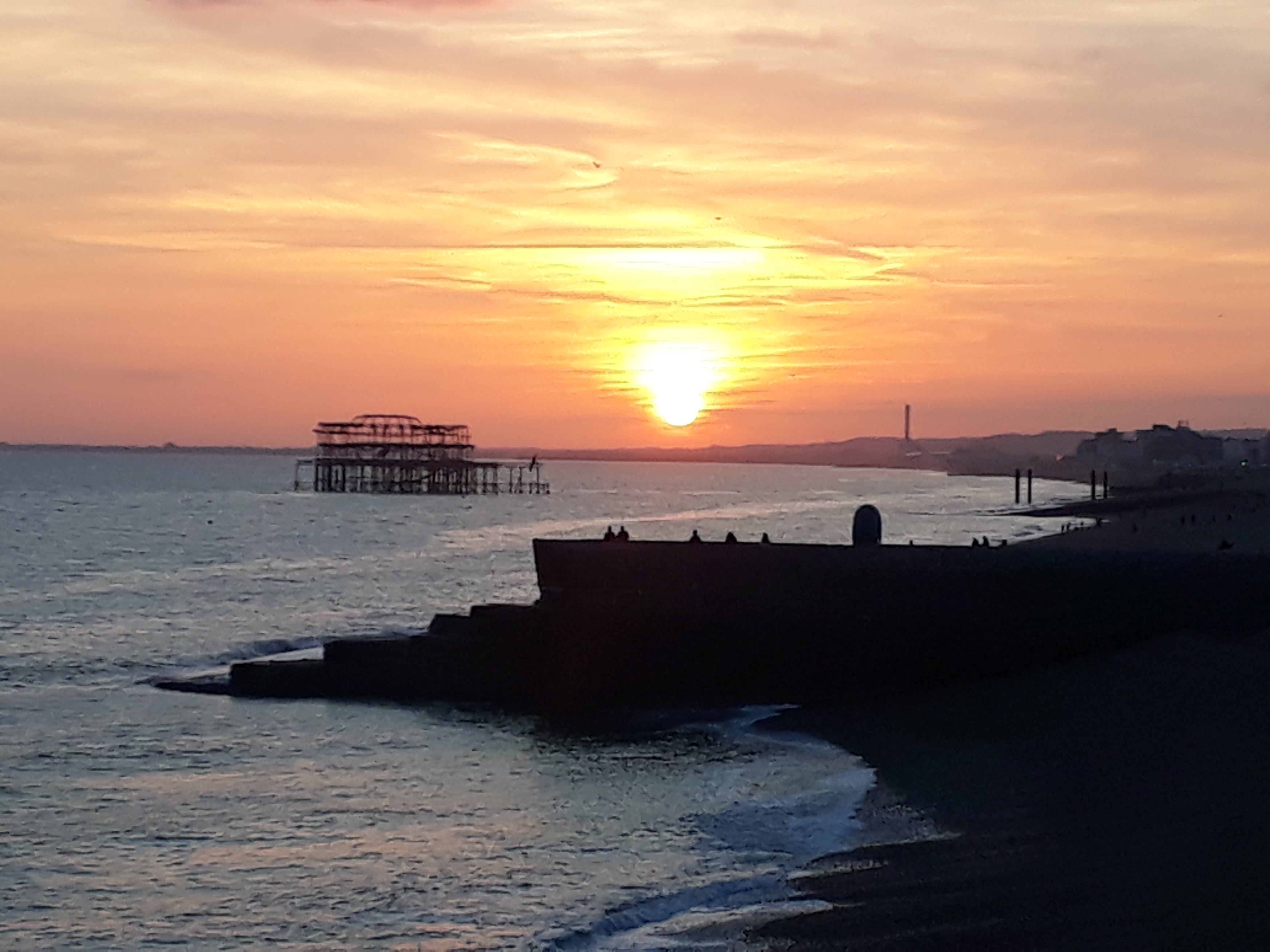
We lost the last couple of overs due to the fading light. When the play ended for the day, I had another quick look at the photographs inside the pavilion and then left the ground to take the short walk to the sea front. On reaching it, I turned to my left and started my long straight amble towards the distant Brighton Palace Pier. Behind me in the west, the sun was beginning its descent.

Distant Times

18th September 2024

I have recently spent a few days in the South East of England fulfilling various social engagements: catching up with friends, visiting family, and so on. During this period, I took the opportunity to visit two sporting venues that I had not been to for a long time, albeit not to watch any actual sport.

The first was for a reception hosted by Robert Gausden, to whom I referred in An Ordinary Spectator: 50 Years of Watching Sport as a work colleague in 1981 at what was then Queen Mary College in the University of London. We shared an office as research assistants in the Economics Department. Robert was – and is – a keen follower of sport and, in that year, we took the opportunity to take in many of the summer’s events, including cricket at Lord’s, tennis at Wimbledon and Ryder Cup golf at Walton Heath.

The reception was to mark Robert’s (quasi) retirement after 45 years in academia, principally as a university lecturer, and was attended by many of the students he had taught – including in Leeds, Newcastle and Portsmouth – ranging from recent graduates to those now in their late 50s. It was held in the President’s Suite at Lord’s.

The Suite is in the Grandstand and gives a commanding view of the stadium. It was a sunny afternoon and the groundstaff were preparing for Middlesex’s County Championship match with Gloucestershire, which started a couple of days later. I stood at the balcony for a few minutes and attempted to make the contrast between the imposing modern structure all around me and what I remembered as having been the view of the ground in 1976.

That had been the year of my first visit. With some friends, I watched one of the days of the England vs West Indies test match from the Mound Stand, when Mike Brearley had worn his rudimentary skull-cap as protection against the formidable opposition fast-bowling line-up that included Andy Roberts and Michael Holding. I recall that Bob Woolmer and David Steele batted bravely for some time, albeit with only the occasional troubling of the scorers. (The records show that Steele made 64 in 4½ hours. “Bazball” it was not).

It was also from the Mound Stand, from seats nearer the front, that I attended my last match at Lord’s when my father and I saw Yorkshire win the 55-over Benson and Hedges Cup in 1987. The final against Northamptonshire ended with the scores level and Yorkshire were judged the winners on the basis of having lost fewer wickets. The match-of-the-match was Jim Love, with whom I had played in the Leeds Schools Under 14 XI (which I had captained) and the Yorkshire Cricket Federation (Under 19) side. His innings of 75 not out was probably the most significant he played in a career of over a decade for the county.

The day after my Lord’s trip, I did the official visitors’ tour of Wembley Stadium. It was very good value at £18 (for me at the senior rate), our party of about 30 or so including visitors from Spain, Sweden, Lithuania, Bulgaria and Morocco.

The tour began in the small museum near the reception area, which I was amused to see included the cross-bar struck by the ball when Geoff Hurst scored his second goal in the World Cup final of 1966. It is arguably the most famous cross-bar in the history of the sport. This was followed by a visit to one of the upstairs bars, which contained a range of posters, photographs and videos and served as a reminder that, over the years, the stadium has hosted not only football, but also both codes of rugby, Gaelic football, American Football, greyhound racing, baseball, show-jumping et al as well as major non-sporting events, not least Live Aid and other major pop and rock concerts. (An aside. I saw the Rolling Stones perform there in 1982).

The tour guide was excellent: amusing and informative and with an obvious pride in the stadium in which he worked. We visited the spectator seats and the Royal Box and the media centre and, having seen the changing rooms, we were asked to form two lines so that we could walk out through the players’ tunnel on to the side of the pitch, at which point – a nice touch – the sound system played the roar of the crowd. (The pitch itself was strictly out of bounds, of course). Beforehand, after we had passed the drugs-testing room, the guide made one hilarious comment, which I am not at liberty to repeat here, but which, for some reason, the two Bulgarians in the group also found highly amusing.

Some of the points of detail were particularly interesting. I had previously not viewed the huge arch, which extends from one side of the stadium to the other, with any great affection, as, to me, it had echoes of triumphalism: a bit too Saddam Hussein if you like. The guide stated, however, if I have understood him correctly, that its purpose was principally functional, in ensuring the stability of the whole structure by locking the two sides together.

Other details were more quirky, if also still important. The guide mentioned that the stadium – which is not a “dome” because the roof does not extend over the whole arena – holds the world record for the largest number of toilets in a single building: 2,816 if I remember correctly, of which over 700 are for females.

On another point, he was adamant that, during his considerable experience of many years working on event days, there had been one particular set of events that had been by far the most enjoyable in terms of the friendliness of the crowd and the near-complete absence of any trouble whatsoever: the recent series of 8 Taylor Swift concerts that drew a total of over 750,000 fans. At this, one of the young women in our group clapped her hands in the (justifiable) reflected glory of having been one of that number.

As at Lord’s, I took the opportunity to cast my mind to my first visit to the stadium: a primary school day-trip from Leeds to watch the Rugby League Challenge Cup final of 1966 in which St Helens overwhelmed Wigan by 21 points to 2. On that day, we sat near the front on the rudimentary wooden benches provided for spectators near the old players’ tunnel at one end of the ground. I recalled in An Ordinary Spectator that “the far side of the ground looked a long way away – it was a long way away – and it was difficult to take in the obvious point that the distant spectators were about to watch the same match as I was”. From my seat in the Royal Box, I looked over to where I had been and closed my eyes and recreated that view from all those years ago.

My earliest – and, prior to last week, even my most recent – visits to Lord’s and Wembley were to the previous versions of the respective stadia. (In the latter’s case, the most recent was for the last of the Challenge Cup finals – Leeds Rhinos versus London Broncos – at the “old” Wembley in 1999). They were Distant Times. The world has moved on and the years have passed and I – we – have grown older.

Our reference points change. In former times, the walk from the Underground station to the stadium was down the concreted Wembley Way with the post-match journey back to the station usually involving a tortuous wait as the police shepherded groups of spectators on to the (occasional) departing trains. (I noted on the tour that one of the photographs showed Wembley Way being constructed by German prisoners-of-war, under the supervision of British engineers, in preparation for the 1948 Olympic Games). Since 2012, Wembley Way has been renamed Olympic Way and, today, it is a spacious and pleasant tree-lined boulevard containing cafes, a hotel and ethnic food retailers. (On the Sunday lunchtime that I was there, there was a vibrant atmosphere, even though no events were being held at the stadium). There are also several multi-storey apartment blocks in the vicinity (with one-bedroom flats currently on the market for around £450,000, according to one of the property sites I casually Googled).

Prior to attending Robert Gausden’s reception at Lord’s – and because I had arrived earlier than anticipated at St John’s Wood station – I took the short walk down one of the other streets to Abbey Road where, inevitably, I found myself taking a photograph of the zebra crossing made famous in the eponymous album cover in 1969. There were quite a few other people milling around, some of whom would have been to the nearby museum and others, like me, just interested – however vaguely – in the locality.

Distant Times. The passing years. Changing reference points. At the reception, in conversation with one of Robert’s recent students, I mentioned that I had taken the short detour to Abbey Road. She looked at me with a polite, but puzzled, expression.

“Abbey Road? What’s that?”.

From International Athletics to Rugby League

1st July 2024

When I attended the World Indoor Championships in Glasgow earlier this year – “Thrilling Action and a New World Record” (4th March 2024) – I was given a copy of the October 2023 edition of Backtrack, the excellent magazine of the British Athletics Supporters Club. The publication had an article by Colin Allan on Arthur Rowe, Britain’s first great shot-putter, who won gold medals at both the Empire and Commonwealth Games and the European Championships of 1958. Allan noted that Rowe broke the British record 13 times and won 5 consecutive Amateur Athletics Association (AAA) Championships between 1957 and 1961. Then, in July 1962, he signed for Oldham RLFC for a reported fee of £1,500.

With the 2024 Olympic Games in Paris now almost upon us, I have been thinking about other attempts by elite performers in track and field to cross over into professional rugby league. It is a story of mixed success.

Arthur Rowe was not one of the successes, unfortunately. At 6 feet 2 inches and 17 stones, he might have been expected to find a role as a prop-forward but, instead, he was selected on the wing for a total of 4 “A” team matches. He did not graduate to the Oldham first team, however, and it was not long before he reverted back to athletics, though he was then limited to the professional competitions of the Highland Games and strongman competitions.

Although Rowe’s switch of allegiance was a major surprise for the athletics world of the early 1960s, this had already been dwarfed in shock value by the events of a decade earlier. In July 1953, the sprinter McDonald Bailey signed for Leigh for a reported fee of £1,000 with further payments to follow depending on appearances.

Although born in Williamsville, Trinidad and Tobago, Bailey had represented Great Britain in the 1948 and 1952 Olympic Games, winning a bronze medal in the latter in Helsinki. He had won the sprint double 7 times at the AAA Championships and, in Belgrade in 1951, he had run 10.2 seconds for the 100 metres, thereby equalling the world record set by Jesse Owens 15 years earlier. (The record would be equalled by six other sprinters, but not overhauled until 1956).

His acquisition by Leigh was a sensation. In modern terms, it was if Usain Bolt had signed for Hull Kingston Rovers.

The Leigh club of the early 1950s was respected in the Northern Rugby League, but it was not one of the elite: the previous season’s Lancashire Cup success had been its first trophy for over 30 years. However, there was no doubt that, if nothing else, it had pulled off a major public relations coup. Bailey’s debut for Leigh – and, as it turned out, his only first-team appearance – was against local rivals Wigan in December 1953, five months after he had signed for the club. This was a specially arranged match to celebrate the switching on of the floodlights at Leigh’s ground, when the reported attendance was just under 15,000.

In his match report for the Yorkshire Post and Leeds Mercury, the rugby league journalist Alfred Drewry began by noting the “17 photographers lining the touchline”. He went on to count the number of passes Bailey received on the wing – 9 in the full 80 minutes, of which he dropped 2, though he did score a try – but also commented that “his defence was feeble in the extreme”. Drewry’s overall conclusion was that “all in all, one was left wondering what all the fuss was about”. Bailey announced his retirement from rugby league shortly afterwards.

If Arthur Rowe and McDonald Bailey did not make the grade in their new sport, are there examples of international athletes who did? There are indeed.

Peter Henderson ran for New Zealand in the 1950 British Empire Games in Auckland, when he reached the final of the 100 yards and then won a bronze medal in the 4 x 110 yards relay. His success in rugby league – having joined Huddersfield in September 1950 – was not exactly a surprise, however, as he had played rugby union for the All Blacks in 7 international matches before focusing on his sprinting talents. Henderson stayed with Huddersfield for 7 seasons during which time he won both Yorkshire Cup and Challenge Cup winners medals (in the 1952-53 season) and racked up a total of 214 tries as a wing three-quarter.

In many respects. Peter Henderson’s sporting career was not dissimilar to that of the South African, Adriaan “Attie” van Heerden, the main difference being that the latter’s athletics peak year of 1920 – when he was the national champion in both the 120 yards and 440 yards hurdles and then a participant at the Olympic Games in Antwerp – preceded his two caps as a Springbok rugby union international. Van Heerden then played for Wigan between 1923-27, scoring over 100 tries in this period. Undoubtedly the most famous of these was in the 1924 Challenge Cup final, played in Rochdale, when he ran around a mounted policeman in the in-goal area who was attempting to keep the huge crowd at bay. (The final of this competition was not played at Wembley until 1929).

It is fair to say that Peter Henderson and Attie van Heerden were already top rank rugby players (albeit not in the league code) who took time out to pursue their athletics careers for a relatively short period before taking up the professional version of the oval ball game. Perhaps a more clear-cut example of the successful transition from top-flight sprinter-to-wing three-quarter was the Welshman, Berwyn Jones, who was signed by Wakefield Trinity in 1964 after playing in a couple of trial matches under the ironic pseudonym of “A Walker”. Jones had also played rugby union, but for his club – Rhymney RFC in South Wales – rather than at a higher level.

Jones had competed in the 1962 European Championships in Belgrade (for Great Britain) and the same year’s British and Commonwealth Games in Perth (for Wales) winning a bronze medal at both in the respective 4 x 100 metres and 4 x 110 yards relay races. His career in rugby league was with Wakefield and then Bradford Northern and (briefly) St Helens over the course of 5 seasons and he was another prolific try-scorer. He also represented Great Britain on three occasions in international matches against France and, in 1966, he was selected for the GB tour of Australasia – the highest accolade for a British player – during which he played in 15 matches and scored 24 tries.

It is a fascinating quirk that, when Berwyn Jones lined up for the sprint relay finals of the two athletics championships of 1962, one of his teammates/rivals was Alf Meakin from Swinton. Perhaps they compared notes on the attractions of alternative sporting careers. Like Jones, Meakin was a double medal winner, taking bronze in the 4 x 100 metres in Belgrade and then gold (for England) in the 4 x 110 yards in Perth.

Having completed in the 1964 Olympic Games in Tokyo, Meakin had trials with Leeds in the autumn of that year, but was not offered a contract after one first-team and two “A” team matches. (His only previous rugby experience had been in a handful of matches in the union code with the RAF). However, he had more success with Blackpool Borough, for whom he scored 12 tries in the 1965-66 season before taking up a post as a sprint coach with Preston North End FC.

For those athletes named so far, the decision to seek a career in rugby league would have been taken in the knowledge that there was no going back to life as an amateur athlete. Colin Allan’s article makes it clear that the AAA’s regulations regarding being paid to play rugby were effectively no less stringent than those of the Rugby Football Union. (In New Zealand, the RFU’s lead on professionalism was thoroughly endorsed by the NZRU: Peter Henderson’s ban from playing or coaching rugby union lasted for 38 years).

Against this, therefore, it was heartening to read in Allan’s article of the letter sent to Arthur Rowe by Jack Crump, the British Team Manager, wishing him every success in his professional sporting career: an honourable gesture by the senior administrator. Alf Meakin also received similar correspondence.

The Bradford club – by now in its modern guise as the Bradford Bulls – had success with another former British athlete, when it signed Abi Ekoku in 1997 from the Halifax Blue Sox, the player having initially joined the London Broncos in 1993. Like Arthur Rowe, his specialism was in the field events; he was selected by England for both the shot and discus in the 1990 Commonwealth Games in Auckland, coming sixth in the former event.

Unlike Rowe, Ekoku did secure a regular place as a wing or centre three-quarter in his new sport. Just as Peter Henderson had done almost 40 years earlier, he played in rugby league’s showcase club fixture – the Challenge Cup final at Wembley – for the Bulls against St Helens in 1997, though it was a loser’s medal that he was awarded at the end of the match. Following his retirement from playing, Ekoku remained in the sport, at various times being the CEO of the Keighley Cougars and Bradford Bulls and then the Great Britain team manager.

For the most recent attempt to move into a professional rugby league career from the disciplines of the sprint lane, we turn to Dwain Chambers, who was taken on (temporarily) by the Castleford Tigers club in March 2008. Chambers had returned to competitive athletics in 2006 following a two-year drug ban, but his peak years as a 100m sprinter were already behind him; his personal best had been the 9.97 seconds recorded when winning a bronze medal at the 1999 World Championships in Seville and he had followed this up with a 4th place in the same event’s final in the Sydney Olympic Games a year later.

By the time of Chambers’ rugby sojourn, we were well into the Super League era with that division’s first-team squads all being full-time professionals. We had also entered the period in which the on and off-field experiences of professional sportsmen were subject to the closest media scrutiny. For Chambers’ first (and, again, only) game for Castleford (an “A” team match against York), the Guardian’s rugby league correspondent – the highly respected Andy Wilson – provided a blow-by-blow account of each time Chambers touched the ball (7 in total in the 40 minutes he was on the field) or attempted a tackle (3 successful, 4 missed).

Or perhaps nothing had changed: Wilson was echoing the approach taken by Alfred Drewry when reporting on McDonald Bailey in the Leigh vs Wigan match over half a century earlier.

I recall that the media interest in the Castleford/Chambers connection extended to the BBC’s national evening news, but – apart, again, from the short-term publicity angle – the outcome was not a success. Castleford did not pursue their interest, though the press reports suggest that they had been impressed with Chambers’ effort and commitment.

Dwain Chambers was aged 30 when he took part in his Castleford trial match; in the earlier generations, Arthur Rowe had been 26 and McDonald Bailey 32 when they dipped their toes into the rugby league waters. Without having had any previous exposure to rugby in some form, the challenges they were attempting were surely close to impossible. It was – and is – a demanding sport, in which overall speed and fitness are necessary, but not sufficient, conditions to attain success. There are a range of other skills to be mastered in handling, tackling, positional play and – not least – learning to absorb the physical assaults (lawful and unlawful) on the body. By contrast, Berwyn Jones, Peter Henderson and “Attie” van Heerden had had prior rugby experience, in the Henderson and van Heerden cases at the highest level.

I have always had an interest – and an admiration – for those elite sportsmen and sportswomen who attempt to reach the top in other sports, though I suspect that the days of the elite athletes trying their hand in professional rugby are long gone. Nonetheless, when I watch the Olympic Games athletics on the television next month, I might keep half an eye open for that potential wing three-quarter.
It’s Not Cricket

18th May 2024

I did not play for the Club. Nor was I a member. Nor, indeed, did I have any connection with it.

Nonetheless, one day last week, a year after it had permanently closed down, I paid my respects by visiting its former ground and taking a stroll around where the boundary used to be.

Poloc CC, situated on the south side of Glasgow, was founded in 1878 and resident at its Shawholm ground from 1880. Resident until 2023 that is, when it was announced that the landlord would be terminating the lease. The Club’s subsequent negotiations – with the landlord’s agents and the new tenant – led nowhere. It would have to leave. At a Special Meeting of the members, it was decided that Poloc CC would be dissolved on 30th April 2023.

1880: the construction of the Panama Canal begins; the Amateur Athletics Association is formed in Oxford; and WG Grace scores 152 for England against Australia at the Oval in the first home Test match.

The nearest railway station is Pollokshaws West, a 10 minute ride from Glasgow Central. This itself has a historical context. A blue plaque on the brick wall of the platform at which I arrived informed me that the station was opened as Pollokshaws in September 1848 by the Glasgow, Barrhead and Neilston Direct Railway. It is the oldest surviving station in Glasgow.

A cursory glance at the story might lead one to suppose that Poloc CC played on an inner-city site that was ripe for development as a housing complex or a retail park. Not so. The ground is – was – situated within Pollok Country Park, one of urban Britain’s finest open spaces. (Note to self: care needed with the different spellings).

The Club closed down with some style. Five of its spectators’ benches – suitably inscribed “Remember Shawholm, Remember Poloc”– were distributed to the other founder members of the Western District Cricket Union with others gifted to longstanding Club members.

It was on another bench – supplied by the Friends of Pollok Country Park – that I paused for a rest on my lap of the ground. In front of me was the path that stretched down one side of the playing area, a popular route with joggers and dog walkers. To my far left, behind a high fence, were the grounds of the Police Scotland Dog Training Centre; I doubted that many folk would ignore the prominent warning sign to “keep out”. Behind me, the gently drifting White Cart Water, into which – I guessed – one or two cricket balls might have been smote with long straight hits over the years.

The ground itself is framed by a series of tall mature trees, which would have provided the sense of an enclosed arena to those in action in the middle. The pavilion remains in place, now in use by the new tenant, its whitewashed façade in need of some refreshment. The entrance from the pavilion on to the playing area was down a slight slope, up which a tired boundary shot might have struggled to reach the sanctuary of the rope. Around the ground, the outer reaches of the former outfield had been roughly mown, the cut grass remaining loose on the undulating surface. On the far side, beyond the boundary, there was the rusted metal frame of one of cricket nets.

Of course, we know that nothing lasts forever. But we are still shocked when – whether through the actions of man or nature – something that had apparently seemed permanent is no more. For the generations of Club members and players, there will have been an obvious sense of loss and even despair.

However, even for those of us looking on from outside, there is a feeling of diminution. Economists speak of the “existence value” that we attach to something that we know to exist even if we might never see it for ourselves and of the intrinsic loss that occurs with its removal – as with the Sycamore Gap tree at Hadrian’s Wall, for example. I think that a long-established community cricket club – with an ethnic diversity of its membership and a vibrant junior section – falls into this category. (Somewhat ironically, the grounds of the former Poloc CC have their own sycamore tree, standing sentry near the path at the entrance. It is a beautiful sight and – thankfully – it is still standing).

The new tenant is a football academy that, according to its website, “strives to provide every young player the best experience to living their dream of becoming a professional footballer” (sic) by giving “the highest coaching to all age groups, both male and female”. As I prepared to head back to the railway station, I was passed by three young boys – smartly attired in the academy’s kit and with their backpacks no doubt carrying their boots and other essentials – as they headed towards the pavilion. Good luck to them.

From a general perspective, the change in the ground’s tenancy reflects two things, I think. The first is the lack of sentimentality to be found within the cold winds of market forces. A landlord seeks a higher rate of return: end of story.

Second, there is further confirmation – if it were needed – of the overwhelming dominance of one particular sport in the West of Scotland.

And it’s not cricket.

Record Breakers

24th April 2024

Earlier this month, the Glamorgan captain Sam Northeast broke the record for the highest individual score by a batsman in a first-class match at Lord’s, when he made 335 not out in the fixture against Middlesex. The previous record had been held by Graham Gooch – 333 in 1990.

Northeast has a track record for huge scores. In a 2002 match – batting for Glamorgan against Leicestershire – he amassed 410 not out, the ninth highest first-class score in the history of the game. These are remarkable feats of skill, concentration, patience and stamina.

Now comes the “but”. I know that records are there to be broken… But…

Gooch’s innings was in a Test match between England and India, in which the opposition bowlers included Kapil Dev, Manoj Prabhakar, Ravi Shastri and Navenda Hirwani who, between them, would end their Test careers with a total of 747 wickets. He opened the batting on the first morning of the three-match series with India having won the toss and decided to field. There was a sizeable crowd and the pressure was on. Sam Northeast’s innings was in a County Championship second division fixture in which the two sides’ first innings produced a total of 1275 runs for the loss of 13 wickets. He declared his side’s innings closed at the end of the over in which he had broken the record.

The question of what I would have done under the circumstances is largely irrelevant, of course, given that my only time on a first-class cricket field was for a few minutes as a substitute fielder in a Cambridge University versus Warwickshire match at Fenner’s nearly 50 years ago. (For completeness: I threw the ball in over the top of the stumps after Dennis Amiss had hit it past me in the covers for two runs on his way to making 123). However, had I been in Northeast’s position, I do wonder if I might have declared on equalling Gooch’s record, rather than surpassing it. Why not be bracketed with an England captain who played in 118 Test matches and scored 8,900 runs in the process?

There is a precedent for this. In a Test match against Pakistan in Peshawar in 1998, the Australian captain Mark Taylor declared his side’s innings closed when he had reached an unbeaten 334. At the time, this happened to be the (joint) Australian record for an individual Test match innings, the existing record-holder being a certain Don Bradman, who had registered the feat against England at Headingley in 1930. The slight complication here is that this was Taylor’s score at the end of a day’s play and he had attempted to add to his total when facing the final two deliveries. He declared the innings closed before play began the next morning. (The milestone was overhauled a few years later when Matthew Hayden amassed 380 against the might of the Zimbabwean bowling attack).

A variant of this theme is given in the final innings that the Australian Darren Lehmann played for Yorkshire, against Durham at Headingley in 2006. In making 339 he did beat Bradman’s record Headingley score, but fell short of another record of which, certainly, most Yorkshire players (including Lehmann) and supporters would have been aware: George Herbert Hirst’s 341, which dated from a match against Leicestershire in 1905. In a subsequent interview, Lehmann – undoubtedly the most successful of Yorkshire’s overseas players – stated that he had been attempting to break Hirst’s record and had been bowled trying to hit a six. However, he also stated that, on reflection, “I’m actually quite glad that I haven’t got the record because I think that a Yorkshireman should have it.”

For most sporting records, the option for the potential record-breaker to ease up in order to merely equal the target rather than beat it simply does not apply: the sprinter approaching the finish line, the goalkeeper clocking up consecutive clean sheets, the tennis player chasing Grand Slam titles… However, for the batsman in cricket, there is this rare opportunity, although I recognise that there can also be caveats. If I had been Sam Northeast on 333 with my side needing one run to win off the final ball of the match, I suspect my attitude would have been different.

There is no right or wrong to this, of course. The current generation of sportsmen and women will have different perspectives on the role – and relevance – of history in their chosen sport. Moreover, in Northeast’s case, by the time that he had reached Gooch’s landmark he must surely have been experiencing a dizzying combination of euphoria and exhaustion. And, as we see with Darren Lehmann, one’s thought processes at the moment of potential history might evolve into something different with the passage of time.

Footnote. Graham Gooch also scored 123 in the second innings of the 1990 Lord’s Test match. With his match aggregate of 456, he thus continues to hold the records for the most runs scored in a Test match and in a first-class match at Lord’s.

Famous and Forgotten

19th April 2024

The latest book by the eminent rugby league historian Robert Gate – Famous and Forgotten: Albert Goldthorpe and Archie Rigg – covers the parallel careers of two of the earliest of the game’s great players. Goldthorpe played for Hunslet between 1888-1910 and Rigg for Halifax and (briefly) Bradford between 1891-1908. Both therefore began their playing days before the “Great Split” of 1895 – when a group of northern clubs seceded from the Rugby Football Union over the issue of “broken time payments” (to compensate players for the lost wages when playing for their clubs) to form the Northern Rugby Football Union, later the Northern Rugby League – and became key participants in the establishment of the new code at the turn of the century and into the Edwardian era.

Gate catalogues the similarities between the two players in terms of their records, skills, durability, sportsmanship, successes and disappointments. And yet – his main theme – their legacies are significantly different: Goldthorpe was inducted into Rugby League’s official “Hall of Fame” in 2015 and has a “legendary status as an icon of rugby league”; Rigg is all but unknown.

It is always a pleasure to read of Albert Goldthorpe’s achievements in his sport and in life. (I still have the shivers in recollecting an absolutely appalling portrayal of him by Dennis Waterman in an Australian television drama made in the 1980s). His Yorkshire Cup success with Hunslet in 1905 was merely a precursor to the 1907-08 season, when, at the age of 36, he led the side to their “All Four Cups” triumph. Hunslet won the Challenge Cup, Championship, Yorkshire Cup and Yorkshire League, the first time that this had been achieved in a single campaign.

Quite apart from his 700-plus appearances for Hunslet during his 22 years in the game and the record league goals and points tallies that he had accumulated by the time of his retirement, it is Goldthorpe’s stewardship during the All Four Cups season that has ensured his enduring recognition. When the final whistle sounded at the conclusion of Hunslet’s 12-2 win over Oldham in the replayed Championship final of 1908, his rightful place as a totemic figure in the game’s history was guaranteed.

Gate makes a strong case for Archie Rigg’s inclusion in the RL Hall of Fame – rather than just in the Halifax club’s corresponding pantheon, where he is currently placed. He captained Yorkshire in the first 5 seasons of the Northern Union and led Halifax to success in the 1903 Challenge Cup final against Salford at Headingley.

However, I do wonder – if Archie Rigg were to be considered for promotion – to which other candidates of that era this might also apply. To give one example, John Willie Higson was not only a member of Hunslet’s “Terrible Six” pack of forwards in 1907-08 but, after transferring to Huddersfield, was also a member of the “Team of All Talents” that itself won all four cups in 1914-15. He was the only player to be part of two such sides. (Swinton – in 1927-28 – were the only other side to accomplish the feat before the county leagues were abolished in 1970). Moreover – unlike both Goldthorpe and Rigg – Higson was an international player, winning 5 caps for either Great Britain or England (under the Northern Union banner) in 1908-09.

It is at this point that I must confess to a more personal interest in one of the subjects of Robert Gates’ book: that is, in finding out whether there was any family connection to Archie Rigg. The surname is not common – to say the least – amongst the front-line rugby league players of any era, my attempt to rectify this having terminated when I played my final match for the Chapel Allerton Primary School in Leeds nearly 60 years ago.

An hour’s research on Ancestry has provided the answer, I think. My known paternal line goes back four generations to the birth of George Rigg in North Yorkshire in 1802 to “Mary Rigg of Baldersby and an unknown father” (according to the parish register).

By contrast, Archie Rigg was of proven Halifax stock – still Yorkshire, of course, but sufficiently distant from the rural north to be fairly conclusive for this exercise. He was born James Archer Rigg in the town in 1872, his parents being John Rigg – a joiner by trade – and Sarah Birtwhistle. John had been born in about 1836 and John’s father, Samuel, in about 1800, the latter a cordwainer in Halifax. Whilst it is always possible that there was some earlier overlap in the branches of a single family tree, of course, I have to concede that this is unlikely.

I have been here before. In An Ordinary Spectator Returns, I reported on the cricketer Keith Rigg, who played in 8 test matches for Australia in the 1930s and made a century against South Africa in 1931. I concluded there that his great grandparents were William and Louisa Rigg (née Clark), who had married in Newington, Surrey, in 1837 and subsequently migrated to Australia, where they settled in Victoria. Surrey is even more of a stretch from Baldersby than Halifax. The search continues.

In the meantime, there is much to ponder about Famous and Forgotten – and in a general sense, rather than simply in sporting terms. What is it that determines whether the heroes of today will take a prominent place in the history books of tomorrow?

Thrilling Action and a World Record

4th March 2024

I am aware that there has been only minimal coverage of elite athletics in the three Ordinary Spectator books: brief references to the first London Marathon in 1981 and the 5th Avenue Mile in New York in 1984 and recollections of the television coverage of the Olympic Games in my teenage years. On Saturday evening, I took the opportunity of (partly) addressing this shortfall by attending the middle evening session of the 3-day 2024 World Athletics Indoor Championships at the Emirates Arena in Glasgow.

Glasgow punches above its weight for major sporting events. In the last 10 years, quite apart from the seasonal adventures of the local football and rugby union clubs, I have attended (and written about) international football at Hampden Park (Scotland versus Belgium in 2019 and a Round of 16 match at Euro2020, the latter postponed by a year), the 2014 Commonwealth Games (swimming and gymnastics), a World Championship boxing bout in 2022 and the European Cycling Championships of 2018. For the 2023 UCI Cycling World Championships, I watched the two road races (Men’s and Women’s) and the Men’s Time Trial as well as spending an evening at the Sir Chris Hoy Velodrome.

The city’s experience in hosting such occasions has meant that the stewarding is consistently friendly and helpful. On Saturday, this extended to the steward manning one of the road junctions on the short walk from Dalmarnock station to the arena. “There’s a reason it’s indoors”, he informed us with a smile as we waited on this chilly evening for a green pedestrian signal. “My hands are blue”.

Inside the arena, there was a full agenda – 2 sets of sprint semi-finals, the high jump component of the Men’s heptathlon and 8 finals – and there was continual action for the better part of 3 hours with, at times, progress being made in 3 events simultaneously. The evening’s MCs were informative, without being overbearing, and the provision of up-to-date information on the electronic scoreboards at the ends of the arena was excellent.

The role of modern technology in the proceedings was demonstrated in the first of the Men’s 60 metres hurdles semi-finals, when the Spanish athlete Asier Martinez was disqualified for a false start. He was judged, not to have set off before the gun fired, but to have done so faster than the allocated time that the scientists have calculated to be the minimum that it takes for the human brain to react to the firing. Martinez appealed the decision and was allowed to compete in the race, but the judges’ original decision was upheld.

Given the sophistication of the technology in use – for example, the runners’ times were given to two-hundredths of a second, with a thousandth of a second being available, if required – it seemed pleasingly quaint that, for the heptathlon’s high jump and Women’s pole vault, the success or failure of an attempt was signalled by the official sitting near the apparatus raising a white or red flag. Nicely low-tech, I thought, concluding that this might not be the most difficult job of the evening.

There were three particular highlights, the most significant of which for the meeting as a whole was probably when the Dutch runner Fenike Bol set a new indoor World Record of 49.17 seconds in the Women’s 400 metres. For the home supporters, however, there were the gold medal performances of Molly Caudrey in the Women’s pole vault – following an absorbing contest with the New Zealander, Eliza McCartney – and Josh Kerr in the Men’s 3,000 metres.

Kerr – a tall, powerful and elegant runner – judged the race to perfection. In a closely bunched field, he spent several laps biding his time and easing his way in the middle of the pack before progressing up the line, negotiating some barging and then taking the lead with about 100 metres to go. The roars built up over the concluding laps and then echoed around the arena as Kerr rounded the final bend and sprinted down the straight. It was a genuinely thrilling and memorable piece of sporting action.

Across the evening as a whole, there was much to take in, some of it on the margins of the main action. I noted the calm efficiency with which the officials marshalled the high jumpers in the preparations for their attempts at the bar (which was right in front of us). With less available space than there would have been in an outdoor arena, the jumpers’ run-ups straddled both the post-tape lanes of the sprinters and the start of the run-ups of the Men’s triple-jumpers. The officials managed the heavy traffic with some skill.

The spectators played their part too. It was noticeable that the general hubbub of noise and conversation in the crowd would transform into a respectful near-silence as the sprinters made their final preparations prior to blast-off. There was also warm appreciation of the gold-medal winners from around the globe, including the Americans Elle St Pierre and Grant Holloway, the Belgian Alexander Doom, and Hugues Fabrice Zango of Burkina Faso. When Holloway won the Men’s 60 metres hurdles – his 76th consecutive win in the event, no less – he joyfully bounced off the thick padded cushion at the end of the sprint lane as if he were a hyperactive Tigger.

Unfortunately, the evening was not without its casualties. The French pole-vaulter Margot Chevrier suffered a horrendous ankle injury after she mistimed one of her attempts and crashed awkwardly in the pit of the landing area. There was a delay of several minutes whilst she was attended to – initially being given oxygen – and carefully lifted on to the wheeled stretcher. Later, the start of the last event of the evening – the Women’s 60 metre sprint final – was also delayed after the American Aleia Hobbs injured her calf in her warm-up. Her desperation to compete was clearly evident, as she attempted to massage the problem away, but it was also obvious that this would be in vain. The race was won by Julien Alfred of St Lucia in 6.98 seconds, two-hundredths of the second ahead of the Polish athlete, Ewa Swoboda.

If I had one suggestion to make of the evening, it would be to re-arrange the schedule so that the podium athletes could receive their medals at intervals between the events. On Saturday, these ceremonies were conducted at the close of play, when many of the spectators had started to leave the arena. That more stayed on this occasion than might otherwise have been the case was no doubt due to the successes of Molly Caudrey and Josh Kerr. I realise that it would elongate the main part of the evening as a whole – and the 8 medal ceremonies here would perhaps have added a good half-hour to the programme, given the time needed for the awarding of the prizes and the playing of the national anthems. But it seems a shame that the successful competitors – for some of whom the evening might turn out to have been the career highlight – are recognised only in a corner of the arena and when the bulk of the spectators are heading for the car park or the railway station.

60 metres in 6.98 seconds. These days, it takes me at least that long to get myself off the living room sofa and into a standing position.

SilverWood Books: Meet the Author

18th August 2023

The third book in the “An Ordinary Spectator” series was published last month by SilverWood Books to the same high standard as the first two volumes.

I am pleased to report that I was subsequent invited by Helen Hart, the Publishing Director of SilverWood Books, to be in the spotlight for the regular “Meet the Author” Social Media Feature on its Facebook site (https://www.facebook.com/silverwoodbooks).

The Feature makes use of a short questionnaire on the author’s background and writing.

Name/Pen name

John Rigg

Where are you from/where are you based?

I was born and brought up in Leeds, Yorkshire. However, I have lived in Milngavie, just to the north of Glasgow, for over 30 years.

Do you write full time or do you have a ‘day job’?

I am a retired civil servant. I do not write full time and, therefore, I have the luxury of choosing when to research/write and fit it in around other activities.

How has your other work influenced your writing?

During the latter stages of my career, I visited many interesting places in Scotland and Europe. I am interested in local histories and cultures and, I hope, this is evident in some of my writing on sports spectating: shinty in the Scottish Highlands, Gaelic Football in County Mayo, rugby league in Castleford, and so on.

What is your favourite book?

I read Headingley by John Marshall in my teenage years. It is a history of the Yorkshire County Cricket Club (up to 1969) – simply written, but with some evocative (and sometimes moving) descriptions of players and matches – and I readily identified with this illustrious sporting institution. Recent events at the Club – and the accompanying media frenzy – have saddened me greatly.

Did this book inspire any aspects of your book? If so, how?

At the very least, I am keen that my sports writing should be interesting to the reader – even if he/she is not a fan of a particular sport per se – so as to encourage further reading. The great writers on sport – for example, Paul Gallico on boxing and golf in the New York in the 1930s and CLR James on West Indian cricket and culture – succeeded in placing their specific interests within the broader context of the societies around them.

Where is your writing space?
Technically, the study, where I have a laptop and desktop. However, much of the content of the essays in my most recent book – An Ordinary Spectator Returns: Watching Sport Again – was formulated in my head during or immediately after watching a sports event. I always take a notepad to jot down fleeting ideas. I find that I can write the initial draft quite quickly, after which I like to take my time on the fine-tuning.

Are you currently working on anything new?

I am currently working on the family histories on both my side and my wife’s. I like the research – which we have used as reasons to visit Ireland, Malta and Germany, as well as various parts of the UK. Hopefully, it is one for a future SilverWood publication list. I am also writing another novel (under my JR Alexander persona), but the family history volume will come first.

How does it feel to be a published author?

There is an obvious pride in seeing a project completed and produced to a high standard and this has not diminished with the three An Ordinary Spectator books. There is also gratitude to family and friends for their encouragement and support. And, not least, a sense of satisfaction when someone – often a complete stranger – contacts me to say how my reminiscences of watching sport in the past have prompted their own recollections of watching an event in their own youth, perhaps with a father or uncle.

The Flame

31st December 2022

The slim candle – about two inches in length – stands on a tiny brass plinth in the corner of a small shallow box. Behind the box, which is placed on the top shelf of a bookcase, is the letter rack that I purchased from the beriozka in Moscow in 1980, a souvenir of the Olympic Games that had taken place a few weeks before my visit. The rack contains a miscellany of bookmarks and used theatre tickets and (very) old golf scorecards – with pride of place, I think – the card and envelope (“Dear Stanta” (sic)) that my (then) infant daughter wrote to Father Christmas all those years ago.

After I bring a match to the candle and turn off the room’s electric light, the flame provides the only illumination. I take my seat, so that my eyes – spectacles removed and placed within reach next to me – are level with the flame at a distance of about two feet. The back of the bookcase is tightly adjacent to one of the softly painted walls of the room.

At first it seems as if the flame won’t take. There is a hesitation at the end of the wick, as if the fragility of the beginning of life will bring about its immediate termination. But then the flame grows stronger and I know that it will run for its full duration. 20 minutes are promised in which “to pause and reflect”, although, as it later transpires, the actual lifespan is shorter by a couple of minutes.

The flame dances slightly. There is no obvious draught in the room and the expulsion of CO2 from my light breathing does not extend across the full range between us but, nonetheless, there is a delicate movement in the flame as if, once lit, it can never stand perfectly still, but must always be in motion.

The flame grows taller and stronger. The face of the letter rack becomes brightly illuminated in stark contrast to the surrounding darkness – is it too much to compare this immediate scene with part of a masterpiece by Caravaggio or Joseph Wright of Derby? Equally striking is the sharpness of the silhouette generated by the rack and its contents on the wall: a clear definition of grey-black against the light of the background surface. Briefly, I turn around and see my own silhouette – a distant hulking grey – on the wall behind me. It is a question of position and perspective: there will be a variety of silhouettes around the room, depending on the surrounding architecture and the place of the viewer.

My thoughts are temporarily dominated by this perspective of cause and effect. I am the flame. The letter rack and its contents represent the events of my life – family, sport, culture, travel – and the silhouette is the totality of the wider impacts that have been left behind: on the lives of those I have loved and on the lives of those I have never known. I realise that this analogy is both painful and sad, for when the flame expires so will these broader impacts.

The flame flourishes. After a while, its length matches that of the remaining wax in the candle and then it exceeds it – double the length, triple the length… I find that if I screw my eyes up tightly, there appears to be a long beam of light that extends from well above the candle and through its length and then down towards the floor. At the two ends of the beam, the light seems to widen and split, as if attempting to replicate Newton’s experiment of pure white light refracting in a prism.

For a few moments, I replace my spectacles. Not surprisingly, the flame is much more sharply defined – I am short-sighted – with its sharper edges and clearer shape. But I prefer the softer, vaguer version, so I remove my glasses once again. Inside the flame, the wick appears to lean to one side, as if tiring from the effort of remaining upright. Its tip glows red, whilst the base of the flame shows blue.

The end of the flame’s life is action-packed. Its size diminishes slightly, as if prefacing a steady reduction in scope and brightness. But no, it recovers, attempting to restore its former grandeur. Then it declines again, this time without a recovery to its previous glory. For a while, it holds on again, before reducing in size once more. These variations in its life force are reflected instantaneously in changes in the brightness of the letter rack and the sharpness of the silhouette on the wall. In the flame’s inexorable decline, there is a constant shift in the subject’s breathing: heavy gasps followed by light exhalation.

The fullness of the flame is lost for the first time. There is still some light, however – or rather a collection of lights: small pinpricks of different colours, not dissimilar to the illuminations on the tiniest of Christmas trees. Amazingly, a small, short-lived full flame re-appears and then is lost again. The pinpricks re-appear. Finally, they also are extinguished. It takes me a few seconds to realise that I am staring into a darkness that, this time, will not be relieved.

I follow my instructions and continue to pause and reflect for another couple of minutes. Then, after getting up to switch on the room light, I return to the bookcase and examine the box. I see that part of its corner has been burnt away leaving a small open semi-circle, where the thin card had previously been.

The flame had left a permanent impact after all.

Footnote

An Ordinary Spectator Returns: Watching Sport Again will be published by SilverWood Books in 2023.