30th November 2022
“The modest Scotland total was knocked off by Yorkshire without the loss of a wicket, thanks to the captain Martyn Moxon and a promising young player called Michael Vaughan”.
[An Ordinary Spectator, page 272].
Initially, all 211 member football associations were eligible to attempt qualification for the 22nd edition of the FIFA World Cup, although half a dozen subsequently fell by the wayside for non-football reasons, including North Korea (due to safety concerns about Covid-19) and Russia (disqualified following the invasion of Ukraine). 32 teams duly qualified for the multi-billion dollar tournament in Qatar, the group stage of which is currently approaching its conclusion. In 18 days time, the final will be contested in the 80,000 capacity Lusail Iconic Stadium.
It is all something of a far cry from the first official international football (soccer) international, which was played between Scotland and England at the West of Scotland Cricket Club ground in Partick, Glasgow, on 30th November 1872: 150 years ago today. The match – watched by 4,000 spectators, some (though not all) of whom paid one shilling each – finished in a 0-0 draw.
An important word here is “official”. Football historians will point to five other England-Scotland matches that had taken place from 1870, but these had all been in London with, crucially, the Scotland teams entirely comprised of players based in England. For the November 1872 encounter, the England team crossed the border to take on a side whose players were all based in Scotland. (It would appear that the organisers set out to present this match as the first official international at a very early stage).
Indeed, the Scotland team was not only drawn from domestically-based players. It was drawn from the members of a single club – Queen’s Park, the pioneers of the development of the skills and tactics of the “association” version of football in the British Isles (and, therefore, the world). By contrast, the England team had players from 9 different clubs, of which Notts County, Sheffield Wednesday and Crystal Palace are instantly recognisable to the modern supporter. Other representatives came from both Oxford and Cambridge Universities, Harrow Chequers and the 1st Surrey Rifles.
For the contemporary newspaper accounts of the match, I consulted the Leeds Mercury and the Yorkshire Post and Leeds Intelligentsia for 2nd December 1872, both of which allocated one paragraph to the game, the latter in its “Sporting News” section after its reports on steeple-chasing, coursing and hunting.
The reports suggest that there were several things with which the football supporter of a century and a half later can readily identify. Most obviously, the contest was 11-a-side (in contrast with the first rugby international, played in March 1871 at Raeburn Place in Edinburgh, in which Scotland and England had each fielded 20 players – see “Plan B”, 7th March 2022). In addition, both sides were commended for their splendid dribbling skills, although passing moves seem to have been in short supply. Moreover, Scotland wore dark blue shirts with an embroidered thistle and England white shirts, although – less frequently observed these days – the English also wore caps and the Scots red cowls. The closest that either side came to scoring a goal was when the ball narrowly – and, to some, disputedly – cleared the tape that was used to represent the England crossbar. (Where was VAR when it was needed?)
Prior to today, my only previous visit to the West of Scotland CC ground had been in May 1995, when I watched Scotland play Yorkshire in a group match in the Benson and Hedges Trophy. Jim Love, with whom I had played in the Yorkshire Cricket Federation (i.e. Under 19) side of 1974, was the Scotland captain. He scored a half-century but, as noted above, it was a one-sided affair, the visitors winning by 10 wickets. My reference to the venue in An Ordinary Spectator opined “[T]hat more is not made of the fact that this was the location for the first-ever soccer international… is something of a minor mystery to me”.
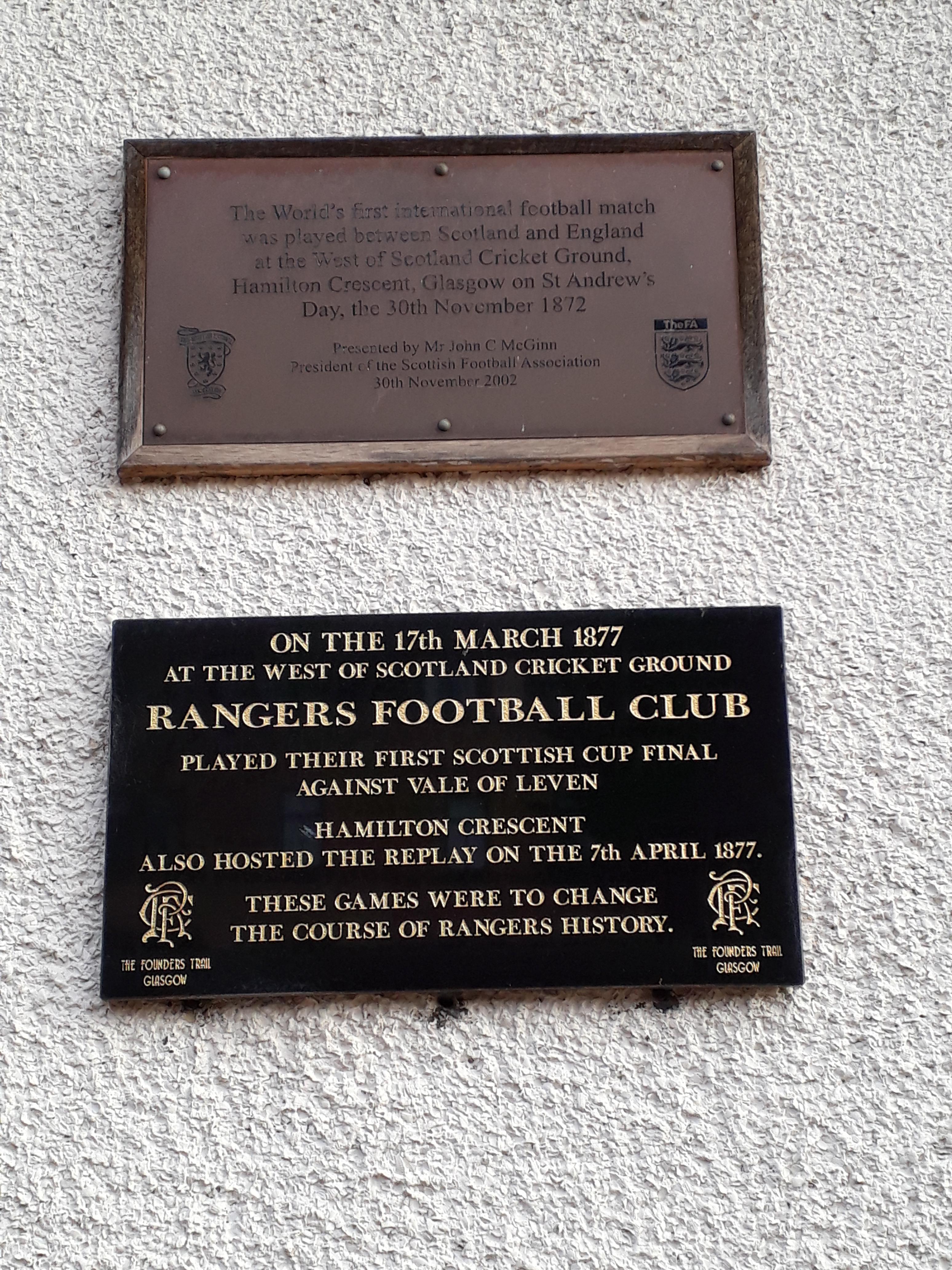
The significance of the ground (for football) is now indicated by two plaques that have been placed on the clubhouse wall in the period since my initial visit. The upper one reads:
“The World’s first international football match
was played between Scotland and England
at the West of Scotland Cricket Ground,
Hamilton Crescent, Glasgow, on St Andrew’s
Day, the 30th November, 1872.
Presented by Mr John C McGinn,
President of the Scottish Football Association,
30th November 2002.”
The plaque is neatly presented, albeit with its wooden frame showing some signs of wear after two decades of west of Scotland weather. It is also unobtrusive. Indeed – to the casual observer – it is dominated by the second plaque placed just below it (in 2018), which commemorates the first appearance of Rangers Football Club in a Scottish Cup Final: a match (and its replay) against Vale of Leven on the same ground in 1877.
The inscription on the latter states triumphantly that: “[T]hese games were to change the course of Rangers history”. As a symbolic representation of the hegemonic role that the Old Firm of Rangers and Celtic play in Scottish football, the dual-plaque display says a great deal, I think.
The Scottish Football Association has maintained a low-key approach to this latest anniversary, apart from announcing a commemorative Scotland-England fixture at Hampden Park in September next year. (The SFA website gives far more prominence to the 50th anniversary of the inaugural women’s international in 1972). This appears to follow the lead of Scottish Rugby. I noted that in Plan B that there was nothing at the Edinburgh Academical sports ground at Raeburn Place to mark the 150th anniversary of rugby union’s first international, whilst the stone monument commemorating the centenary in 1971 is currently at the edge of a large pile of rubble on the far side of the field.
Accordingly, when I took the train into Partick this morning to visit the cricket ground, I expected that I might be largely alone, perhaps to walk around the boundary edge and take a couple of photographs before wandering back to Dumbarton Road in search of a coffee shop. How wrong I was. It was not long before I learned that The Hampden Collection – a group of volunteers celebrating the pioneering role Scotland played at the dawn of association football – had spent some considerable time with the West of Scotland CC and others preparing for the 150th anniversary.
By one o’clock, a sizeable number had gathered on the terracing of the clubhouse – boosted by a substantial media presence – as two teams of primary school footballers attired in the respective kits of 1872 (though without the caps and cowls) replayed the inaugural fixture. There was only limited space for 11-a-side on the truncated pitch, but there was no little skill shown – the England goalkeeper made a splendid first-half save – as well as sound positional awareness. There was also some bravery; the teams were both comprised of boys and girls and one of the latter, having inadvertently taken the ball full in the face, continued on as if nothing had happened (though I did notice that the referee kept an eye on her to check she was ok).
The day’s event closed with a short ceremony at 2.15pm when there was a “kick-off” involving two of the great grandsons of Joseph Taylor, one of that first Scotland team.
During the course of the day, I spoke at length on separate occasions to three of the volunteers, beginning with Will Moffat of the Hampden Bowling Club, with whom I had an enjoyable chat on entering the ground. Each in turn demonstrated their informed enthusiasm for the group’s work and their detailed knowledge of the first international. Thus, I was able to supplement that which I had previously acquired from Wikipedia with the information that the pitch had run north-south (the Scots playing downhill in the first half towards the imposing façade of Partick Burgh Hall, which had been completed earlier that year) and that the kick-off had been delayed from its 2.00pm scheduled start due to the sheer numbers of spectators.
My interests are not only in watching sport in the present day and in reflecting on the sport that I have watched in the course of my lifetime. I am also drawn to the circumstances surrounding those defining occasions – and the associated venues – in the history of sport that have been the key milestones on the long journey of sports spectating (and playing) that has brought us into modern times. In terms of international football, this is a journey that has – to date – run from the West of Scotland CC in Scotland 1872 to the Lusail Iconic Stadium in Qatar in 2022.
And the result of the primary school pupils’ soccer match? Not quite the exact replication of the goalless draw of 150 years ago. A late goal gave victory to England: 1-0.
[For completeness, I did later find my coffee shop on the Dumbarton Road. The excellent Caffé Monza on my way back to Partick Station].
 An Ordinary Spectator